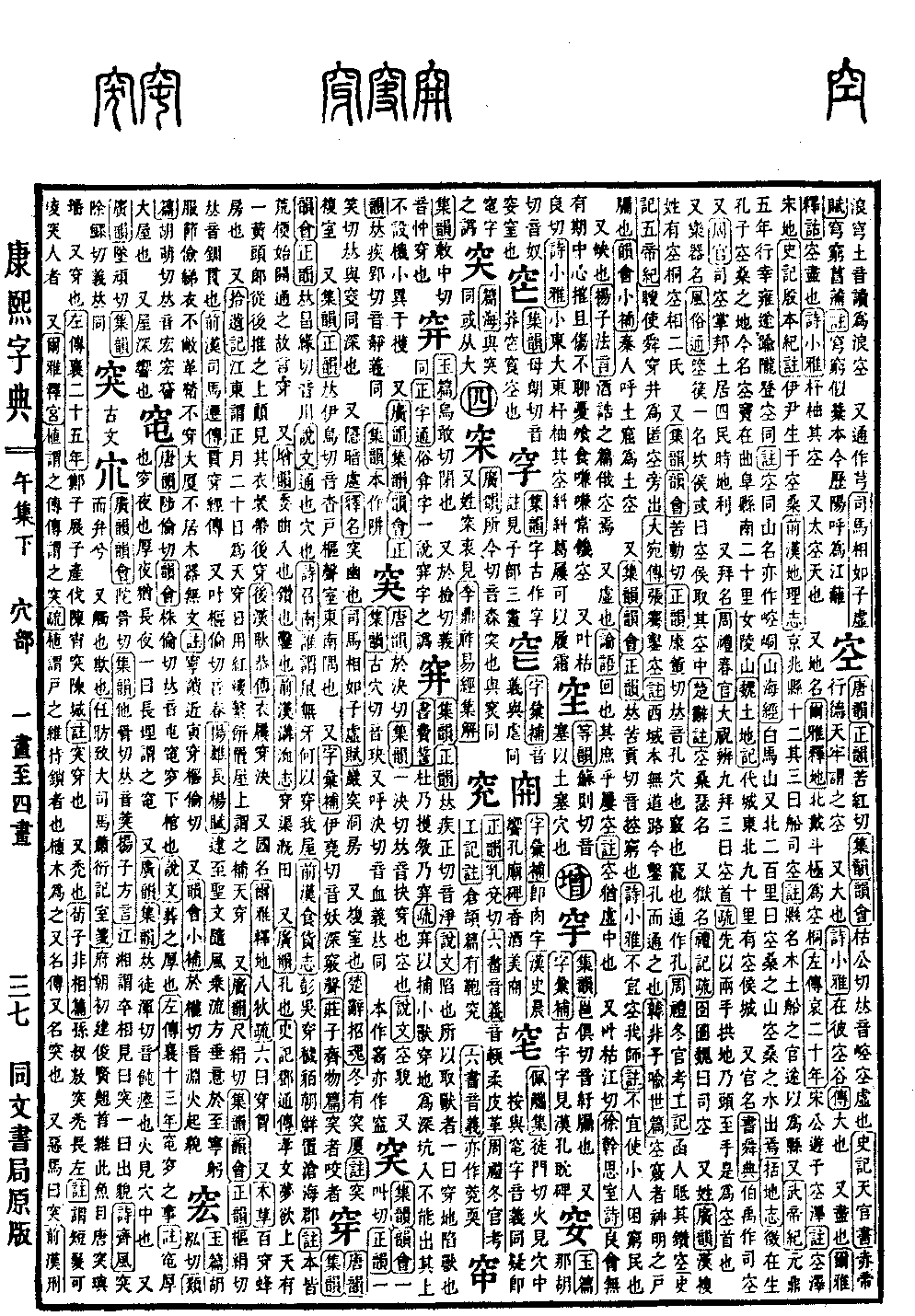
Wu Collection, Lower Volume
Radical: Cave (xué)
Kangxi Strokes: 9
Page 863, Entry 21
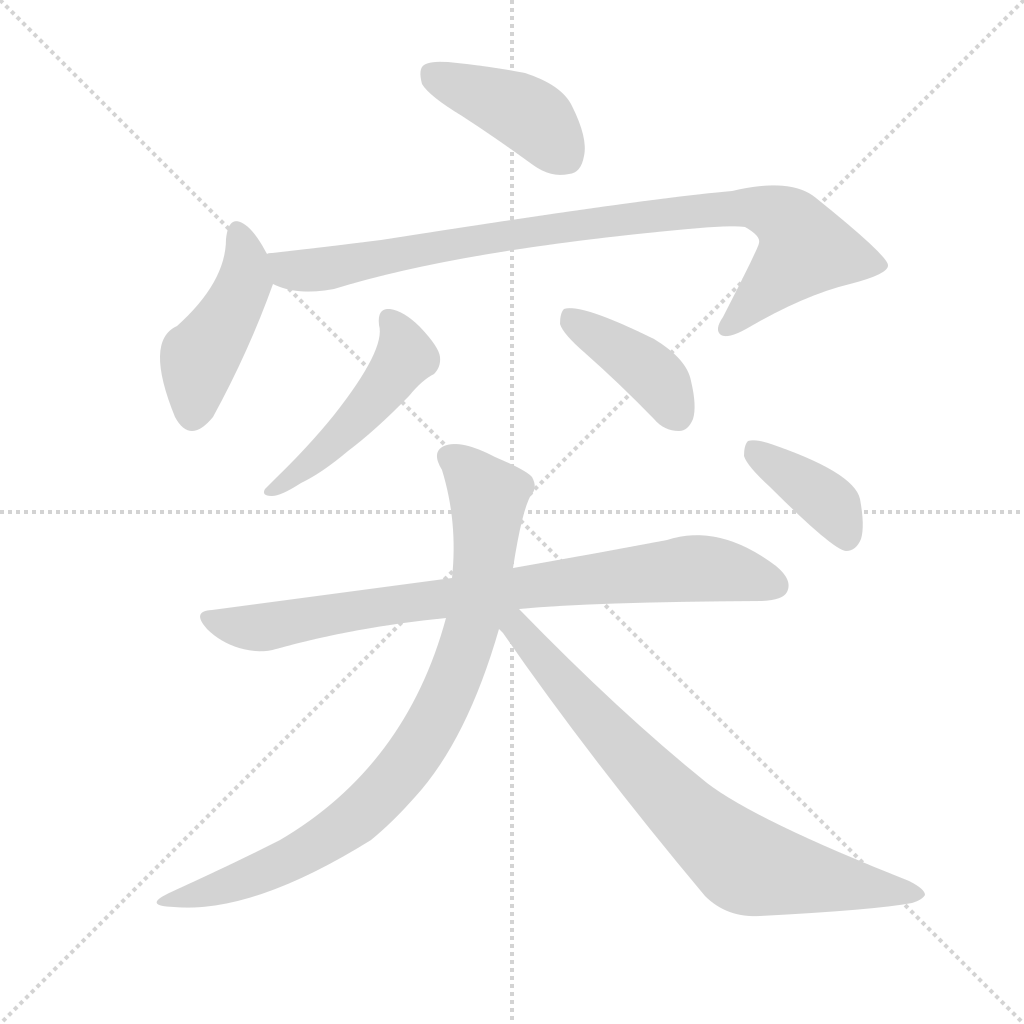
In ancient texts, according to Guangyun (General Rhymes) and Yunhui (Collection of Rhymes), the pronunciation is tu. According to Jiyun (Collection of Rhymes), the pronunciation is tu. Both give the sound as tu (rising tone). In the Fangyan (Regional Dialects) by Yangzi, it is recorded that in the Jiang and Xiang regions, a sudden meeting is called tu. One interpretation refers to the appearance of something emerging. In the Book of Odes (Shijing), Qi Wind section: A young man suddenly dons his cap of adulthood. It also carries the meaning of rushing or offending. In the Reminiscence of Ren Fang to Grand Marshal Xiao Yan: The幕府 (staff headquarters) has just been established, and men of virtue look forward to it with expectation; only I, a fish-eye among pearls, have offended the fine jade. It also means to penetrate or pierce through. In the Zuo Tradition (Zuozhuan), 25th year of Duke Xiang: Zi Zhan and Zi Chan of the state of Zheng led their armies to attack, penetrating the city walls at night. The commentary notes that tu means to pierce through. It also means bald. In the Xunzi, Non-Physiognomy chapter: Sun Shu’ao had sparse hair and a bald head, with a left hand longer than his right. The commentary notes this refers to short hair that appears to rush at others. According to the Erya (Approaching Elegance), Explanations of Palaces: Upright wooden pillars are called chuan, also known as tu. The commentary notes: This refers to the parts used on door panels for support and locking, made of wood, also called chuan or tu. It also refers to a vicious horse as tu. In the Book of Han (Hanshu), Treatise on Law: Using a horse's headstall and reins to control a fierce and vicious horse. The commentary notes: tu refers to a vicious horse. It also refers to a chimney. In the Book of Han, Biography of Huo Guang: His family’s chimney was straight. According to Jiyun, it is also written as tu. It also refers to a hidden gate in city fortifications. In the Book of the Later Han (Houhanshu), Biography of Dou Rong: Gongsun Shu ordered the guarding of the tu gate. The commentary notes: A tu gate is a hidden gate for city defense. There are also the surnames Qutu and Tutu, which are foreign clan names. According to the Zishuolue (Outline of Characters): Sparrows coming from the north of the Great Wall are sometimes called tujue (Turkic). According to Jiyun, it is pronounced tuo, with the same meaning. According to Jiyun, it is pronounced die. It refers to a dog suddenly darting out from a cave. It also means slippery. In the Book of Changes (Yijing), Hexagram of Clinging: It comes suddenly. This is the reading used by Wang Su. According to Jiyun, it is pronounced tu, with the same meaning. According to the Zihuibu (Supplement to the Collection of Characters), it is pronounced du. The Shandong Gazetteer records: Jinan Prefecture has the Baotu Spring, located in front of Baixue Tower. It also rhymes as dui. In the Rhapsody on the Long Flute by Ma Rong: Waves rising like fish scales, uneven and strange. The spring water gushes forth with a sound, rushing and fleeing, violently crashing.