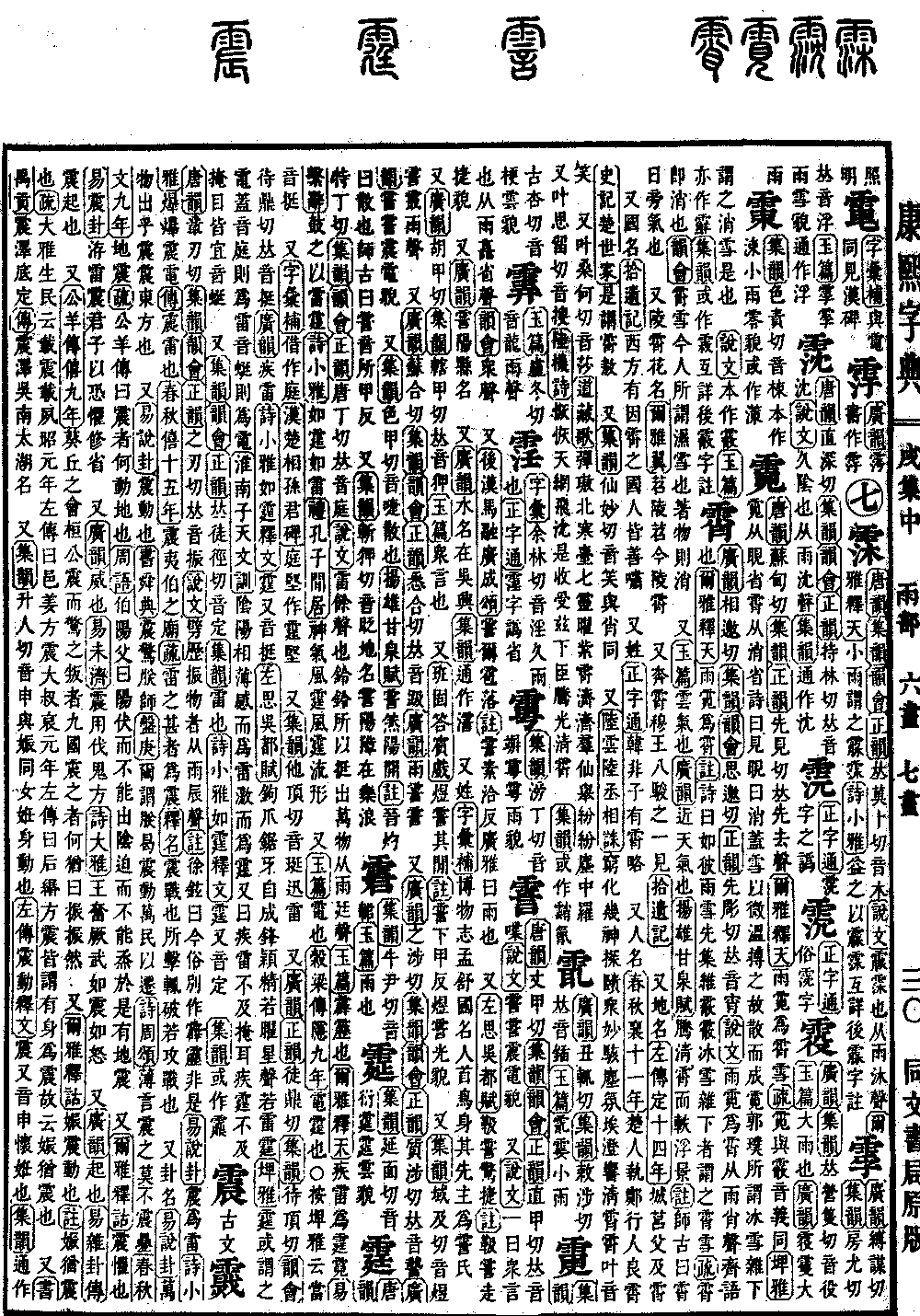
Xu Collection, Middle Volume
Radical: Rain (yǔ)
Kangxi Strokes: 15
Page 1374, Entry 17
Pronounced die.
According to the Explaining Graphs and Analyzing Characters (Shuowen Jiezi), it describes the appearance of thunder and lightning occurring simultaneously. Another explanation in the same text suggests it refers to the sound of many people speaking. It is composed of the radical for rain, with the component representing many words shortened to provide the sound.
The Compendium of Rhymes (Yunhui) states it refers to a multitude of sounds.
In the Rhapsody on the Extended Park (Guangcheng Song) by Ma Rong in the Later Han, it is written: Hail falls in a scattering manner. The commentary notes the pronunciation as suqia. The Extensive Refinements (Guangya) states it refers to rain.
In the Rhapsody on the Capital of Wu (Wudu Fu) by Zuo Si, it describes a sudden, quick, and nimble movement. The commentary states the term describes the appearance of running with great speed.
According to the Extensive Rhymes (Guangyun), Zhayang is the name of a county.
According to the Extensive Rhymes (Guangyun), it is also the name of a river located in Wuxing.
The Collected Rhymes (Jiyun) notes it is also written in a variant form.
It is also a surname.
The Supplement to the Collection of Characters (Zihui Bu) records in the Treatise on the Investigation of Things (Bowuzhi) that Mengshu is the name of a country where the people have the bodies of birds and the heads of humans; their ancestral leader possessed the surname Zha.
Pronounced xia.
The Jade Compendium (Yupian) states it refers to the sound of many people speaking.
In the Reply to the Guest’s Jest (Da Bin Xi) by Ban Gu, it describes a bright and glistening appearance. The commentary notes the pronunciation as xia.
According to the Collected Rhymes (Jiyun), the term refers to the sound of falling rain.
Pronounced sa.
The Extensive Rhymes (Guangyun) describes it as the sound of rain.
Pronounced zhe.
The Extensive Rhymes (Guangyun) describes the appearance of thunder and lightning occurring simultaneously.
Pronounced die.
It carries the meaning of dispersing or scattering. In the Rhapsody on Sweet Springs (Ganquan Fu) by Yang Xiong, it is written: Opening up and scattering in the sunlight. The commentary by Jin Zhuo states it means to disperse. Yan Shigu states the pronunciation is suojia.
Pronounced zha.
It is a place name. Zhayang Zhang is located in Lelang.