You Collection, Upper Volume
Radical: Speech (yán)
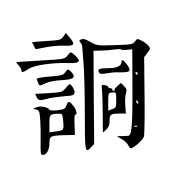
詷
Kangxi strokes: 13
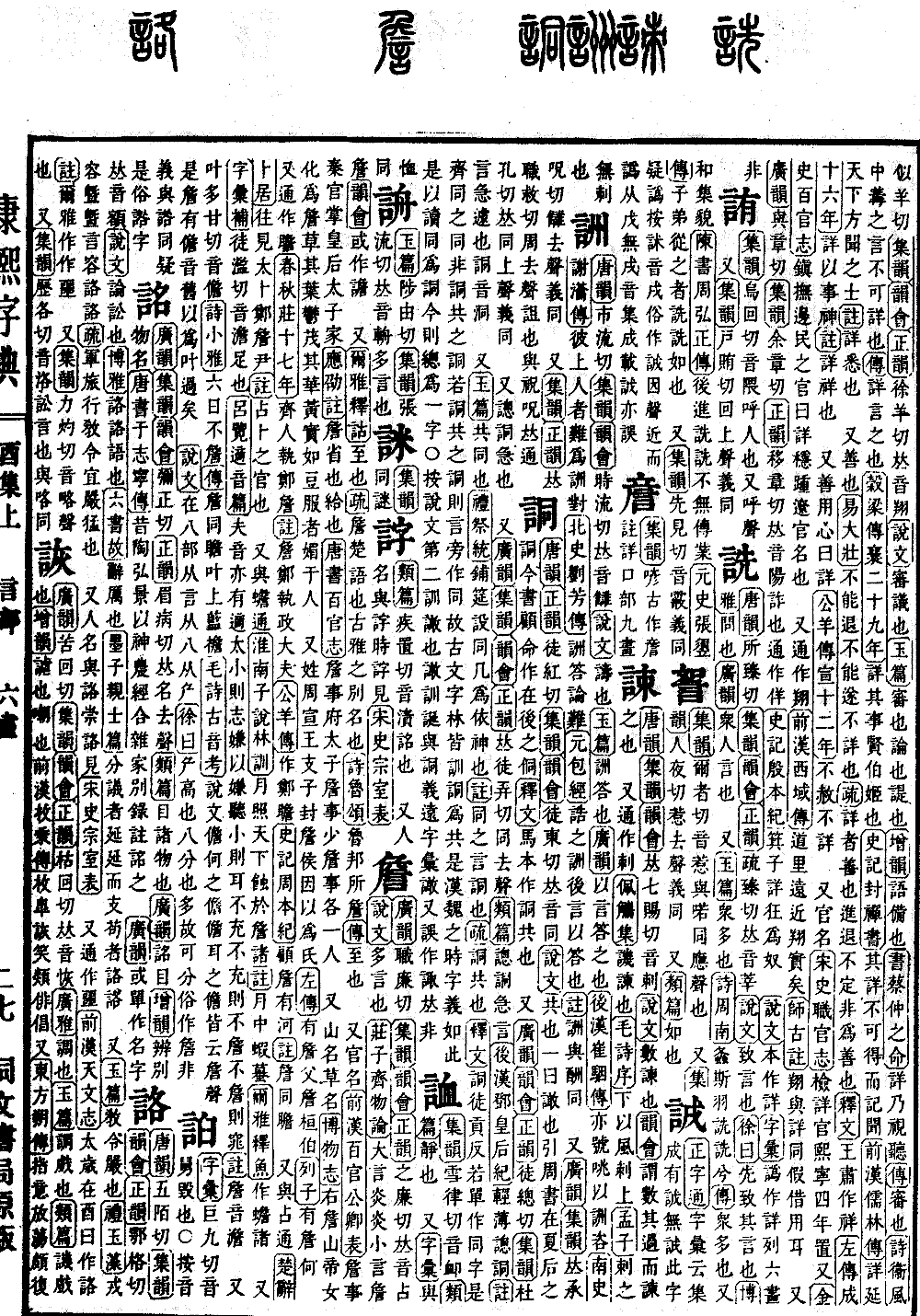
Page 1159, Entry 08
Pronounced tong.
According to the Explaining Graphs and Analyzing Characters (Shuowen Jiezi), it means together. Another interpretation suggests it means exaggerated or boastful. It cites the Book of Zhou (Zhou Shu) passage, In the time of the Xia successors, there was tong, which today in the Book of Documents (Shangshu), Gu Ming chapter, is written as, In the time of the successors, there was dong.
The Explanation of Text (Shiwen) notes that the version of Ma Rong was written as tong, meaning together.
Also pronounced tong (rising tone). The meaning is the same.
Also, zong-tong, meaning urgent or pressing.
Also pronounced dong (falling tone).
The Classified Compendium (Lei Pian) states that zong-tong means speaking in an urgent manner.
In the History of the Later Han (Hou Hanshu), Biography of Empress Deng: Frivolous and urgent (zong-tong).
The commentary notes it means speaking in a hurried manner. Pronounced dong.
Also, according to the Jade Compendium (Yu Pian), it means together.
In the Book of Rites (Liji), Jitong chapter: Spread the mats and set out the common (tong) tables to rely upon the spirits.
The commentary notes that the character tong here carries the meaning of tong.
The Subcommentary (Shu) states that tong means together.
The Explanation of Text (Shiwen) states that tong is pronounced like tong (falling tone). If written simply as the character tong, it refers to the tong meaning uniform or identical, not the tong meaning together. For the meaning of together, the speech radical is added to the character tong. Therefore, the Ancient Script (Guwen) and the Character Forest (Zilin) both define tong as together. This shows that in the Han and Wei dynasties, the meanings were distinguished in this way; thus, the character tong was read as tong, though today it has been generalized into a single character.
Note: The second definition in the Explaining Graphs and Analyzing Characters (Shuowen Jiezi) is to boast. Boasting is defined as absurd, which is far from the meaning of tong. In the Collection of Characters (Zihui), this is incorrectly written as the character zou, which is erroneous.