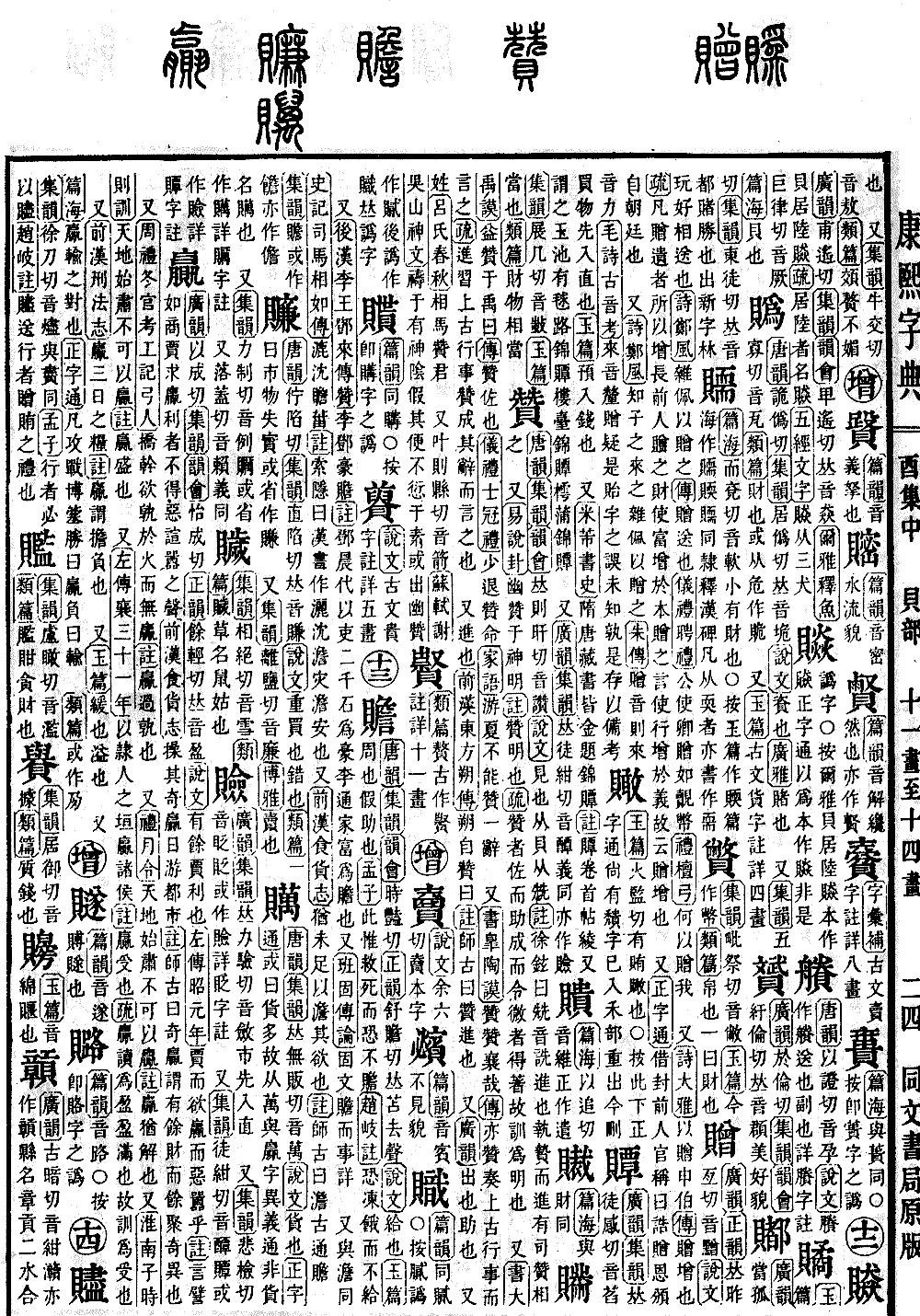
You Collection, Middle Volume. Radical: Shellfish (bèi). Kangxi stroke count: 20. Page 1212, Entry 01.
Pronounced shan (falling tone).
Shuowen Jiezi (Explanation of Graphs and Analysis of Characters): To provide.
Yupian (Jade Chapters): To assist or relieve. To provide aid or support.
Mencius (Mengzi): In this situation, one only seeks to save one's life, fearing that it will not be sufficient for provision.
Zhao Qi Commentary: Fearing to suffer from cold or hunger and being unable to provide.
Also, History of the Later Han (Hou Hanshu), Biography of Li, Wang, Deng, and Lai: Li Tong and Deng Chen were wealthy and provided for.
Commentary: Deng Chen’s family served as high-ranking officials for generations and were considered a powerful clan; Li Tong’s family was wealthy and considered well-provided.
Also, Pan Ku Biography Discourse: Pan Ku’s writing was rich and lush, and his narration was detailed.
Also, same as the character dan.
Records of the Grand Historian (Shiji), Biography of Sima Xiangru: Filter out the sediment and turbidity, stabilize the disasters.
Commentary: Suoyin states: The Book of Han (Hanshu) is written as "sprinkle, settle, stabilize disasters." Dan means to stabilize.
Also, History of the Former Han (Qian Hanshu), Treatise on Food and Money: Still unable to satisfy their desires.
Commentary: Shigu states: Dan was used interchangeably with shan in ancient times.
Jiyun (Collection of Rhymes): Shan sometimes appears in the variant form. Also written as dan.