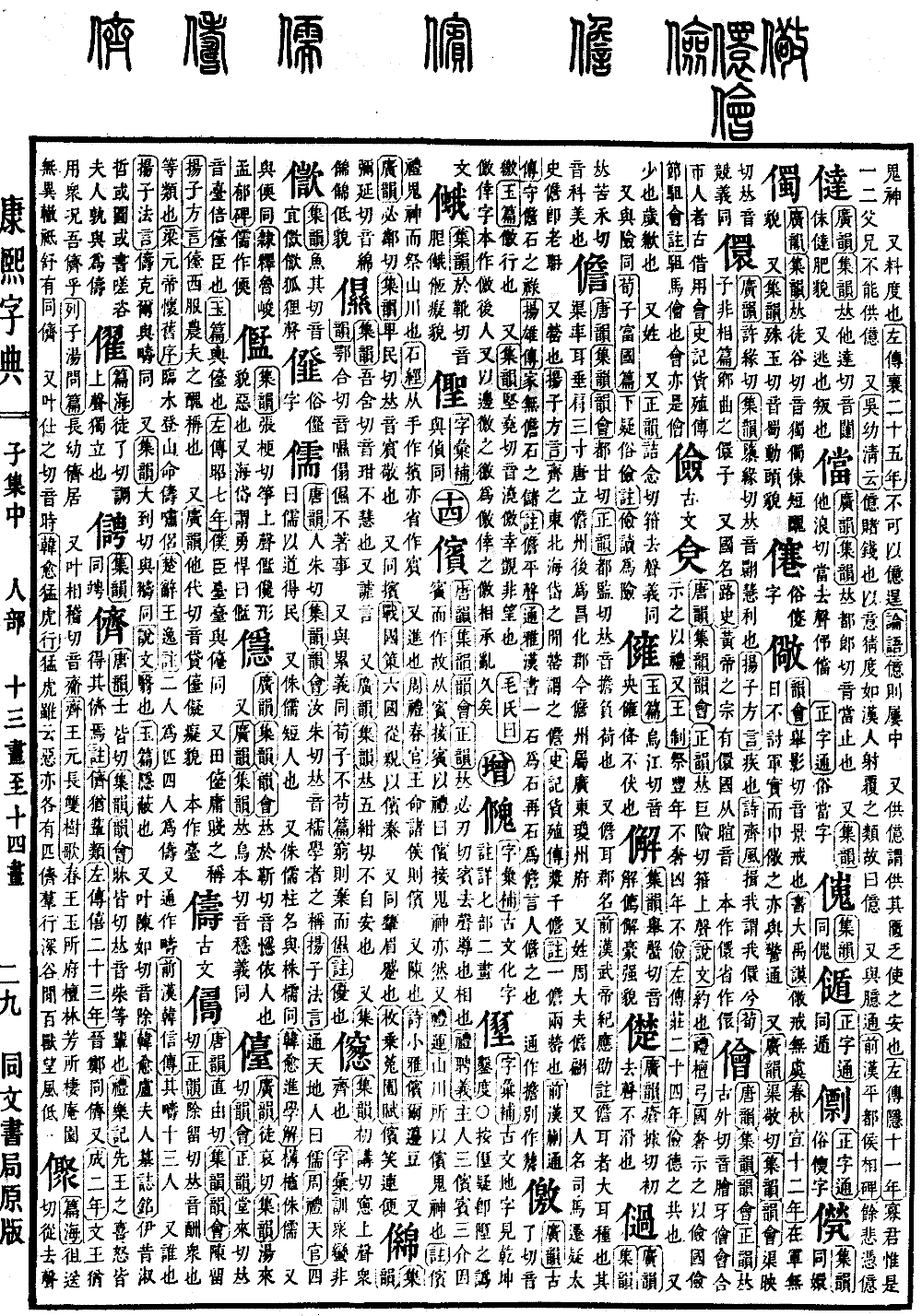
Zi Collection, Middle Volume
Radical: Person (rén)
Dan
Kangxi strokes: 15
Page 119, Entry 18
Pronounced dan. It means to carry a load or to bear a burden. It also refers to Daner, which is the name of a prefecture. According to the annotation by Ying Shao in the Record of Emperor Wu in the History of the Former Han (Hanshu), Daner refers to a tribe whose people have large ears. Their leaders have ears that hang down to their shoulders, reaching three inches in length. During the Tang dynasty, Dan Prefecture was established, which was later renamed Changhua Prefecture. The present-day Dan Prefecture belongs to Qiongzhou Prefecture in Guangdong.
It is also a surname. During the Zhou dynasty, there was a high official named Dan Pian. It is also used as a personal name. Sima Qian suspected that the Grand Historian Dan was Lao Dan.
It further refers to a type of earthenware vessel. According to the Dialect (Fangyan) by Yang Xiong, in the northeastern part of the State of Qi, between the Bohai Sea and Mount Tai, an earthenware jar is called a dan. In the Biographies of Money-makers in the Records of the Grand Historian (Shiji), it is mentioned that there were a thousand dan of liquid. The annotation states that one dan equals two earthenware jars. In the Biography of Kuai Tong in the History of the Former Han (Hanshu), it refers to living on a meager salary. In the Biography of Yang Xiong, it states the family had no reserve of even a single dan of grain. The annotation notes that dan is read in the level tone. According to the General Refinement (Tongya), one dan in the History of the Former Han (Hanshu) is known as a shi, and two dan are called a dan, signifying an amount a person can carry on a shoulder pole. It is also written as the variant form (dān). It is also written in other variant forms.