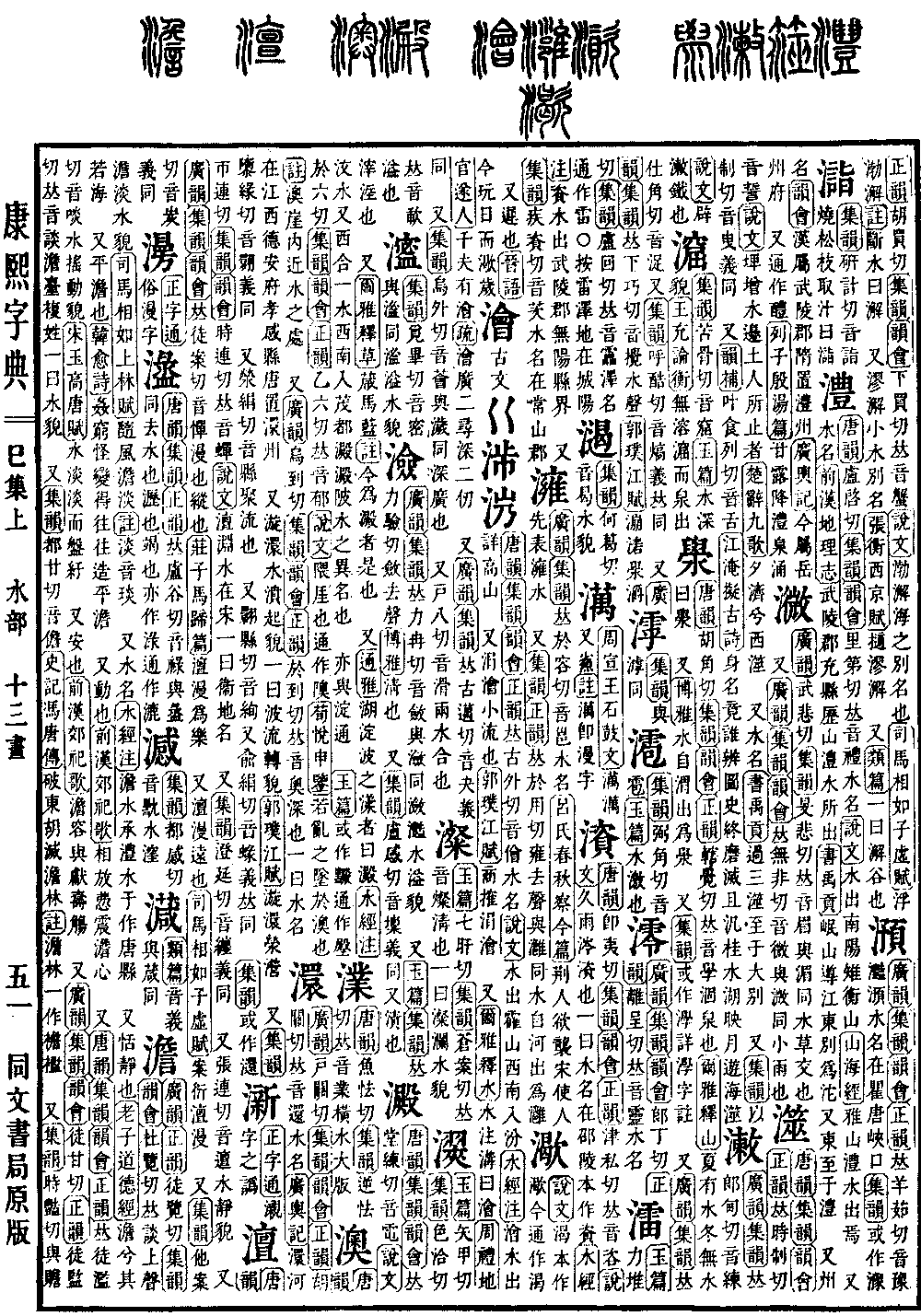
Si Collection, Upper Volume
Radical: Water (shuǐ)
澹
Kangxi strokes: 17
Page 653, Entry 36
Pronounced dan (rising tone). Describes the appearance of water. In the Upper Forest Rhapsody (Shanglin Fu) by Sima Xiangru: Flowing along with the wind, moving water. Note: Dan is pronounced yan (rising tone).
Also, a river name. In the Commentary on the Classic of Waterways (Shuijing Zhu): The Dan River in Zuotang County, which connects to the Li River.
Also, tranquil and quiet. In the Dao De Jing by Laozi: Tranquil like the great ocean.
Also, plain and simple. In a poem by Han Yu: After exhaustively studying strange variations, one often achieves a realm of simplicity.
Also, agitation. In the Hymns for the Suburban Sacrifices of the Former Han (Qianhan Jiaosige): Mutually imitating, shaking and cleansing the spirit.
Pronounced dan (falling tone). The appearance of water ripples swaying. In the Gaotang Rhapsody (Gaotang Fu) by Song Yu: Water ripples swaying and winding in a tortuous path.
Also, stable and at peace. In the Hymns for the Suburban Sacrifices of the Former Han (Qianhan Jiaosige): Composed and at ease, raising a cup to wish for longevity.
Pronounced tan. Dantai, a compound surname. One source says it describes the appearance of water.
Pronounced dan. In the Biography of Feng Tang in the Records of the Grand Historian (Shiji): Defeated the Eastern Hu, eradicated Danlin. Note: Danlin is also written as Chanlan.
Pronounced yan (falling tone). Same as the character shan (to supply/to suffice). In the Treatise on Food and Money of the Former Han (Qianhan Shi Huozhi): Exhausting the wealth of the world to maintain his rule, yet still unable to satisfy his desires. Note: In ancient times, it was interchangeable with the character shan.
Textual verification: In the Gaotang Rhapsody (Gaotang Fu) by Song Yu, the text reads dan dan (swaying) and should not be written as dan dan (plain/simple).