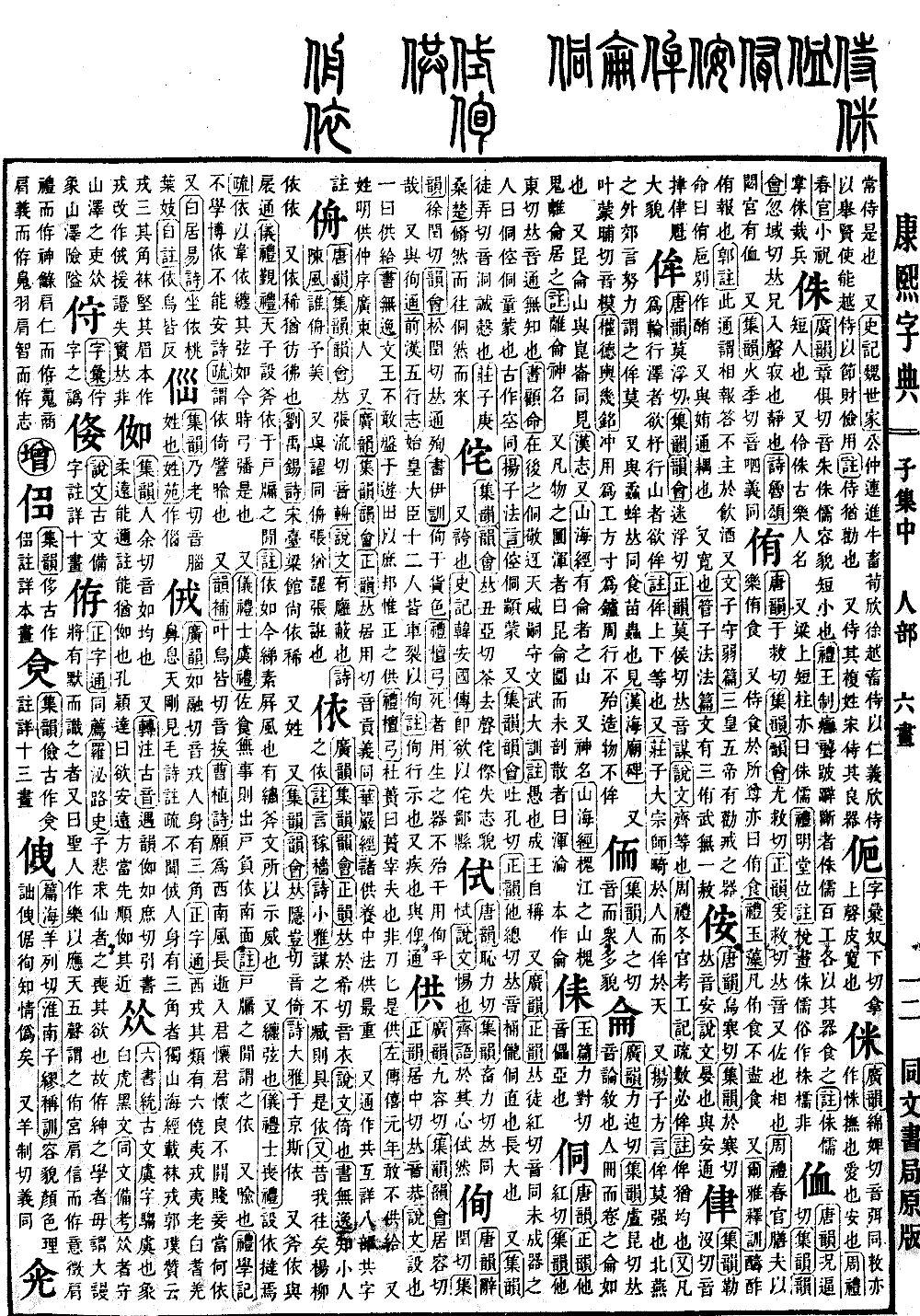
Zi Collection, Middle Volume. Radical: Person (rén). Yi. Kangxi Strokes: 8. Page Number: Page 102, Number 18. According to the Guangyun (Guangyun), Jiyun (Jiyun), Yunhui (Yunhui), and Zhengyun (Zhengyun), the pronunciation is the same as the word for clothes (yi). The Shuowen Jiezi (Shuowen) defines the character as to lean on or rely upon. In the Book of Documents (Shangshu), the section Without Ease contains the phrase knowing what the common people rely on, where a note explains this refers to the work of farming. In the Minor Odes section of the Book of Odes (Shijing), it says if the planning is not good, then all will rely on this, meaning that if plans are poorly made, one becomes dependent on those flaws. Another passage in the same work says long ago when I departed, the willows were light and supple, describing the soft and swaying appearance of willow trees. There is also the term yixi, meaning vaguely or indistinctly. A poem by Liu Yuxi says the terraces of Song and the halls of Liang are still vaguely visible, meaning they can still be seen faintly. Furthermore, Yi is a surname. According to the Jiyun and Yunhui, it is also pronounced similarly to the word for lean (yi). In the Major Odes of the Book of Odes (Shijing), it says in the capital they found reliance, meaning seeking support within the capital. There is also the term fuyi, which is interchangeable with the screen known as yi. In the Rites of Audience section of the Book of Etiquette and Ceremonial (Yili), it says the Son of Heaven set the axe-screen between the door and the window, where a note explains that the yi was like a screen made of plain silk of that era, embroidered with axe patterns to signify majesty. It also refers to wrapping a string. In the Rites of Final Evening (Jixili) section of the Book of Etiquette and Ceremonial (Yili), it mentions setting the leather-wrapped bowstring there, with a commentary explaining that yi refers to using leather to wrap a bowstring, similar to the bows used at that time. In the Rites of Sacrifice to the Deceased section of the Book of Etiquette and Ceremonial (Yili), it states when the ritual assistant has no duties, they exit the door and stand with their back to the space between the door and window, facing south, where a note explains that the space between a door and a window is called an yi. It also signifies the use of metaphors. In the Record of Learning section of the Book of Rites (Liji), it says without learning broad metaphors, one cannot be at ease with poetry, with a commentary explaining that this refers to using metaphors to gain understanding. In the Supplement to Rhymes (Yunbu), the pronunciation is given as ai. A poem by Cao Zhi says I wish to be the southwest wind, traveling far into your embrace; but your heart remains closed, so where shall this humble woman find reliance?, expressing the sentiment of seeking support. A poem by Bai Juyi says sitting beside the Peach Leaf courtesan, with his own note stating that in this instance the word is pronounced as wu jie. Verification: In the Rites of Final Evening section of the Book of Etiquette and Ceremonial (Yili), which was previously cited as Rites of Mourning (Shisangli), it says setting the leather-wrapped bowstring there, where the commentary explains that yi refers to using leather to wrap a bowstring, similar to the bows of the time. Based on the original text, the title Rites of Mourning is corrected to Rites of Final Evening, and the phrase like the current time is corrected to exactly as of now.