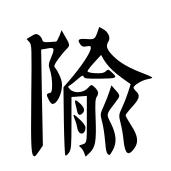
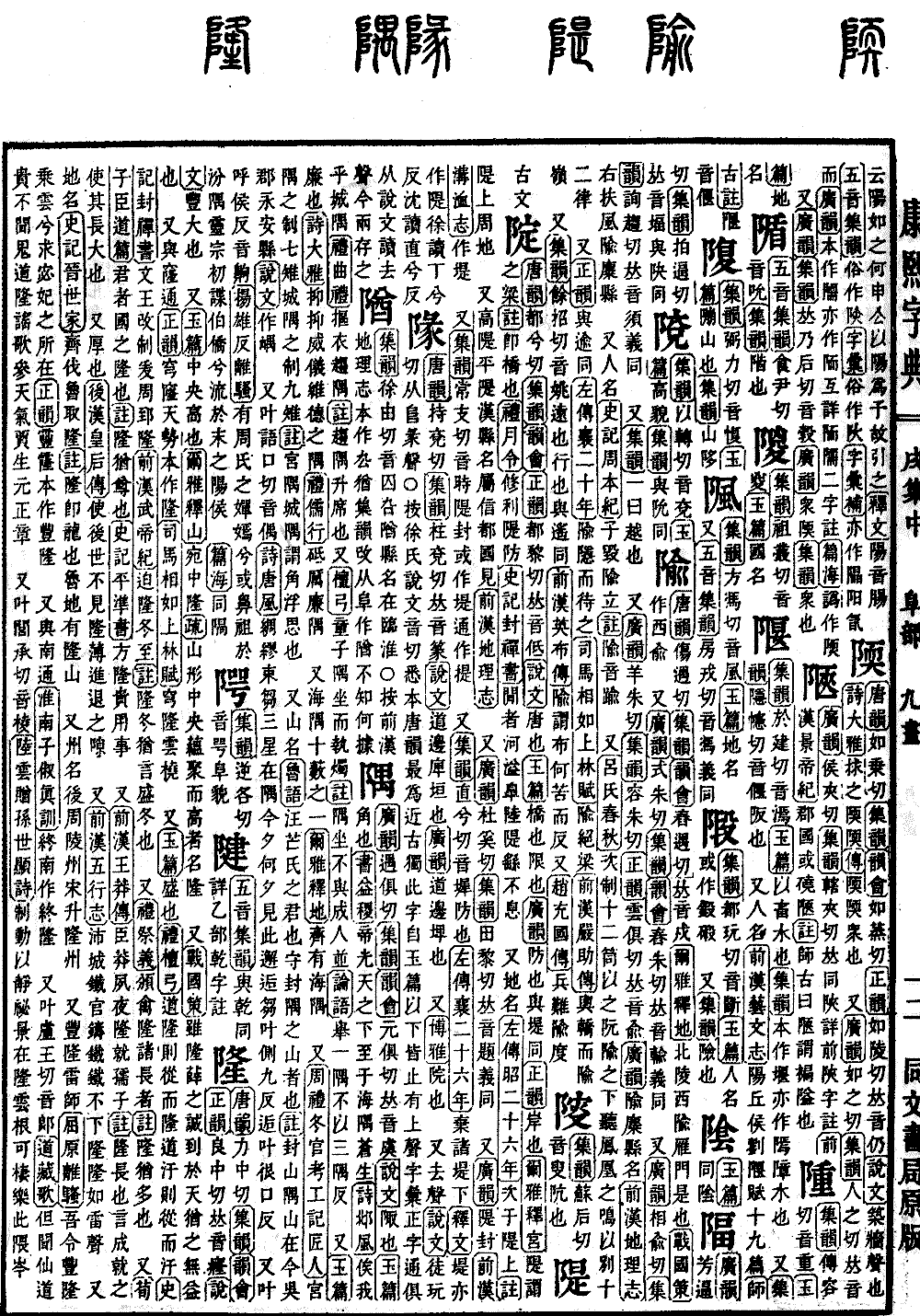
Xu Collection, Middle Volume. Radical: Mound (fù). Kangxi Strokes: 17. Page: 1356, Entry 13. According to Tang Rhyme (Tangyun), pronounced shangyu qie. According to Jiyun (Jiyun) and Yunhui (Yunhui), pronounced chongyu qie, with the sound shù. From Er Ya (Erya), 'Explanation of Earth': "North of the mounds, west of Yu, that is Yanmen pass." In Strategies of the Warring States (Zhanguoce), it is written as xi yu. Also, according to Guangyun (Guangyun), pronounced shizhu qie. According to Jiyun and Yunhui, pronounced chongzhu qie, with the sound shū. The meaning is the same. Also, according to Guangyun, pronounced xiangyu qie. According to Jiyun, pronounced xunqu qie, with the sound xū. The meaning is the same. Also, according to Jiyun, another meaning is 'to cross over' or 'to surpass'. Also, according to Guangyun, pronounced yangzhu qie. According to Jiyun, pronounced rongzhu qie. According to Zhengyun (Zhengyun), pronounced yungju qie, with the sound yú. Guangyun mentions Yu Mi (yúmí), a county name. From Book of Han (Qian Han), 'Treatise on Geography': 'You Fufeng (yòu fúfēng) Yu Mi County.' Also, a person's name. From Records of the Grand Historian (Shiji), 'Basic Annals of Zhou': 'His son Hui and Yu were established.' The commentary notes that Yu is pronounced yú. Also, from Master Lu's Spring and Autumn Annals (Lüshi Chunqiu): 'He then made twelve tubes, placing them under the Ruan Yu (ruǎnyú), listening to the cry of the phoenixes to distinguish the twelve pitches.' Also, according to Zhengyun, it is synonymous with yú. From Zuo Commentary (Zuozhuan), Duke Xiang, 20th Year: 'He went over the hidden path and waited for them.' From Sima Xiangru's 'Rhapsody on the Imperial Park': 'They passed over the broken bridge.' From Book of Han, 'Biography of Yan Zhu': 'They rode in sedan chairs and crossed over the mountain pass.' Also, according to Jiyun, pronounced yuzhao qie, with the sound yáo. It means 'distant' or 'to travel'. It is synonymous with yáo. From Book of Han, 'Biography of Ying Bu': 'He remotely told Bu, "Why do you suffer and rebel?"' Also, from 'Biography of Zhao Chongguo': 'Military affairs are difficult to measure from afar.'