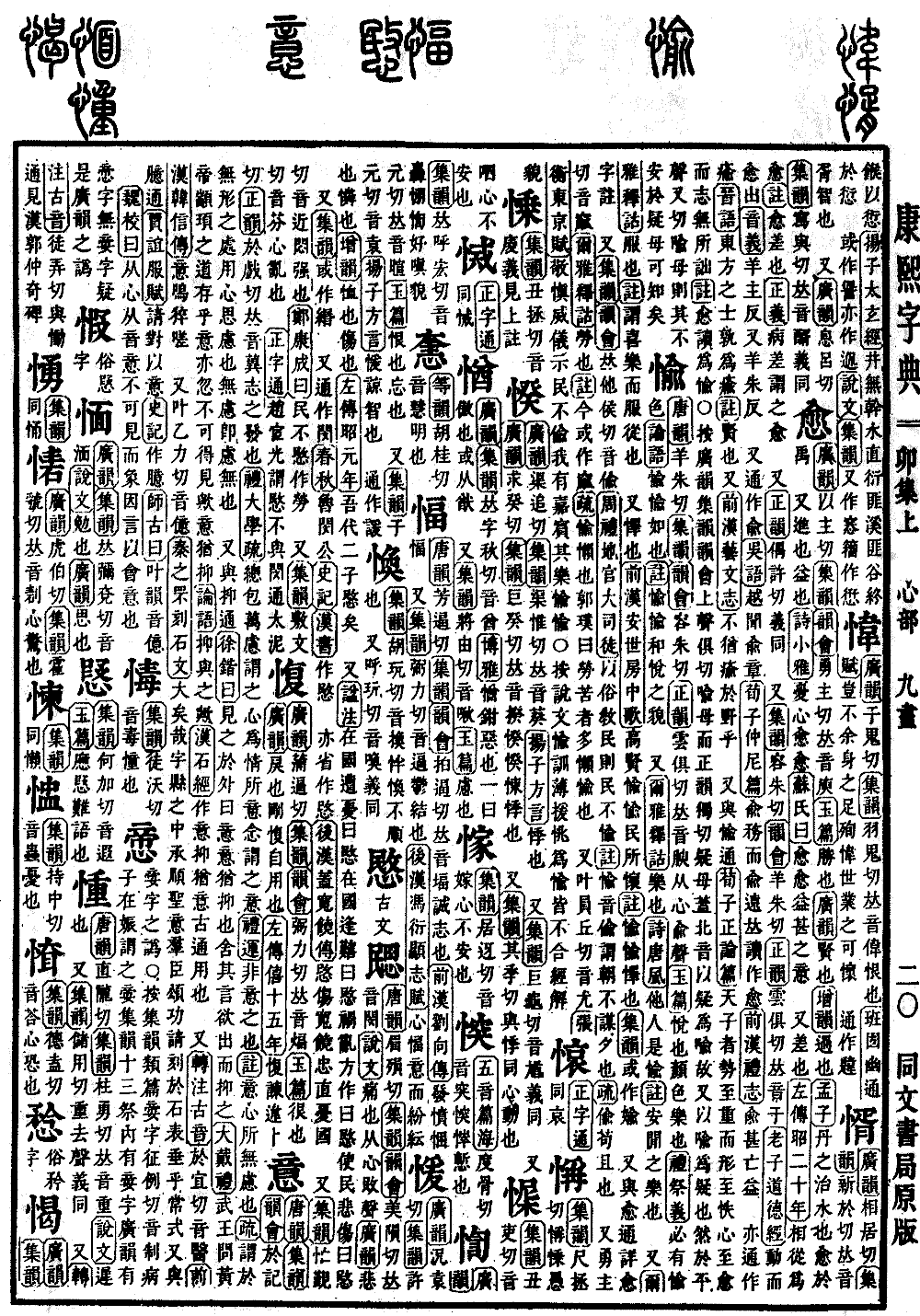
Mao Collection, Upper Volume
Radical: Heart (xīn)
Kangxi strokes: 13
Page 394, Entry 04
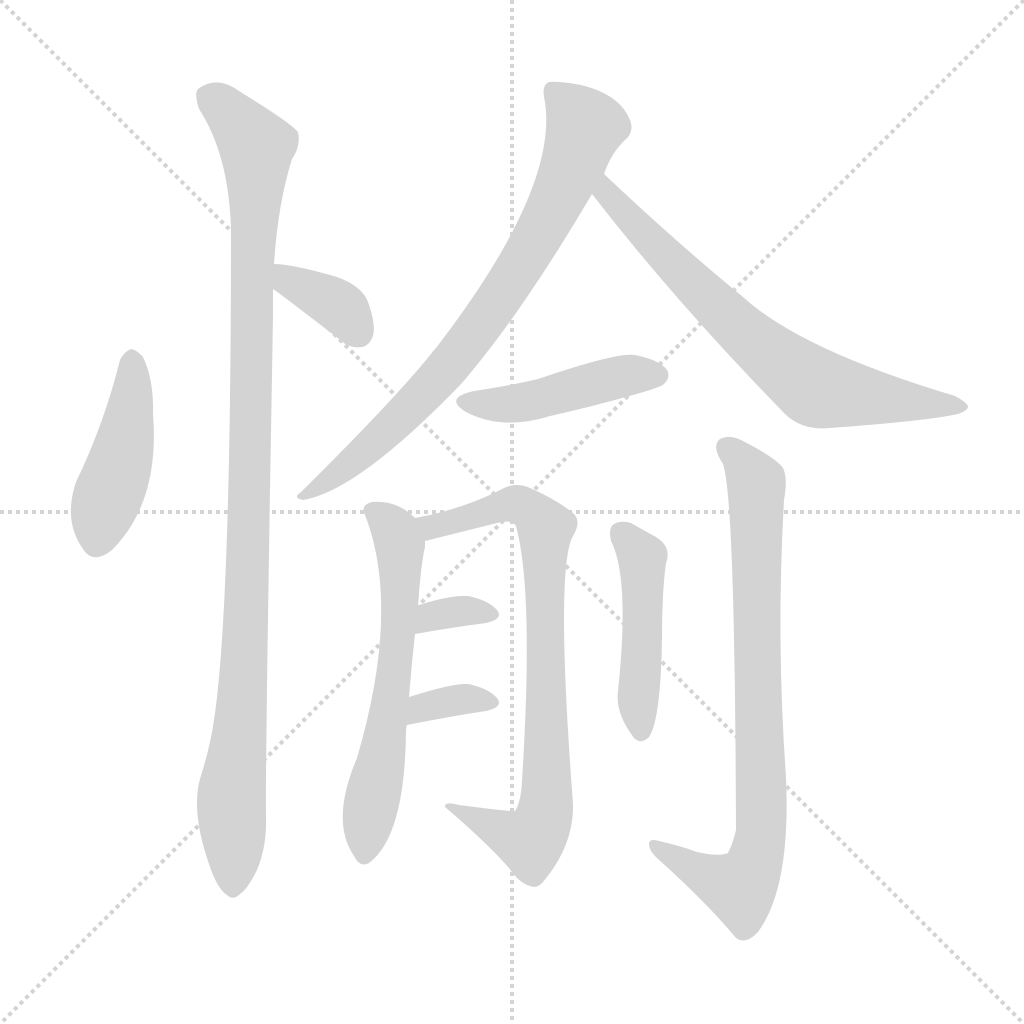
Pronounced yu (level tone). The character form is composed of the radical for heart and the phonetic element yu.
Yu pian: Means to be joyous, the appearance of a happy countenance.
Book of Rites (Liji), Sacrificial Meaning: One must possess an agreeable and joyful expression.
Analects (Lunyu): The appearance of being joyful and agreeable. Commentary: Yu yu denotes an agreeable and joyful appearance.
Also, Erya, Explaining Words: Means to be happy.
Book of Odes (Shijing), Odes of Tang: Others are joyous. Commentary: Peaceful and leisurely joy.
Also, Erya, Explaining Words: Means to obey or submit. Commentary: Refers to submitting due to joy and happiness.
Also: Means to be delighted.
Former Han Dynasty, Music Bureau Songs for the Ancestral Temple: Great worthies are joyful, which is what the people cherish. Commentary: Yu yu means delighted.
Jiyun: Sometimes written in a variant form (tou). Also used interchangeably with the character yu. See the entry for yu for full details.
Also, pronounced tou (level tone).
Rites of Zhou (Zhouli), Earth Offices, Grand Master of the Multitude: Use customs and education to bring stability to the people, so the people will not live their lives in a slipshod or negligent manner. Commentary: Yu is pronounced the same as tou, meaning one does not consider the evening in the morning, focusing only on the present. Commentary: Tou means slipshod or negligent.
Also, pronounced yu (rising tone).
Erya, Explaining Words: Means to be weary or exhausted. Commentary: Sometimes written in a variant form (yu). Commentary: Yu means lazy. Guo Pu states: Those who are weary are for the most part lazy.
Also, pronounced you (level tone).
Zhang Heng, Eastern Capital Rhapsody (Dongjing Fu): Respectful and cautious in demeanor, displaying to the people that one is not frivolous. I have honored guests, and the joy is abundant. Note: The Shuowen Jiezi interprets yu as frivolous, equating it with the character tiao, yet these interpretations do not align with the classic texts.
Textual Research: Rites of Zhou (Zhouli), Earth Offices, Grand Master of the Multitude: Use customs to educate and bring stability to the people, so the people will not live in a slipshod manner. I have amended the original text from teaching the people to teaching and bringing stability.