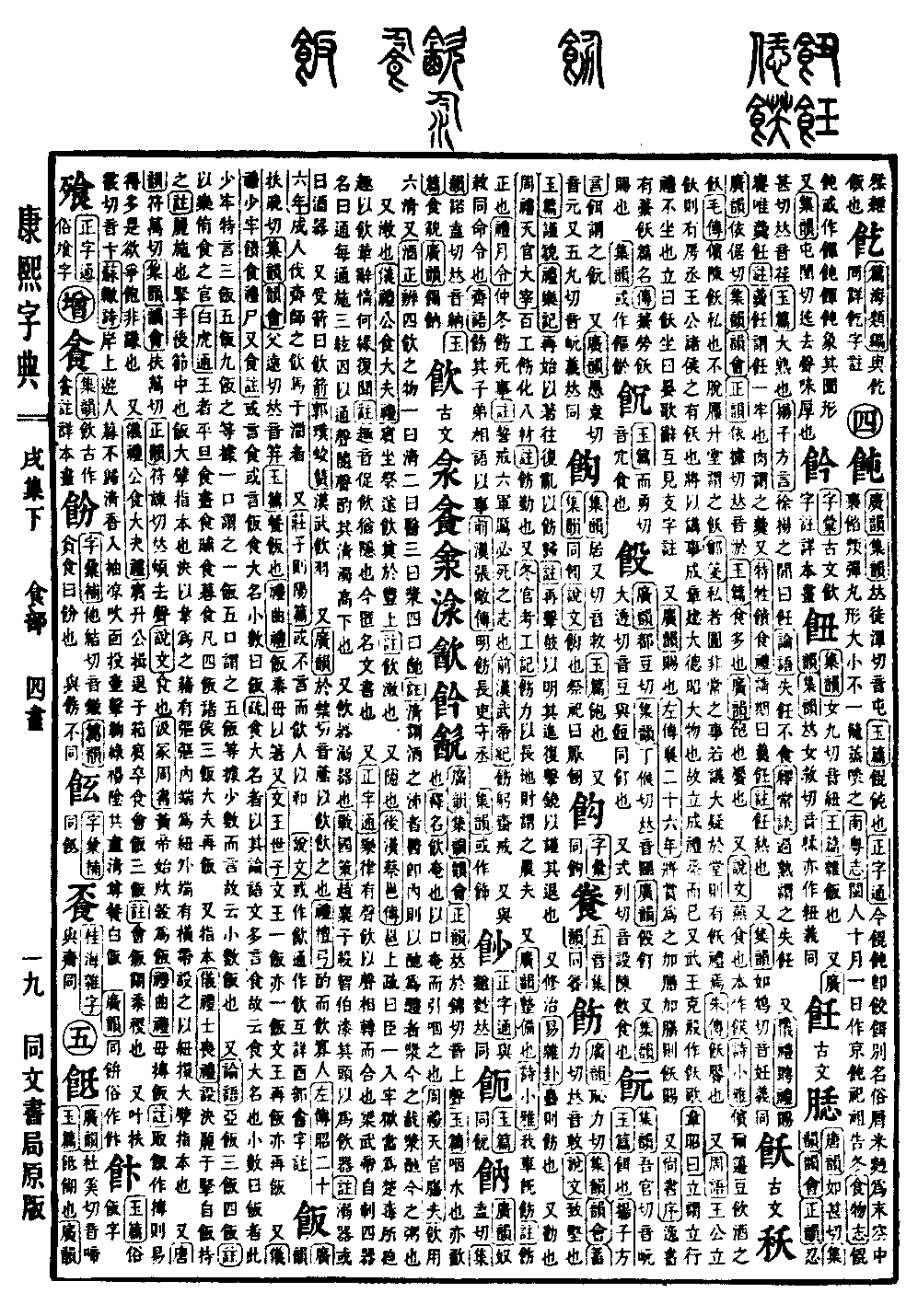
Xu Collection, Lower Volume
Radical: Food (shí)
Kangxi Strokes: 13
Page 1417, Entry 01
Ancient script form: 秗
Pronounced yu (level tone)
According to the Expanded Dictionary of Sounds and Rhymes (Guangyun), to eat a great deal.
According to the Expanded Dictionary of Sounds and Rhymes (Guangyun), to be satiated or satisfied.
Also, according to the Explaining Graphs and Analyzing Characters (Shuowen Jiezi), a feast or meal. Originally written as a different form.
Book of Odes (Shijing), Lesser Odes of the Kingdom: "Arrange your bamboo and wooden food vessels; the wine and the feast are served."
Mao Commentary: To serve food. To feast means to dine privately. To ascend the hall without removing one's shoes is called a feast.
Zheng Commentary: Private means to plan unusual matters. If discussing a great doubt in the hall, then there is the ritual of the feast.
Zhu Commentary: A feast is to be satiated.
Also, in the Discourses of the States (Zhouyu): When kings and dukes stand for a feast, there are steamed offerings in the side chambers. The reason kings, dukes, and feudal lords hold feasts is to discuss affairs and complete regulations, to establish great virtues, and to clarify major objects. Therefore, established rituals are performed, and then there are the steamed offerings.
Also, when King Wu conquered the Shang dynasty, he composed a feast song.
Wei Zhao comments: Standing means to perform the ritual without sitting. Standing is called a feast; sitting is called a banquet. The song lyrics are cross-referenced in the note for the character zhi.
Also, according to the Expanded Dictionary of Sounds and Rhymes (Guangyun), to bestow.
Zuo Commentary, 26th Year of Duke Xiang: About to bestow a reward, one adds an extra meal for them; adding an extra meal is a bestowed feast.
Also, Preface to the Book of Documents (Shangshu): The Lost Documents include a chapter titled Feast.
Commentary: To reward, to bestow.
According to the Collected Rhymes (Jiyun), sometimes written as a variant form.
Textual Research: In the Discourses of the States (Zhouyu), the phrase "Kings and dukes stand for a feast, then there are steamed offerings" has been corrected from the original text's "room aide" to "steamed offerings."