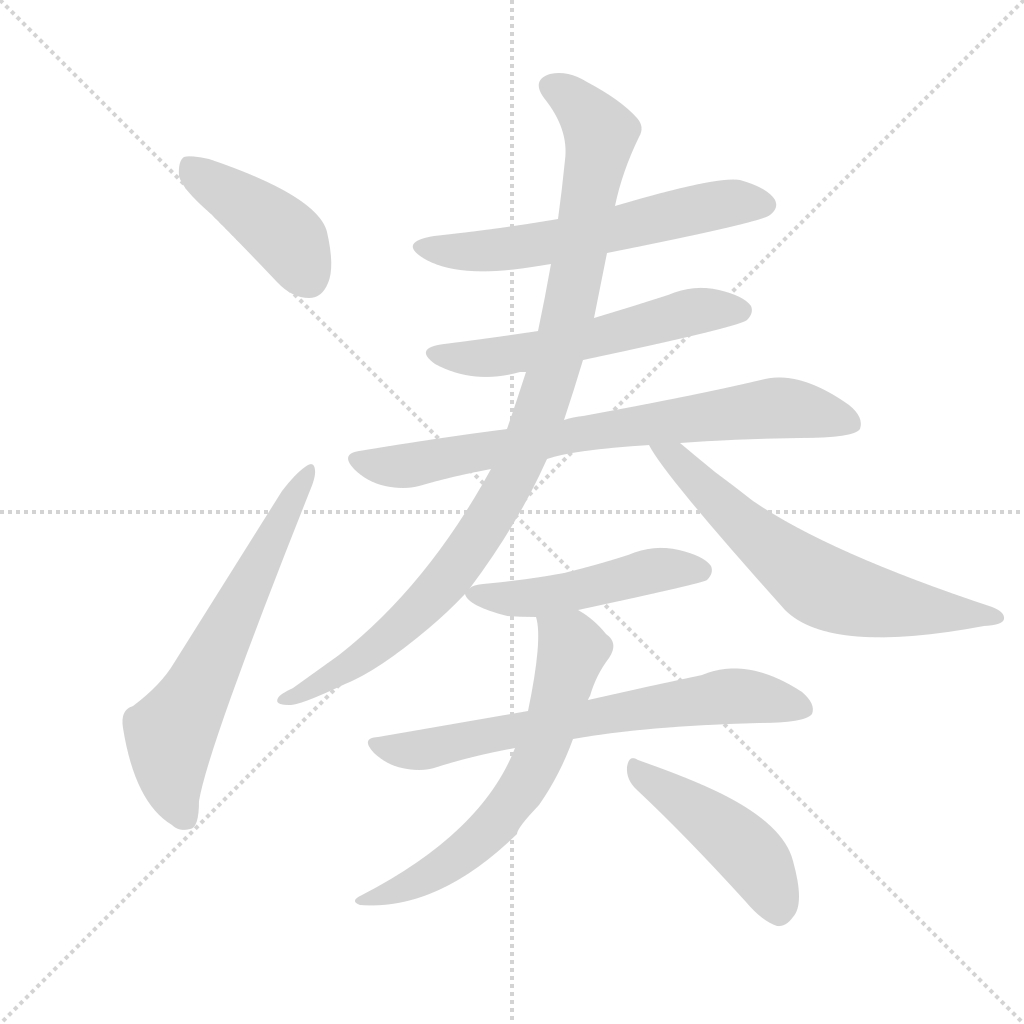
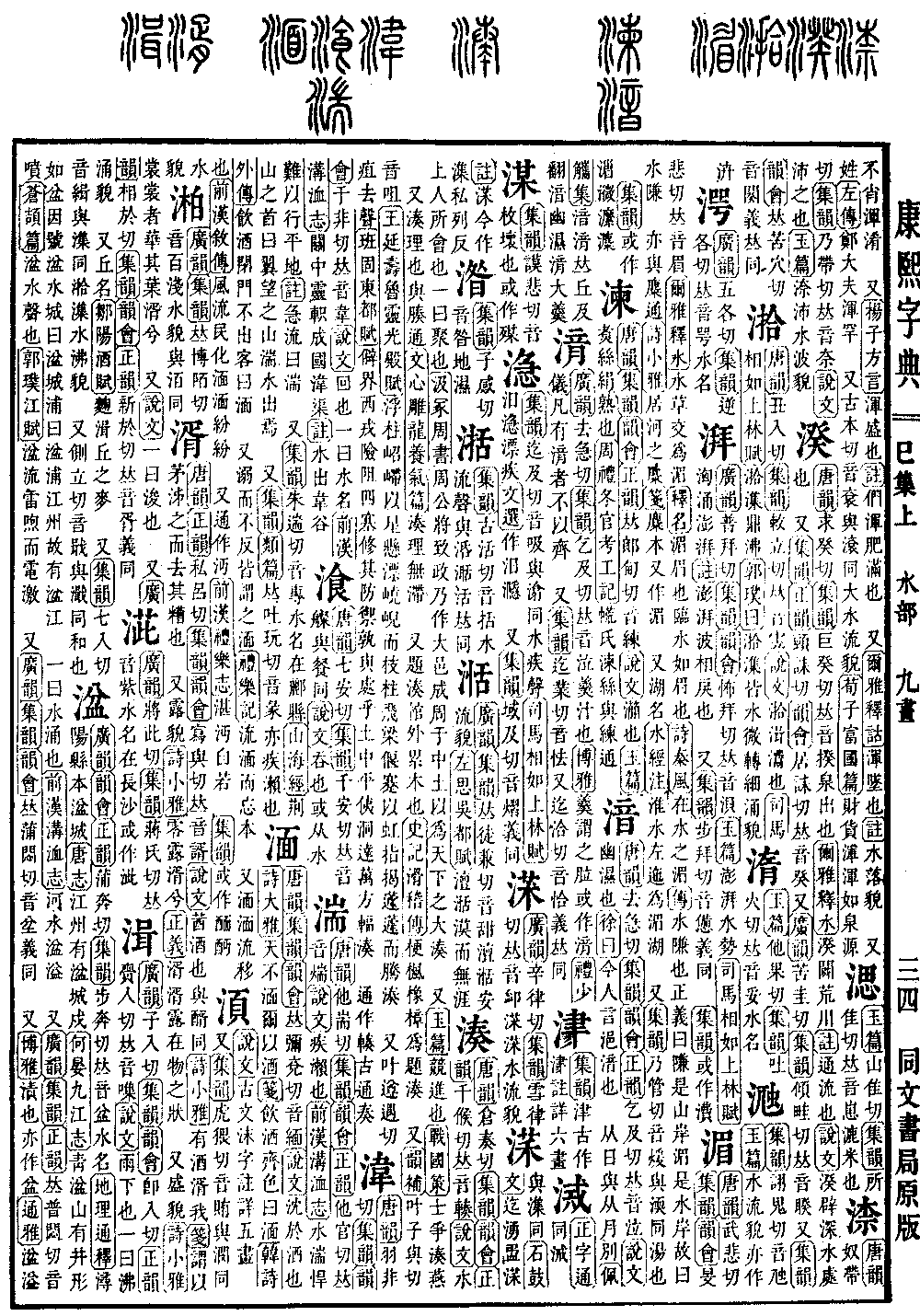
Si Collection, Upper Volume. Radical: Water (shui). Character: cou. Kangxi stroke count: 13. Page 636. Tang Rhyme (Tangyun) indicates the pronunciation is derived from the initial of cang and the final of zou, pronounced cou. Collected Rhymes (Jiyun), Collected Rhymes (Yunhui), and Correct Rhymes (Zhengyun) indicate a pronunciation starting with the initial of qian, pronounced cou. Explaining Graphs and Analyzing Characters (Shuowen Jiezi) defines it as a place where people gather on the water. Another definition is to gather or assemble. Zhou Records from the Grave of Ji (Jizhong Zhoushu) states that when the Duke of Zhou was about to return the government to the king, he built the great city of Chengzhou in the central lands to serve as the great gathering place of the world. Also, Jade Chapters (Yupian) defines it as advancing competitively. Strategies of the Warring States (Zhanguoce) describes how scholars competed to flock to the state of Yan. It also refers to the texture of the skin and muscles, used interchangeably with the character cou. The Literary Mind and the Carving of Dragons (Wenxin Diaolong), in the section on Nourishing Vital Energy, mentions that the skin and muscle textures are without obstruction. It also refers to ticou, which are logs stacked outside a coffin. Records of the Grand Historian (Shiji), in the Biographies of Humorists, describes using various woods such as pian, maple, oak, and camphor to construct these outer coffin stacks. Also, Rhyme Supplement (Yunbu) notes a rhyming pronunciation derived from the initial of zi and final of yu, pronounced ju. Wang Yanshou in the Rhapsody on the Lingguang Palace in Lu (Lu Lingguang Dian Fu) writes that the floating pillars tower like stars suspended, drifting loftily as if branched; the flying beams arch like pointing rainbows, rising tall and lifting to converge. Another rhyming pronunciation is derived from the initial of zun and final of yu, sounding like the departing tone of ju. Ban Gu in the Rhapsody on the Eastern Capital (Dongdu Fu) writes that the region was situated in the remote borders of the Western Rong, with dangerous obstacles on all sides; in terms of maintaining defenses, what could be better than dwelling in the center of the earth, where the terrain is level and open, and the ten thousand directions converge like spokes at a hub. It is commonly written in the variant form cou. Historically, it was interchangeable with the character zou. Textual Research: In the Records of the Grand Historian, Biographies of Humorists, the wood name originally written as geng maple has been corrected to pian maple in accordance with the source text.