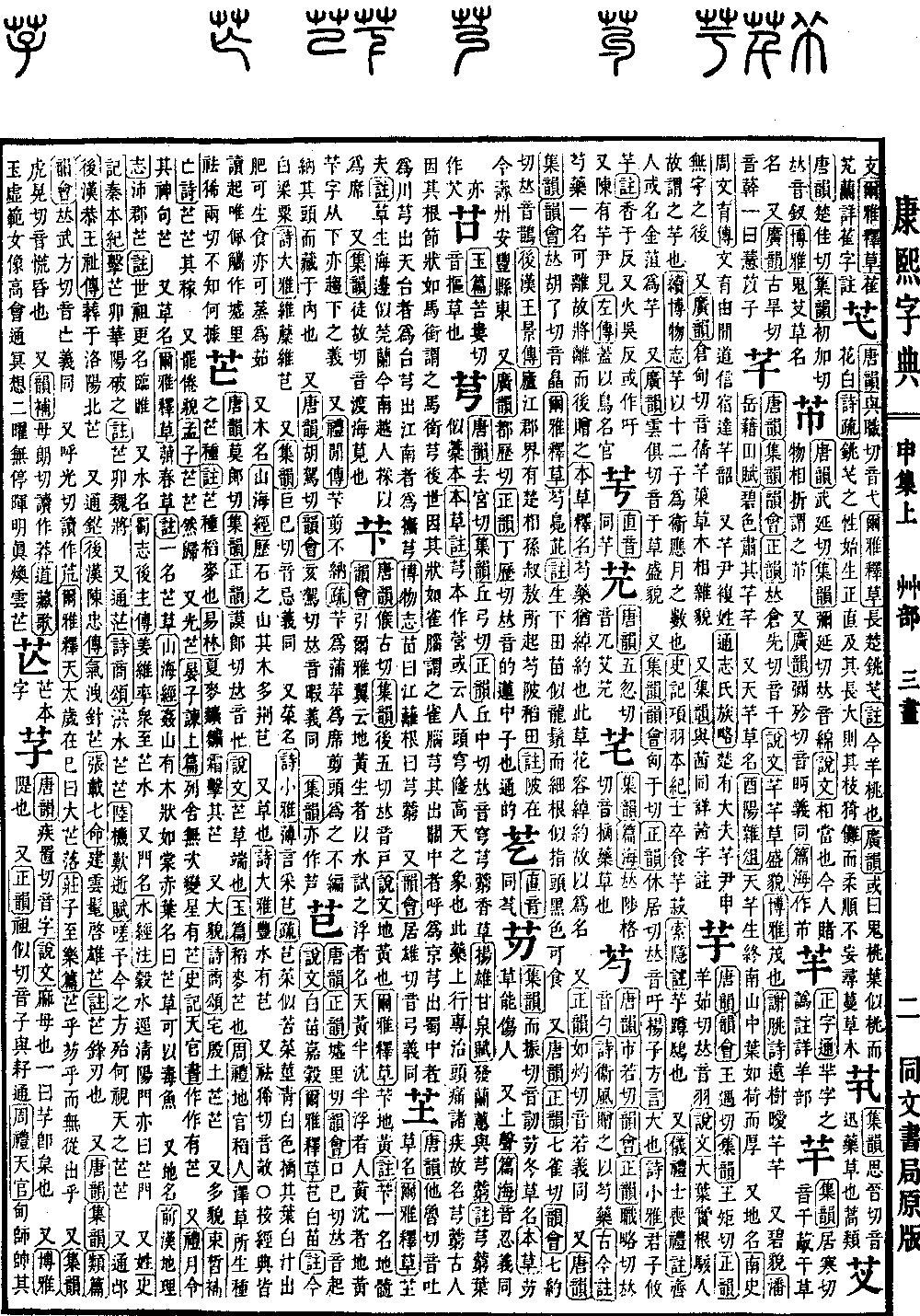
Shen Collection, Upper Volume
Radical: Grass (cǎo)
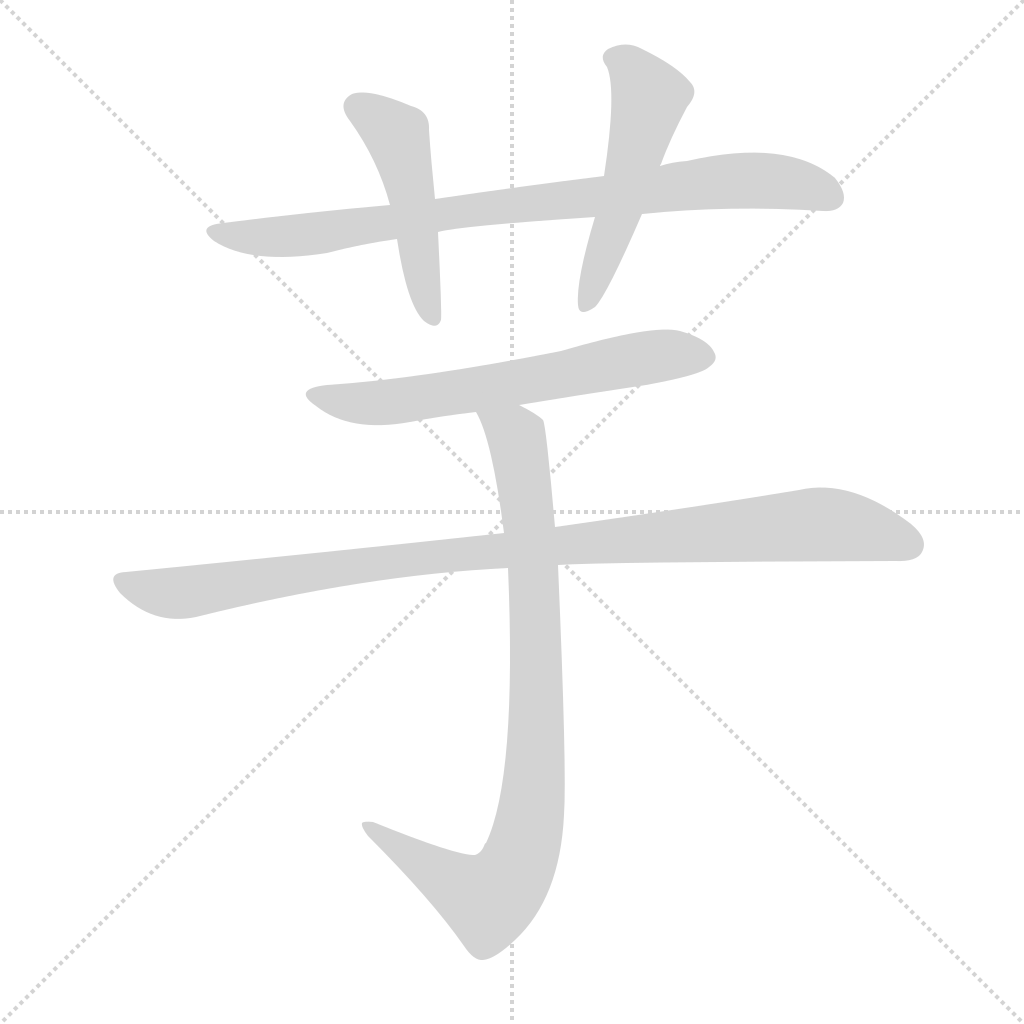
芋
Kangxi strokes: 9
Page 1018, Entry 08
Pronounced yu (rising tone).
Shuowen Jiezi (Dictionary of Explaining and Analyzing Characters) states: The leaves are large, and the rootstalk is thick and surprising, hence it is called yu.
Xu Bowuzhi (Continued Records of All Things) states: The yu plant has twelve daughter tubers surrounding the mother tuber, corresponding to the number of months in a year.
Records of the Grand Historian (Shiji), Biography of Xiang Yu: The soldiers ate taro and beans.
Suoyin Commentary states: Yu is the same as cun chi (a term for large taro).
Additionally, the Commentary on the Book of Etiquette and Ceremonial (Yili), Section on Mortuary Rites for Officials, states: In the land of Qi, there are people who call whole pickled vegetables yu.
Also, pronounced yu. Describes the appearance of lush grass and trees.
Also, pronounced xu (rising tone).
Yang Xiong's Dialects (Fangyan) defines it as meaning large.
Book of Odes (Shijing), Minor Odes of the Kingdom: Where the gentleman finds peace. The commentary notes it is pronounced as xiang-yu (reversed). Also pronounced huo-wu (reversed). Sometimes written in a variant form (xu).
There was a government official post in the State of Chen called Yuyin, appearing in the Zuo Tradition (Zuo Zhuan); it was likely a position named after a bird.
Editorial note: The Commentary on the Book of Etiquette and Ceremonial (Yili) originally stated people in Qi called gold-pickled vegetables yu. Following the original text, this has been corrected to whole-pickled vegetables.