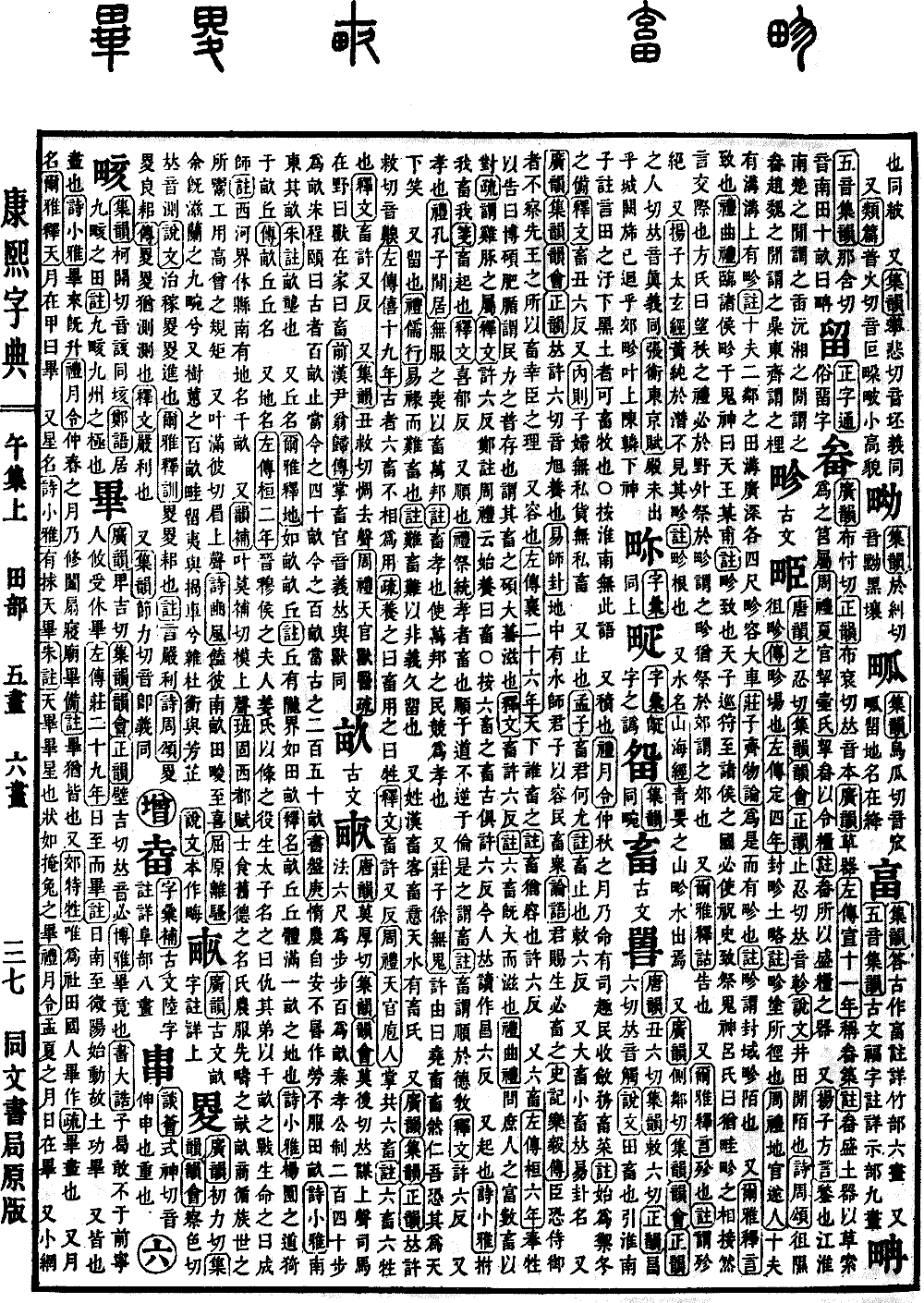
Wu Collection, Upper Volume
Radical: Field (tián)
Page 761, Entry 21
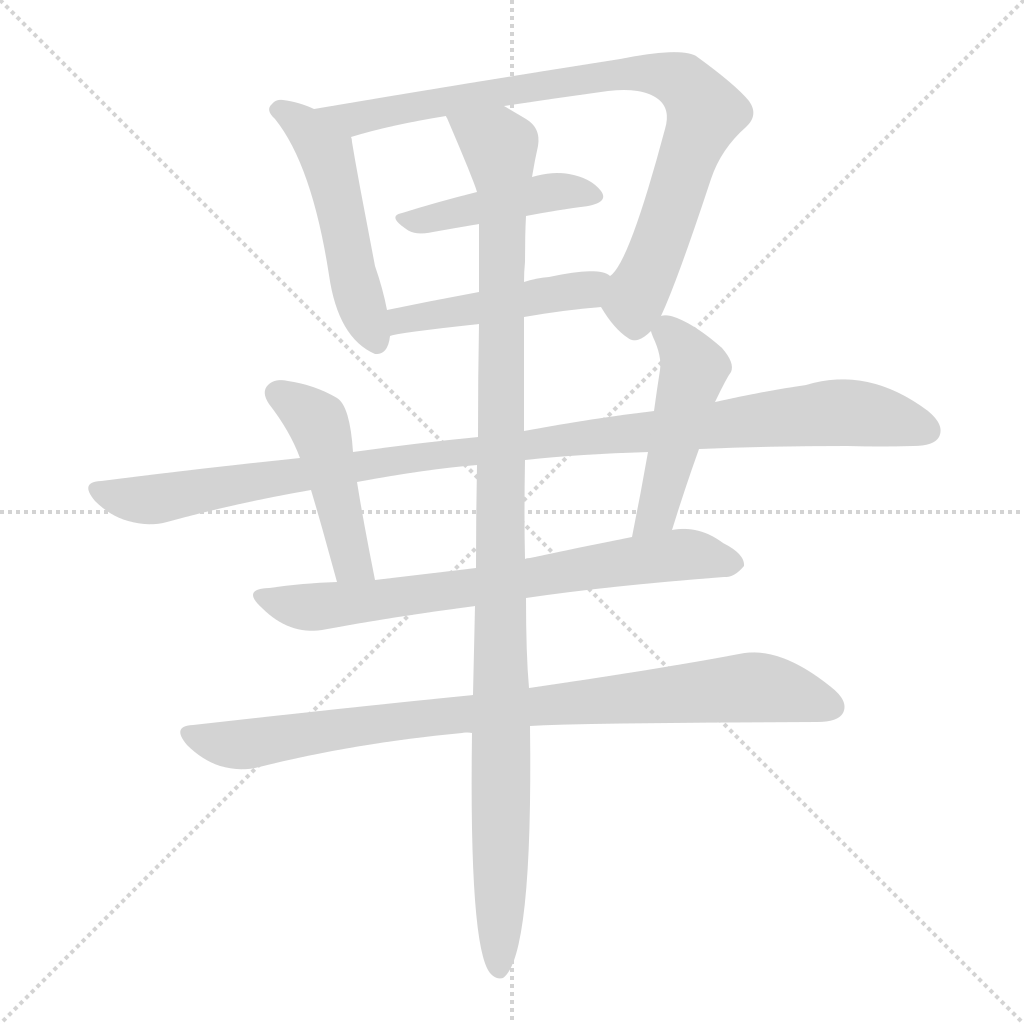
Pronounced bi
Broad Rhymes (Guangyun): Pronounced bi (rising tone)
Collection of Rhymes (Jiyun), Rhyme Compendium (Yunhui), Correct Rhymes (Zhengyun): Pronounced bi (rising tone)
In the Broad Encyclopedia (Boya): Bi means to finish or complete.
Book of Documents (Shangshu), Chapter Great Announcement (Daga): How can I dare not inherit the wonderful tasks received by the virtuous men of previous generations and complete them?
Zuo Commentary (Zuozhuan), 29th Year of Duke Zhuang: Once the winter solstice arrives, work ceases. Note: On the winter solstice, the yang energy begins to sprout, so earth and wood construction projects are halted.
Also means all or entirely. Indicates reaching the end or exhaustion.
Book of Odes (Shijing), Lesser Odes (Xiaoya): Everything has arrived and ascended to the hall.
Book of Rites (Liji), Monthly Ordinances (Yueling): In the second month of mid-spring, repair the gates and doors; the sleeping quarters and ancestral temples shall be entirely complete. Note: Bi means as if entirely.
Also: In the Special Services for the Suburban Sacrifice (Jiaotesheng), only when hunting for the sacrifice to the Earth God do all the people of the state go out. Commentary: Bi means to exhaust or all.
Also a month name. In the Literary Expositor (Erya), section Explaining Heaven (Shitian): The month when the moon is in the chia (jiǎ) day is called Bi.
Also a star name. Book of Odes (Shijing), Lesser Odes (Xiaoya): There is that curved Heavenly Bi star. Zhu Xi's Commentary: Heavenly Bi is the Bi star. Its shape resembles a hunting net for rabbits, which is called a bi.
Book of Rites (Liji), Monthly Ordinances (Yueling): In the fourth month of mid-summer, the sun is in the Bi constellation.
Also a small net. Book of Odes (Shijing), Lesser Odes (Xiaoya): When the mandarin ducks fly, use a bi to net them, use a luo (a type of net) to capture them. Commentary: A net with small meshes and a long handle is called a bi.
Book of Rites (Liji), Monthly Ordinances (Yueling): During hunting, set up capture nets and rabbit nets; spread out luo (capture nets), bi (small nets), and hiding tools for archery.
Yang Xiong, Rhapsody on Hunting (Xiaoliefu): Carrying a huge net that covers the sky.
Also refers to wooden tablets. Literary Expositor (Erya), section Explaining Implements (Shiqi): Wooden tablets are called bi. Note: This refers to the book scrolls of the present time.
Book of Rites (Liji), Record of Learning (Xueji): Present-day teachers only know how to recite from books. Commentary: Zhan means to look. Bi means wooden tablets. Not understanding the principles of the classics, they only stretch out their voices in recitation while looking at the scrolls.
Also refers to a wooden fork used to pierce sacrificial animals. Book of Rites (Liji), Miscellaneous Records (Zaji): For the bi, use mulberry wood. Note: When the host takes the meat, he uses the bi to assist. For funeral sacrifices, use mulberry wood; for auspicious sacrifices, use thorn wood. The shape of the bi resembles a fork, three inches wide and eight inches long, with a handle two feet four inches long, with both ends painted red.
Ceremonial and Rituals (Yili), Special Sacrifice (Teshengkuishi): The clan elder carries the bi and enters first. Note: The bi is shaped like a fork; perhaps because it resembles the Bi star, it takes this name.
Also: Ceremonial and Rituals (Yili), Great Archery Ritual (Dashesheyi): The Sima (Minister of War) faces east and uses a bow as a bi. Note: The bi is an implement used to assist in directing the attendants. Commentary: The bi is a tool used to help hold food from the tripod, so the Sima holds a bow and uses it as a bi to direct the arrangements.
Also: Yangzi's Dialects (Fangyan): The iron part under a carriage is called bi in the regions of the Song state, the Huai River, and the Chu state.
Also in the Supplement to the Collection of Characters (Zihuibu): Bi gate is the Lu gate.
Also a place name. Literary Expositor (Erya), section Explaining Earth (Shidi): Bi is a hall wall. Note: This is the name of a road on Zhongnan Mountain; Bi is its edge, resembling the wall of a hall.
Book of Odes (Shijing), Odes of Qin (Qinfeng), Zhongnan: With annotations regarding the borders and hall-like walls. Note: Bi is the name of a road on Zhongnan Mountain; its edges are like the walls of a hall.
Also a state name. Zuo Commentary (Zuozhuan), 24th Year of Duke Xi: Bi, Yuan, Feng, and Xun were the sons of King Wen.
Records of the Grand Historian (Shiji), Tables of the Princes and Marquises: The Marquis of Biliang, Liu Ying.
Also a surname. Zuo Commentary (Zuozhuan), 1st Year of Duke Min: Bi Wan served as the right-hand man in a chariot.
Narratives of Jin (Jinyu): Obtained Bi Yang. Note: Bi Yang was a scholar of the Jin state.
Also a god name. Broad Encyclopedia (Boya): The wood god is called Bifang.
Zhang Heng, Rhapsody on the Eastern Metropolis (Dongjingfu): How much more so for the demons and the Bifang. Note: Bifang is an old man god, shaped like a bird with two legs and one wing, often holding fire in its mouth to cause disasters in people's homes.
Also a bird name. Classic of Mountains and Seas (Shanhaijing): On Mount Zhang'e there is a bird shaped like a crane, with one leg, red markings, a blue body, and a white beak; its name is Bifang.
Also the same as the character for shooting (bì). Guizang Zhengmu Scripture: Formerly, Yi was skilled at archery... he shot the ten suns and successfully hit them.
Also the same as the character for binding (bì). Ceremonial and Rituals (Yili), Audience Ritual (Jianli): The cap uses six-sheng cloth and is gathered outward. Note: Outer bi refers to the front and back ends of the cap being gathered and sewn outward onto the cap band. Commentary: Outer bi refers to the front and back ends being gathered outward. According to the Record of the Occasion of Death (Jixi Li), bi is written with the binding character.
Also the same as the character for knee pad (bì). Xunzi, Chapter Rectifying Arguments (Zhenglun): Offering an artemisia-colored knee pad.