Yin Collection, Middle Volume
Radical: Mountain (shān)
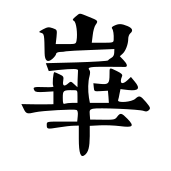
Hua
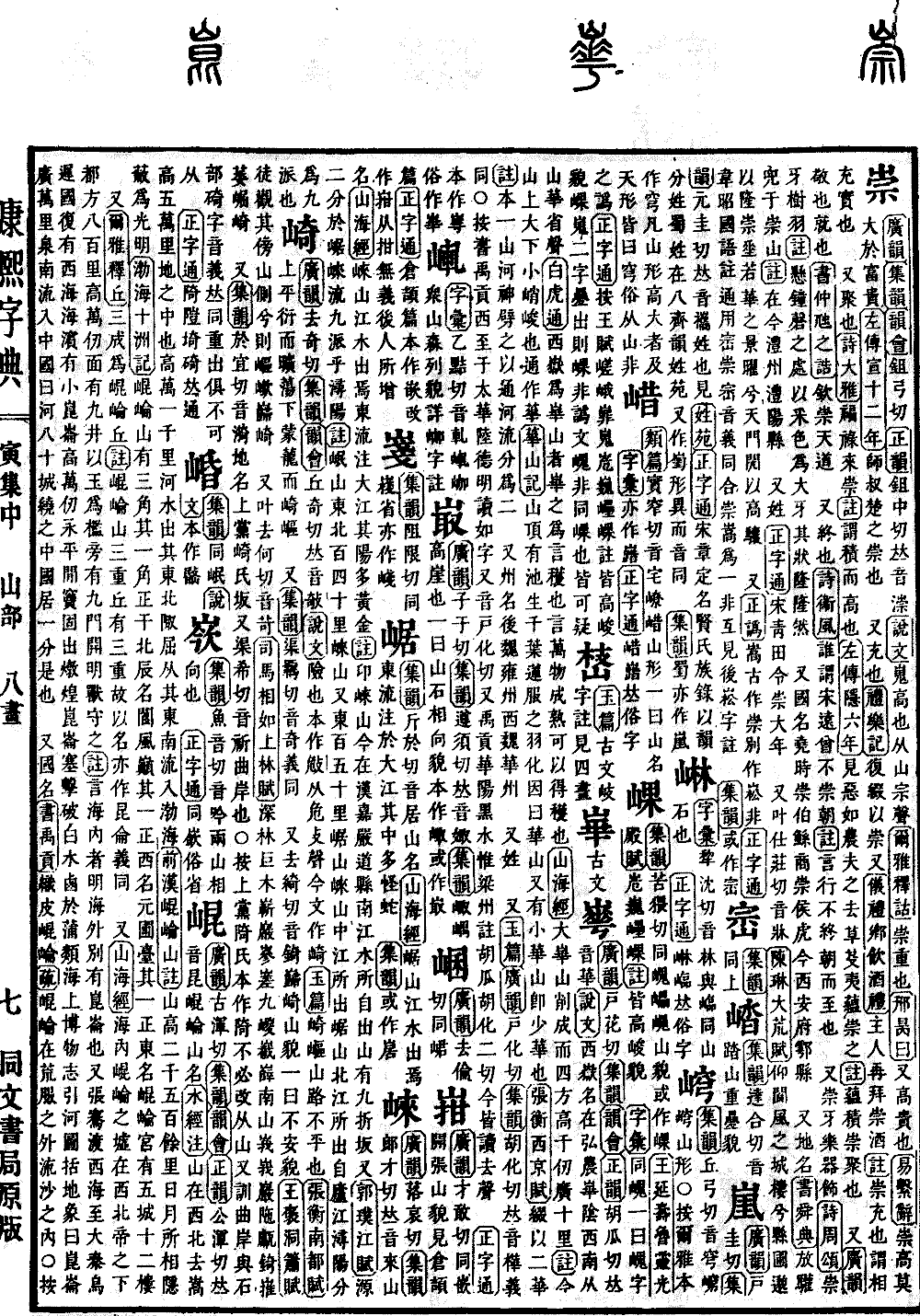
Kangxi dictionary stroke count: 11
Page 313, Entry 10
Classical citations:
Broad Rhymes (Guangyun) indicates the pronunciation as hua (falling tone). Collected Rhymes (Jiyun), Rhyme Meetings (Yunhui), and Correct Rhymes (Zhengyun) indicate the pronunciation as hua (level tone), pronounced the same as hua. Explaining Graphs and Analyzing Characters (Shuowen Jiezi) explains it as the name of the Western Peak. It is located southwest of Huayin County, Hongnong Commandery. The character structure is derived from Mountain (shān), using an abbreviated form of hua as the phonetic element. White Tiger Hall Discussions (Baihu Tong) states that the Western Peak is called Mount Hua because hua implies harvesting, representing the maturation of all things and the ability to gather a harvest. Classic of Mountains and Seas (Shanhaijing) records: Great Mount Hua has a shape as square as if carved, rising to a height of a thousand ren and spanning ten li in width. Commentary states that the mountain is currently large at the base and small at the top, being extremely steep and precipitous. It is also used interchangeably with hua. Mount Hua Record (Huashan Ji) records: The summit contains a pond where thousand-petaled lotus flowers grow; consuming them allows one to become an immortal and ascend, hence it is called Mount Hua. There is also a Lesser Mount Hua, which is Mount Shaohua. Zhang Heng, Western Capital Rhapsody (Xijing Fu) writes: Adorned with the two Huas. Commentary states: It was originally one mountain; the river god split it to allow the river to pass, thus it became two mountains. It is also a name of a prefecture. During the Later Wei dynasty it was called Yong Prefecture, and during the Western Wei dynasty it was called Hua Prefecture. It is also a surname.
Additionally, Jade Chapters (Yupian) and Broad Rhymes (Guangyun) indicate the pronunciation as hua (falling tone); Collected Rhymes (Jiyun) indicates the pronunciation as hua (falling tone), pronounced the same as hua. The meaning is the same. According to the Book of Documents (Shangshu), section Tribute of Yu (Yugong): It extends west to Great Hua. Lu Deming reads it with its original sound, but also provides the pronunciation as hua (falling tone). Furthermore, in Tribute of Yu (Yugong), for the passage Hua south of the Black Water is Liang Prefecture, the commentary provides both hua (level tone) and hua (falling tone) pronunciations; both are now read in the falling tone. Correct Character Comprehension (Zhengzitong) states that the original character is written with a variant form, and the common form is written as hua.