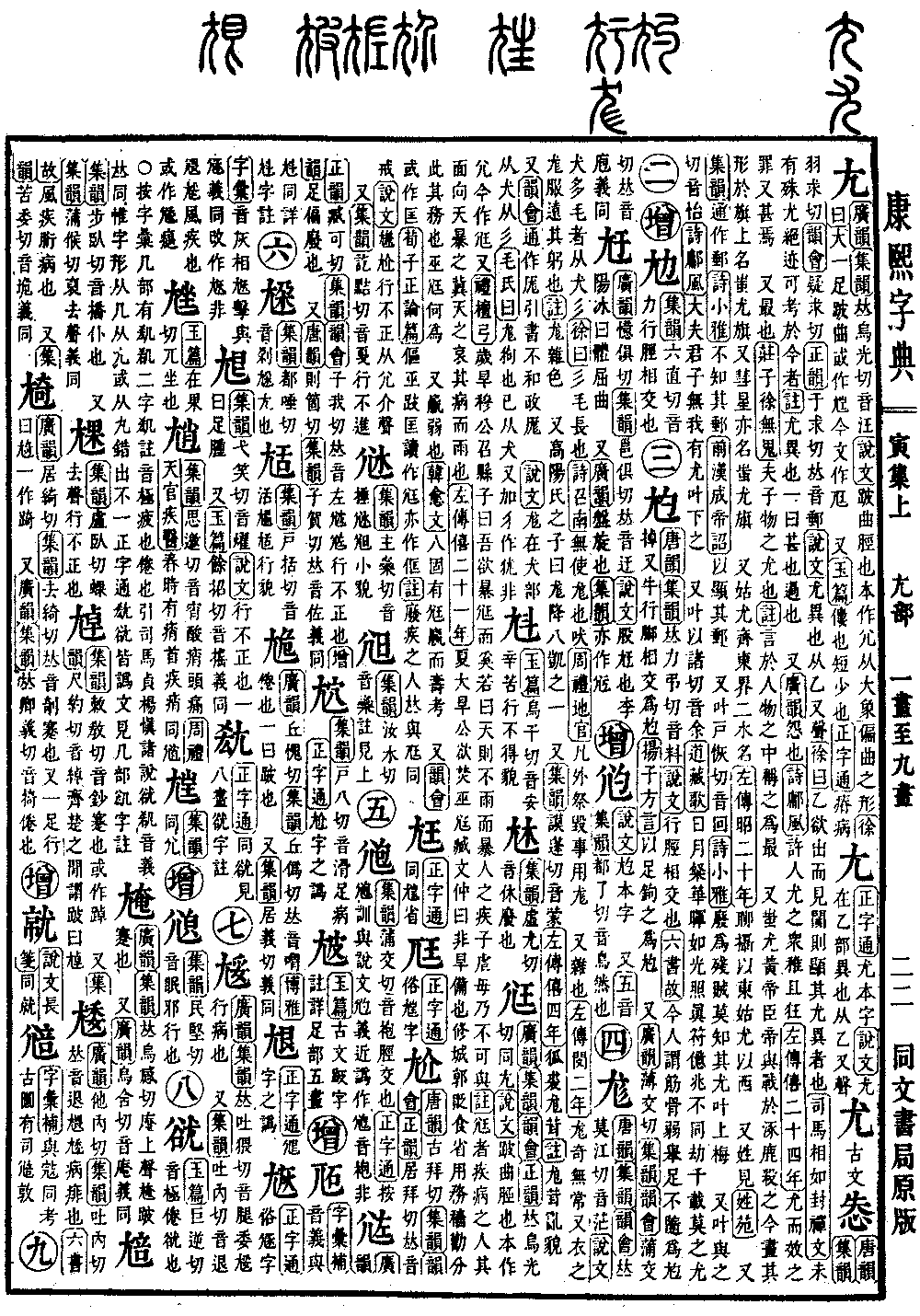
Yin Collection, Upper Volume
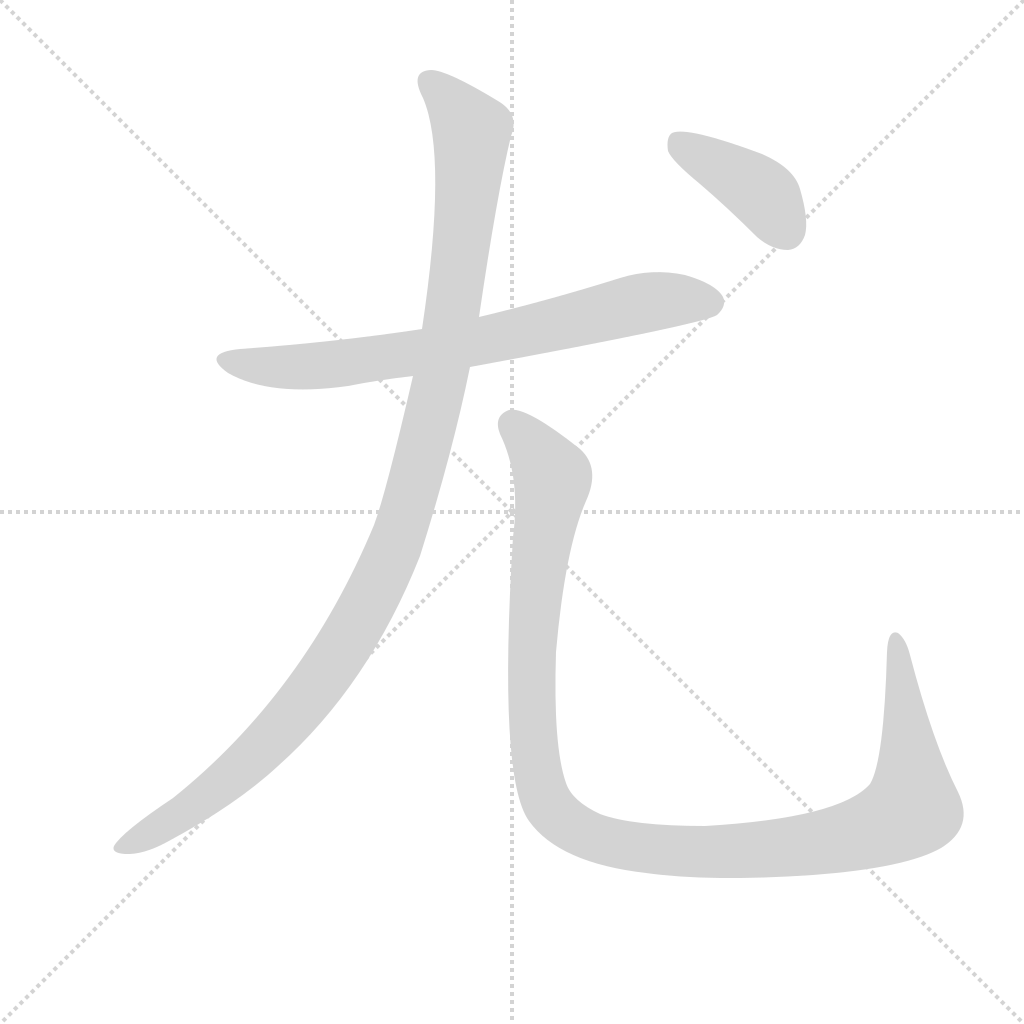
Radical: Lame (yǒu)
Kangxi stroke count: 4
Page 298, Entry 03
The ancient form is written as you (composed of heart and you).
According to Tang Rhymes (Tangyun) and Collection of Rhymes (Jiyun), it is pronounced you; according to Rhyme Compilation (Yunhui), it is pronounced you; according to Correct Rhymes (Zhengyun), it is pronounced you. The pronunciation is the same as the character for post (you).
Explanation in Explaining Graphs and Analyzing Characters (Shuowen Jiezi): You means extraordinary or different. The character structure consists of yi and you, with you serving as the phonetic component.
Xu Kai says: When yi attempts to emerge but is obstructed, its extraordinary nature becomes more apparent.
Sima Xiangru, Essay on the Feng and Shan Sacrifices: There are no extraordinary or unprecedented achievements that can be verified today. Note: You means extraordinary. Another interpretation suggests it indicates a high degree or a fault.
It is also defined in Extensive Rhymes (Guangyun) as resentment.
Classic of Poetry (Shijing), Odes of Yong: The people of Xu blame him; those people are infantile and arrogant.
Zuo Tradition (Zuozhuan), Twenty-fourth Year of Duke Xi: To knowingly commit a fault and then imitate it makes the offense even more severe.
It also means most or extreme.
Zhuangzi, Xu Wugui: The master is the most outstanding among all things. Note: This means among people, he is considered the most excellent.
It also refers to Chiyou, a minister to the Yellow Emperor. The Yellow Emperor fought him at Zhuolu and killed him. Nowadays, his image is depicted on flags, which are called Chiyou flags.
It also refers to a comet, which is also called a Chiyou flag.
It also refers to Guyou, the names of two rivers on the eastern border of the State of Qi.
Zuo Tradition (Zuozhuan), Twentieth Year of Duke Zhao: East of Liaocheng and Shecheng, and west of the Gu and You rivers.
It is also a surname. Found in Anthology of Surnames (Xingyuan).
According to Collection of Rhymes (Jiyun), it is also used interchangeably with the character for post (you).
Classic of Poetry (Shijing), Lesser Odes: Not knowing one's own faults.
History of the Former Han (Qian Hanshu), Edict of Emperor Cheng: To make his faults manifest.
It also functions as a rhyming word, pronounced hui, with a sound like the character for return (hui).
Classic of Poetry (Shijing), Lesser Odes: Wantonly destroying and harming, no one knows his faults. It rhymes with the character for plum (mei) in the previous line.
It also functions as a rhyming word, pronounced yi, with a sound like the character for harmony (yi).
Classic of Poetry (Shijing), Odes of Yong: All you noble gentlemen, do not blame me. It rhymes with the character for this/it (zhi) in the following line.
It also functions as a rhyming word, pronounced yu, with a sound like the character for surplus (yu).
Daoist Canon Songs (Daozang Ge): The sun and moon shine with brilliance, like light illuminating the true talisman. Having experienced various calamities over billions of years, even after thousands of years, no one blames it.