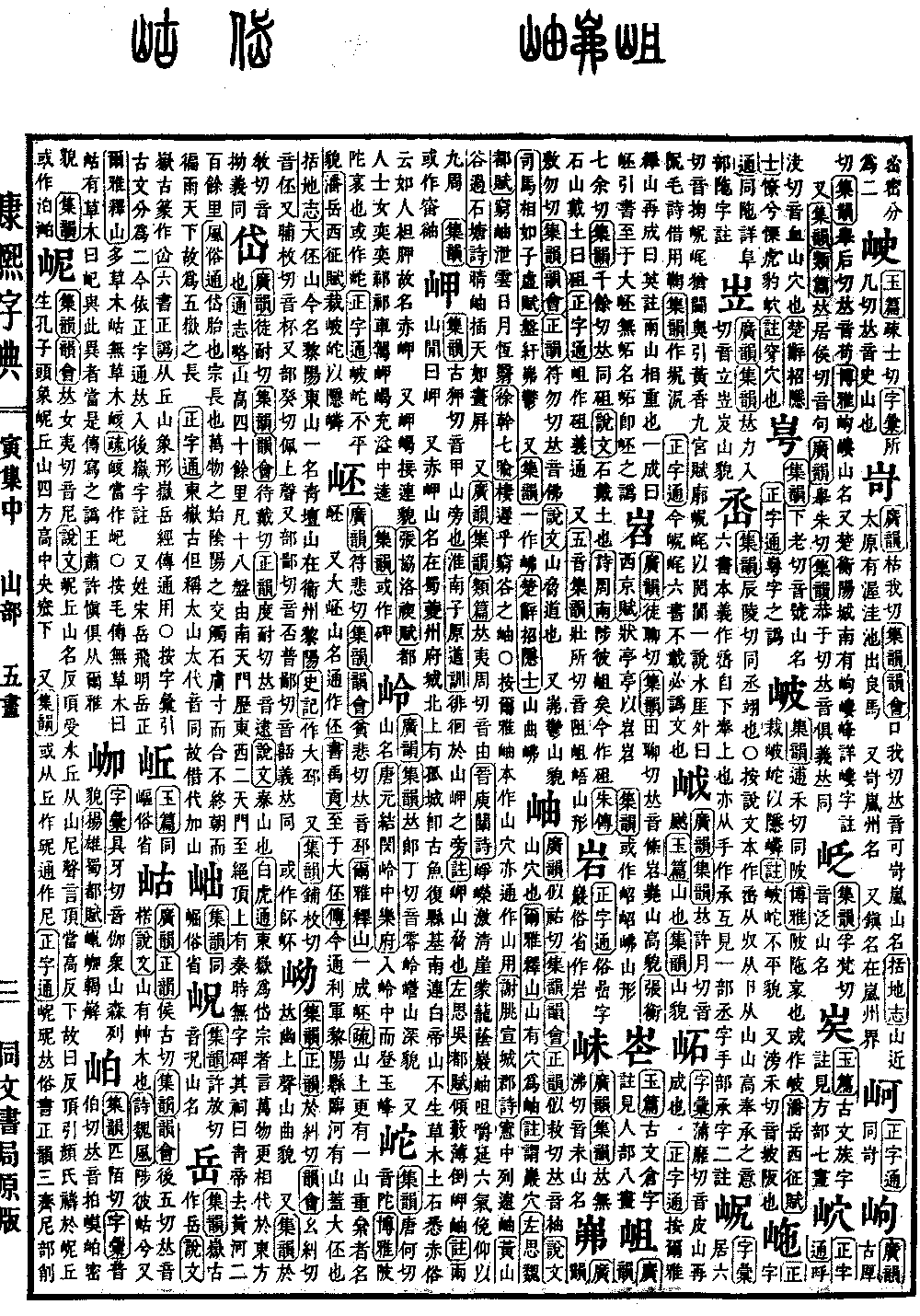
Yin Collection, Middle Volume
Radical: Mountain (shān)
岩
Kangxi stroke count: 8
Page 309, Entry 19
Zhengzitong (Comprehensive Correction of Characters): This is the common variant form of the character yan (yán). The character yan (yán) is written as this simplified variant.
Yan (yán)
Pronounced yan (yán). Pronounced the same as yan (yán).
Shuowen Jiezi (Explaining Graphs and Analyzing Characters): Refers to the edge of a bank. The character is formed with the mountain radical, with yan (yán) providing the phonetic.
Zengyun (Additional Rhymes): A cave made of stone is called an yan (yán); those that are deep and connecting are called caves. Another meaning is dangerous or steep.
Zuo Zhuan (Chronicle of Zuo): This refers to a dangerous city.
Gongyang Zhuan (Gongyang’s Commentary on the Spring and Autumn Annals): The steepness of Mount Xiao is where King Wen of Zhou took shelter from the wind and rain.
Also, zhan-yan (zhānyán) describes a high and precipitous appearance.
Sima Xiangru, Shanglin Fu (Rhapsody of the Shanglin Park): The mountains are high, steep, and uneven.
Also, yan-lang (yánláng) refers to the eaves of a palace corridor.
Han Wudi, Ce Xianliang Zhi (Policy Questions for the Worthy and Good): In the time of Emperor Shun, one could leisurely roam the palace corridors.
Also a place name.
Book of Documents (Shangshu), Yue Ming: Fu Yue built walls in the wilderness of Fu Yan.
Commentary: Fu Yan is located between the states of Yu and Guo.
Also pronounced yan (yán). Yan-yan (yányán) describes a towering appearance.
Book of Odes (Shijing), Lu Song: Mount Tai is towering and high, something looked up to by the state of Lu.
Also, Zhengzitong (Comprehensive Correction of Characters): Originally written as yan (yán). Also written as yan (yán). Used interchangeably with yan (yán), yan (yán), and yan (yán). Note: The characters yan (yán) and yan (yán) are identical. In the Shuowen Jiezi, the character yan (yán) is pronounced yan (yán) and means a mountain cliff. The character yan (yán) is pronounced yan (yán) and means the edge of a bank. It is incorrect to split these into two separate definitions, assuming that yan (yán) refers exclusively to the edge of a bank. The characters yan (yán), yan (yán), and yan (yán) are all written as yan (yán).
Textual Research: Gongyang Zhuan (Gongyang’s Commentary on the Spring and Autumn Annals), Year 32 of Duke Xi: The steepness of Mount Xiao is where King Wen took shelter from the wind and rain. Corrected according to the original text from year 33, and the character for location was changed.