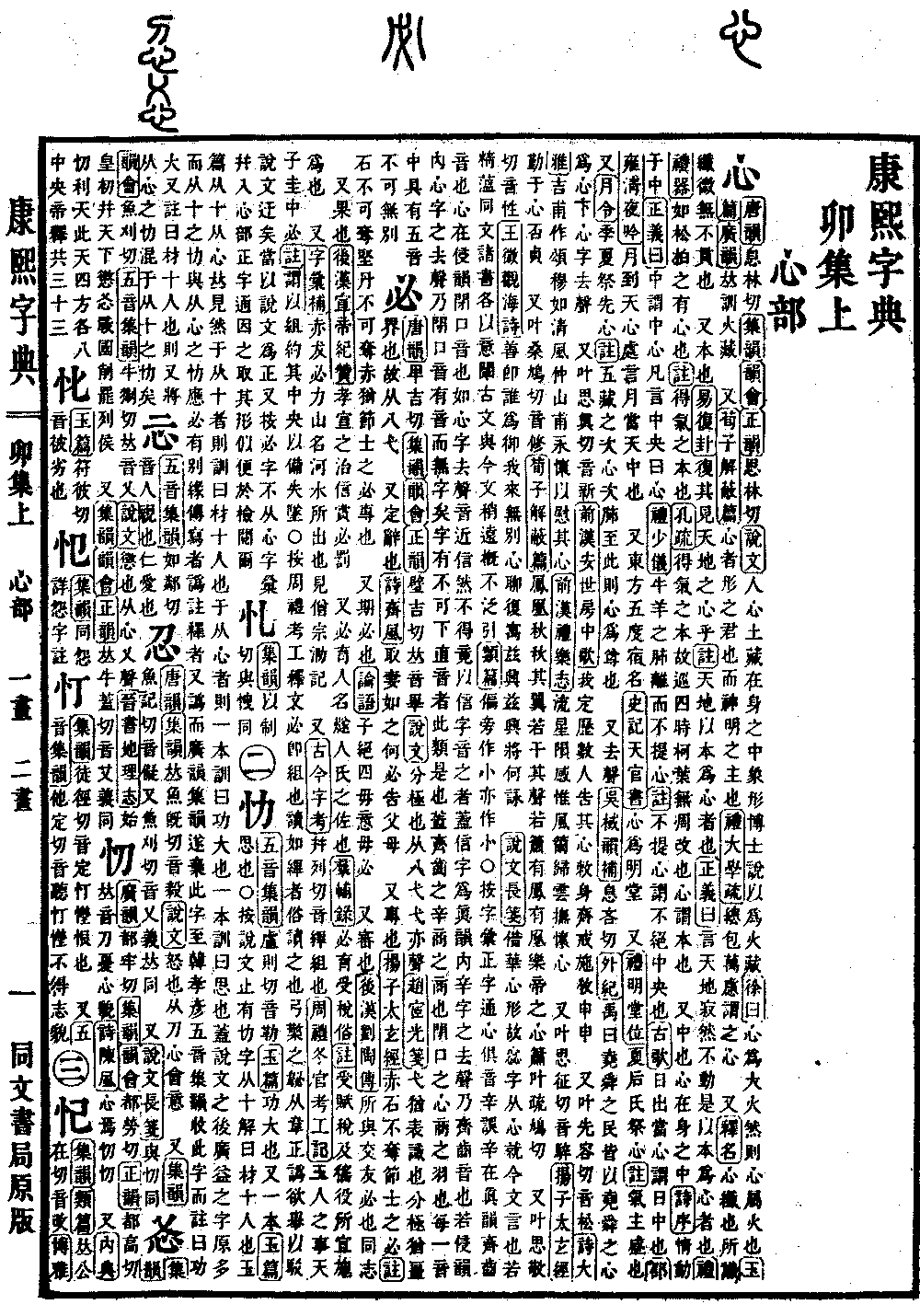
Mao Collection, Upper Volume
Radical: Heart (xīn)
Kangxi stroke count: 4
Page 375, Entry 01
Pronounced xin.
Shuowen Jiezi (Explaining Single-Component Characters and Analyzing Compound Characters): The human heart, an earth organ, located in the center of the body. Pictographic. Scholar-officials explain it as the fire organ.
Xu states: The heart is the great fire; thus, the heart belongs to fire.
Yupian (Jade Chapters) and Guangyun (Expanded Rhymes): Defined as the fire organ.
Also, Xunzi (Master Xun), Chapter on Dispelling Blindness: The heart is the ruler of the body and the master of spiritual brilliance.
Book of Rites (Liji), Commentary on the Great Learning: To contain and encompass all thoughts is called the heart.
Also, Shiming (Explanation of Names): Heart means subtle; there is nothing subtle or minute that it does not comprehend.
Also, it means origin.
Book of Changes (Yijing), Return hexagram: Return to see the heart of heaven and earth?
Note: Heaven and earth use the origin as their heart.
Exegesis: It means that heaven and earth are silent and motionless, thus they use the origin as their heart.
Book of Rites (Liji), Rites and Vessels: Just as pine and cypress trees have hearts.
Note: The origin of the vital energy.
Kong's Sub-commentary: The origin of the vital energy, which is why they survive the four seasons without their branches and leaves withering or changing; heart here refers to the origin.
Also, it means center. The heart is in the center of the body.
Book of Odes (Shijing) Preface: Emotions are stirred within.
Exegesis: Within refers to the center of the heart. All references to the center are called heart.
Book of Rites (Liji), Minor Rites: When presenting the lungs of an ox or sheep, do not lift the heart.
Note: Not lifting the heart means not severing the center.
Ancient Song: The sun rises directly over the heart, meaning the sun is at the meridian.
Shao Yong's Poem on a Clear Night: The moon reaches the heart of the heavens, meaning the moon is at the center of the sky.
Also, the name of a lunar mansion consisting of five degrees in the east.
Records of the Grand Historian (Shiji), Treatise on Celestial Offices: The heart serves as the bright hall.
Also, Book of Rites (Liji), The Bright Hall Position: The Xia Dynasty offered sacrifices to the heart.
Note: It is because the vital energy is most abundant there.
Also, Monthly Ordinances: In the last month of summer, sacrifice is offered to the first heart.
Note: Among the five organs, the heart is adjacent to the lungs; by this time, the heart is considered the most honorable.
Also, pronounced with a departing tone.
Wu Yu, Rhyme Supplements: Pronounced xin (departing tone).
Historical Records (Waiji): Yu said: The people of Yao and Shun all take the hearts of Yao and Shun as their own. The following heart character has a departing tone.
Also, rhymes with zhen, pronounced xin.
History of the Former Han (Qianhan Shu), Song of the Chamber of Ancestral Peace: I determine the calendar and counts, people report their hearts to me. I discipline my body and maintain abstinence, applying instruction again and again.
Also, rhymes with rong, pronounced song.
Book of Odes (Shijing), Greater Odes: Jifu composed a eulogy, like a clear wind. Zhong Shanfu perpetually cherishes it, to comfort his heart.
History of the Former Han (Qianhan Shu), Treatise on Rites and Music: Meteors fall, moved by the wind, grasping the returning clouds, stroking the cherished heart.
Also, rhymes with zheng, pronounced xiong.
Yang Xiong's Great Mystery (Taixuanjing): Diligent in the heart, is it constant?
Also, rhymes with jiu, pronounced xiu.
Xunzi (Master Xun), Chapter on Dispelling Blindness: The phoenix flies, its wings are like this, its voice is like a flute. There is a male phoenix and a female phoenix, rejoicing in the emperor's heart. Xiao rhymes with jiu.
Also, rhymes with jing, pronounced xing.
Wang Wei's Poem on Viewing the Sea: If one is good, who will serve as the charioteer? I come with no other heart. I will simply lodge this inspiration here; what shall this inspiration sing of?
Shuowen Changjian (Extended Notes on Explaining Characters): It borrows the shape of a flower heart, therefore the character rui (pollen) follows heart; this is based on contemporary script. As for works like Jingyun or Tongwen, each interprets the ancient script according to its own meaning, which is slightly far from contemporary script, so I will not cite them broadly.
Leipian (Categorized Chapters): The radical variant is written as the left-side heart radical. Also written as a variant form.
Note: The dictionaries Zihui and Zhengzitong both state that heart is pronounced the same as xin, which is an error. Xin belongs to the zhen rhyme group and is a dental sound. Heart belongs to the qin rhyme group and is a closed-mouth sound. For instance, when heart is in the departing tone, the sound is close to xin (trust), yet one cannot equate the sound of the character heart to xin (trust) entirely. This is because xin (trust) is the departing tone of the character xin (new/spicy) within the zhen rhyme group, which is a dental sound. The departing tone of heart in the qin rhyme group is a closed-mouth sound; it has a sound but no character. There are characters for which one cannot provide a direct homophone, and this is such a case. The dental xin (new/spicy) corresponds to the shang note of the pentatonic scale, while the closed-mouth heart corresponds to the yu note. Each note contains the five tones, so they cannot be confused.