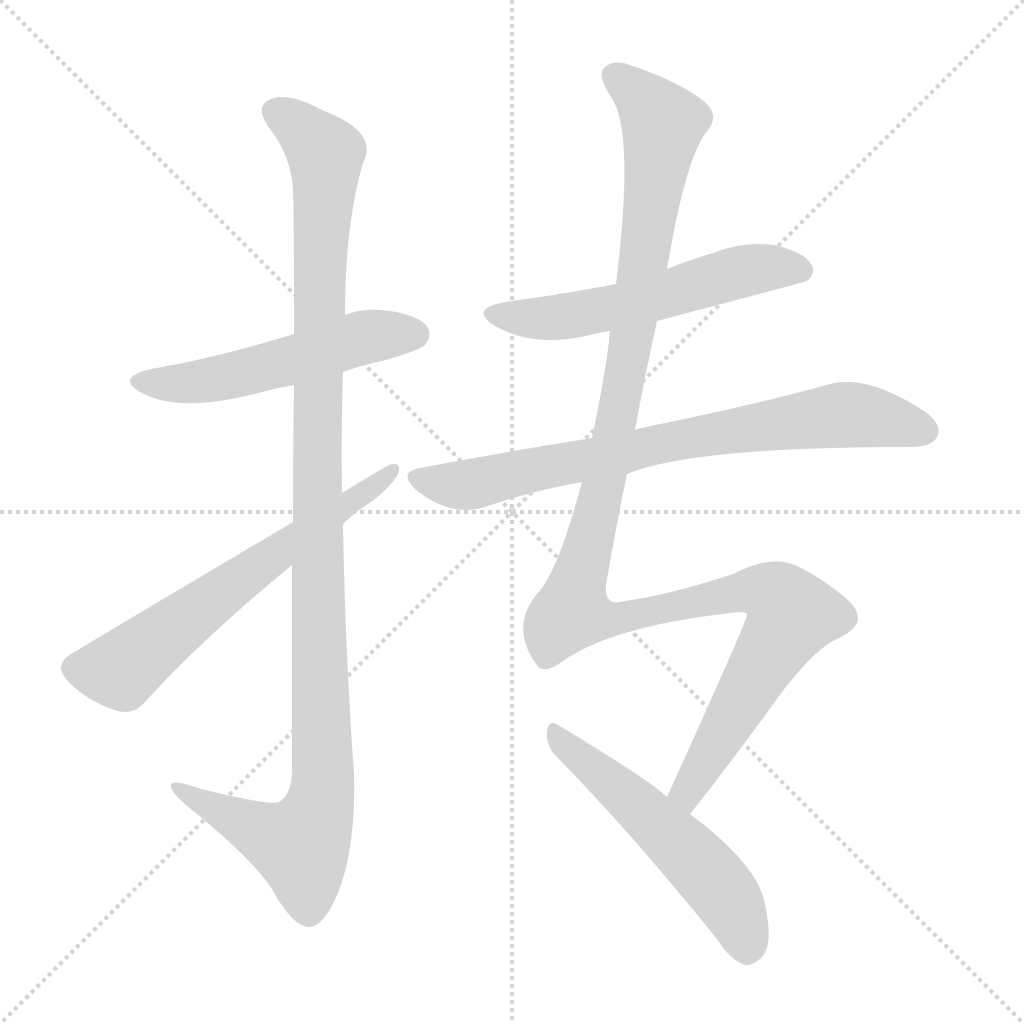
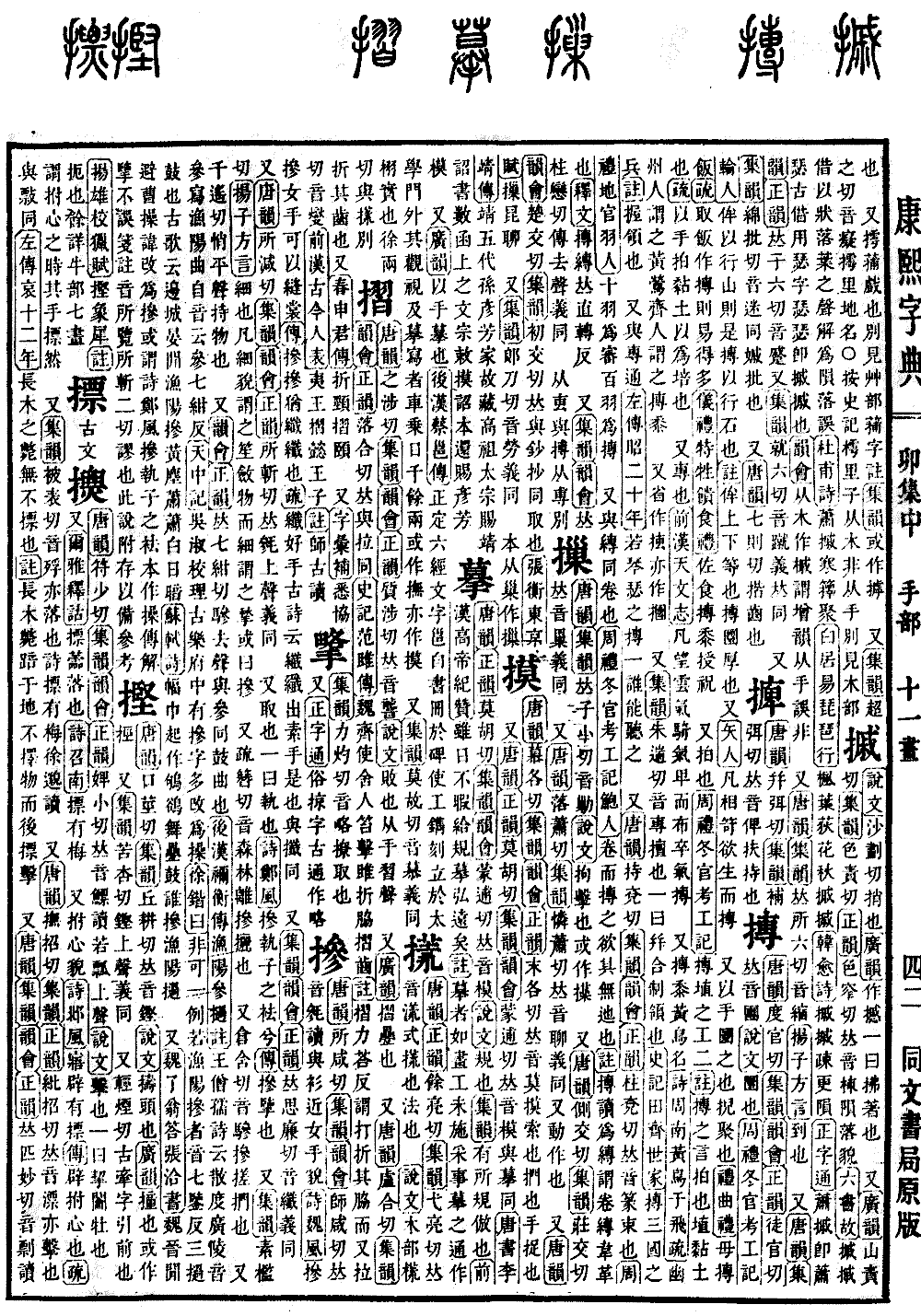
Mao Collection, Middle Volume
Radical: Hand (shǒu)
Kangxi stroke count: 15
Page 452, Entry 02
Pronounced tuan.
According to the Explaining Graphs and Analyzing Characters (Shuowen Jiezi), it means round.
In the Rites of Zhou (Zhouli), section Winter Officials, Record of Trades (Dongguan Kaogongji), it states: If they are equal in height and depth, then they are rounded and travel over stone. The commentary explains: To be equal in height and depth is to be level above and below; to be rounded is to be round and thick.
Also, in the section on Arrow Makers (Shiren): Generally, when assessing the arrow shaft, one desires it to be both fresh and round.
It also refers to rounding something with the hands, or pressing things together.
In the Book of Rites (Liji), section Summary of the Rites (Quli): Do not roll rice into a ball. The sub-commentary explains: Taking rice and rolling it into a ball allows one to get more.
In the Book of Etiquette and Ceremonial (Yili), in the section on Offering Food for a Special Sacrifice (Tesheng Kuishi Li): The assistant to the officiant rolls millet into a ball and presents it to the invoker.
It also means to pat.
In the Rites of Zhou (Zhouli), section Winter Officials, Record of Trades (Dongguan Kaogongji): There are two craftsmen who pat clay. The commentary explains: To pat means to strike. Clay refers to sticky earth. The sub-commentary explains: Using the hand to pat the sticky earth to form it.
It also means exclusive or concentrated.
In the History of the Former Han (Qian Hanshu), section Treatise on Astronomy (Tianwen Zhi): Generally, when observing clouds and vapors, if they spread along the cavalry vapor, the troop vapor is concentrated.
Also, tuan-shu is a name for the yellow bird.
In the Book of Odes (Shijing), section Odes of Zhou and the South (Zhounan), sub-section Yellow Bird (Huangniao), the commentary states: People in Youzhou call it the yellow oriole; people in Qi call it the tuan-shu.
It is also written in a simplified form. It is also written as a variant form.
Pronounced zhuan.
It means to monopolize or usurp. Another definition is to combine and control.
In the Records of the Grand Historian (Shiji), section Hereditary House of Tian Qi (Tianqi Shijia): To monopolize the armies of the three states. The commentary explains: To grasp the command.
It is also used interchangeably with the character for exclusive (zhuan).
In the Zuo Commentary (Zuozhuan), year 20 of Duke Zhao: If the strings of the zither and lute are restricted to one sound, who can listen to it?
Pronounced zhuan.
It means to bind.
In the Rites of Zhou (Zhouli), section Earth Officials, Feather Official (Yuren): Ten feathers make a shen, one hundred feathers make a tuan.
It is also the same as the character for bundle (zhuan). It also means to roll.
In the Rites of Zhou (Zhouli), section Winter Officials, Record of Trades (Dongguan Kaogongji), section on Curriers (Baoren): Roll it and bundle it, wishing it to have no unevenness. The commentary explains: Read the character as bundle (zhuan), meaning to roll and bind leather.
The explanation of texts (Shiwen) notes: The pronunciation of this bundled form is zhuan.
Pronounced zhuan (falling tone).
Meaning is the same. Composed of the element (zhuan), it is distinct from the character for strike (bo), which is composed of the element (fu).