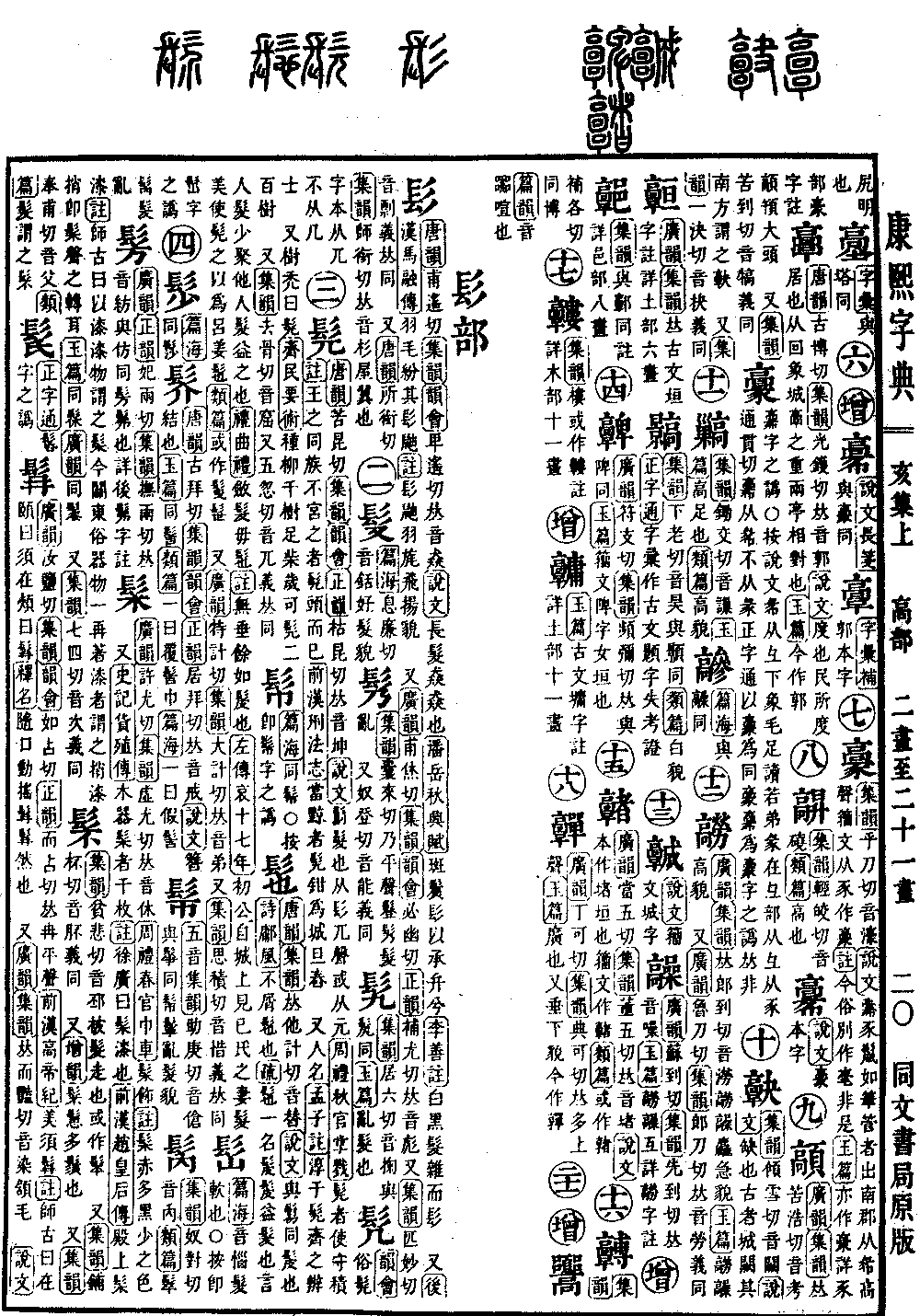
Hai Collection, Upper Volume
Radical: Long Hair (biāo)
Kangxi Strokes: 13
Page 1452, Entry 33
Pronounced ti.
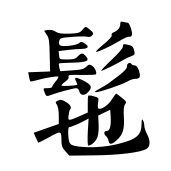
According to the Shuo Wen Jie Zi (Explaining Graphs and Analyzing Characters), this character is the same as ti. It refers to a hairpiece.
In the Book of Odes (Shijing), it is said: One does not disdain the use of a hairpiece. The commentary explains that this refers to adding hair, meaning that when a person has little hair, they collect others' hair to supplement it.
In the Book of Rites (Liji), it is said: When binding hair, do not use a hairpiece. The commentary explains: Do not let excess hair hang down like a false hairpiece.
In the Zuo Zhuan (Zuo's Commentary), under the seventeenth year of Duke Ai, it is recorded: Initially, Duke Zhuang of Wei saw from the city wall that the wife of the Shi clan had beautiful hair; he sent someone to shave her hair to make a hairpiece for Lu Jiang.
According to the Lei Pian (Categorized Dictionary), sometimes also written in a variant form (ti).
Also pronounced di.
Also pronounced xi.
The meaning remains the same.
Textual Research: In the Book of Rites (Liji), the phrase is, When binding hair, do not use a hairpiece. The commentary says, Do not let excess hair hang down like a false hairpiece. According to the original text, the word wu is used, not the word wu.