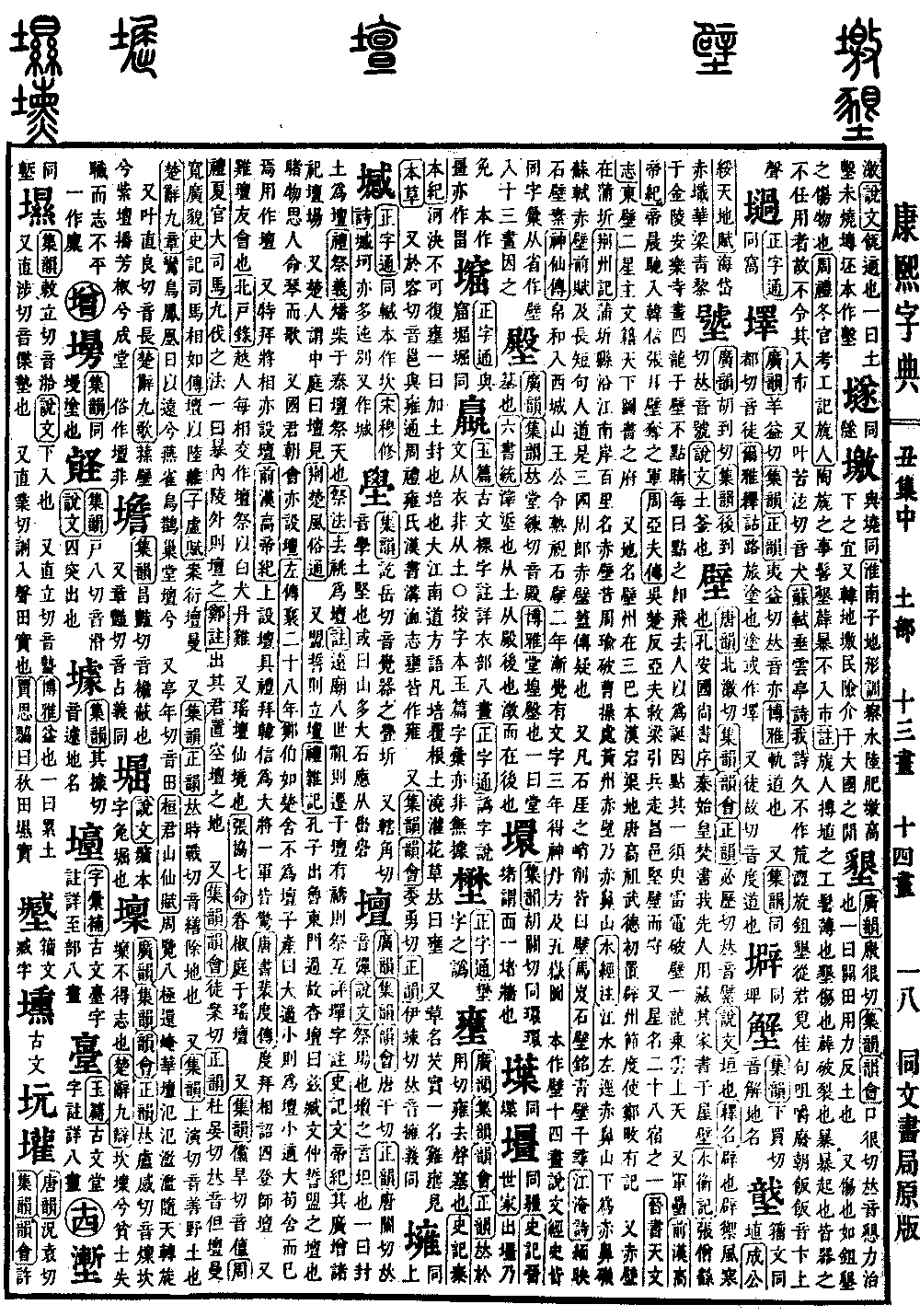
Chou Collection, Middle Volume
Radical: Earth (tǔ)
Page 240, Entry 16
Guangyun (Rhyme Dictionary of the Wide韻), Jiyun (Standard Rhymes), and Yunhui (Collection of Rhymes) state the pronunciation is tan. Zheng Yun (Correct Rhymes) states the pronunciation is tan.
According to the Shuowen (Explaining Graphs and Analyzing Characters), a site for sacrifice. To speak of a tan is to speak of a level surface. Another source says it is earth piled up to form an altar.
Book of Rites (Liji), Sacrificial Meanings: Burning wood on a great altar is for sacrificing to Heaven.
Book of Rites (Liji), Laws of Sacrifice: When ancestral temples are no longer used, one creates an altar. Commentary: When a remote ancestral temple reaches the eighth generation, the spirit is moved to an altar, and sacrifices are made there when there are prayers. See the entry for the character shan (a leveled area) for further details.
Records of the Grand Historian (Shiji), Annals of Emperor Wen: Widely increased the number of altars and ritual grounds.
Furthermore, the people of Chu call the central courtyard a tan, as seen in Jingchu Fengsu Tong (Customs of Jing and Chu).
Additionally, for oaths and alliances, an altar is erected. Book of Rites (Liji), Miscellaneous Records: When Confucius was leaving the eastern gate of Lu, he passed the old Apricot Altar and said, This is the altar where Zang Wenzhong swore an oath. Seeing the object, he thought of the man, called for his lute, and sang.
Also, feudal lords also established altars for court audiences. Zuo Commentary (Zuo Zhuan), 28th Year of Duke Xiang: The Earl of Zheng went to Chu and did not build an altar to stay; Zizhan said, When a great lord visits a smaller one, an altar is built; when a small one visits a great one, one merely stays, why build an altar?
Also, one establishes an altar specifically to appoint generals and ministers. History of the Former Han (Qian Han Shu), Annals of Emperor Gao: The Emperor established an altar and prepared the rites to appoint Han Xin as Grand General, and the entire army was astonished.
History of the Tang (Tang Shu), Biography of Pei Du: When Du was appointed minister, there was an imperial edict to ascend the military altar four times.
Also, a Chicken Altar is a meeting of friends. Beihu Lu (Records North of the Five Ridges): When the Yue people make alliances, they build an altar and sacrifice a white dog and a red chicken.
Also, a Jade Altar is a celestial realm. Zhang Xie, Seven Commands: Looking upon the pepper-walled court at the Jade Altar.
Jiyun (Standard Rhymes) states the pronunciation is tan. Zhou Li (Rites of Zhou), Summer Ministry, Great Marshal: The method of the nine punitive expeditions. One is called to punish those who are violent internally and insulting externally, so one makes an altar. Zheng Commentary: Force their ruler out and place them in the space of an empty altar.
Jiyun (Standard Rhymes) and Yunhui (Collection of Rhymes) state the pronunciation is dan. Tan-man refers to a broad and vast appearance. Records of the Grand Historian (Shiji), Biography of Sima Xiangru: The altar is magnificent. Zixu Fu (Rhapsody of Master Nothingness): Spacious and vast.
Jiyun (Standard Rhymes) and Zheng Yun (Correct Rhymes) state the pronunciation is shan. To clear the ground.
Jiyun (Standard Rhymes) states the pronunciation is shan. Wild earth. Chu Ci (Songs of Chu), Nine Chapters: The luan birds and phoenixes are becoming more distant every day; swallows, sparrows, crows, and magpies nest in the halls and on the altars.
Also pronounced tian. Huan Junshan, Rhapsody on Immortals: Observing the eight poles, returning to the Yan mountain and the Flower Altar. Floating and drifting, following the turning of the heavens.
Also rhymes with chang. Chu Ci (Songs of Chu), Nine Songs: Fragrant walls of sun-grass and purple altars, scattering fragrant pepper to form a hall. The common form is an error. The character tan is written with the component for face, not the component for make.