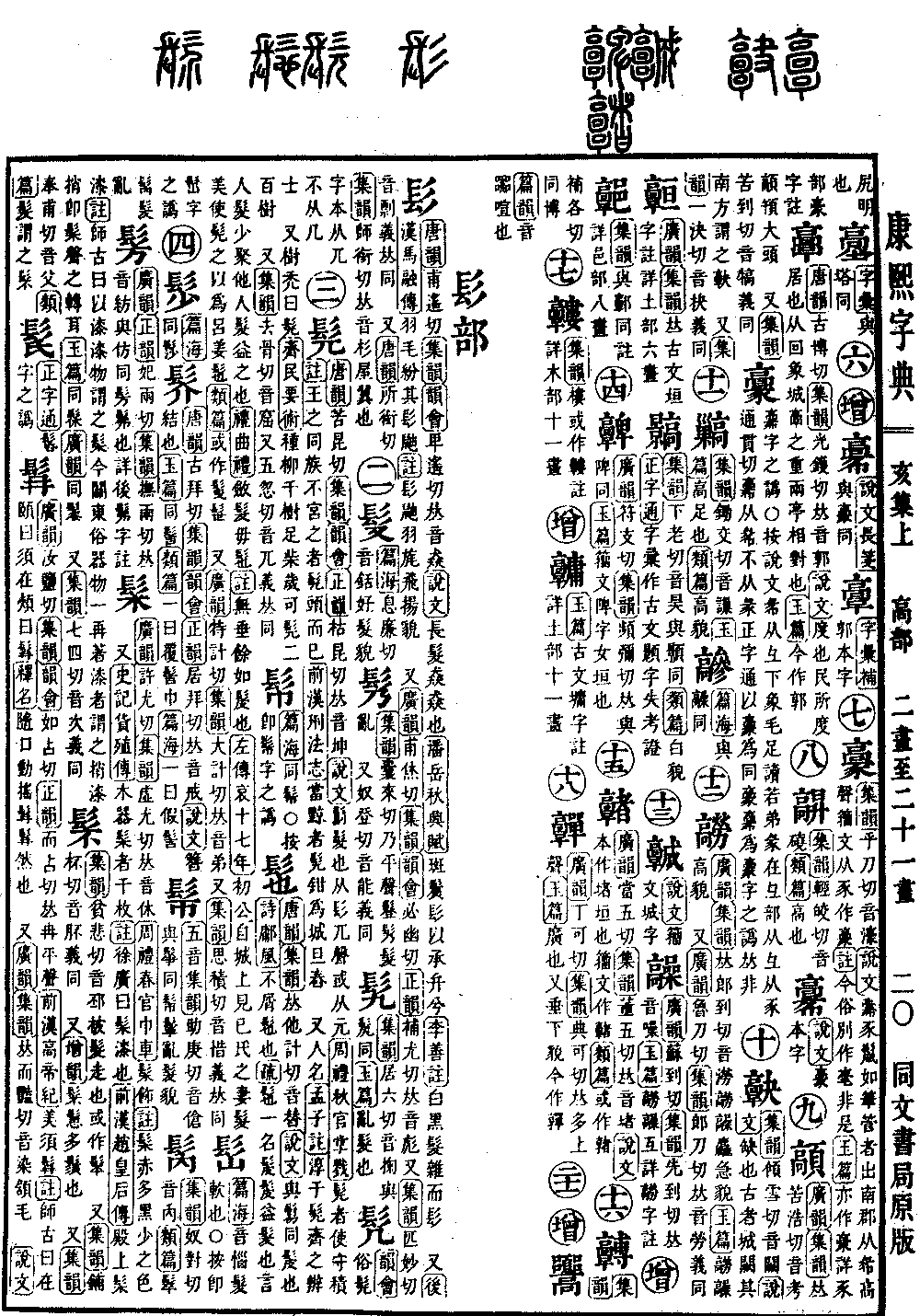
Hai Collection, Upper Volume
Radical: Hair (biāo)
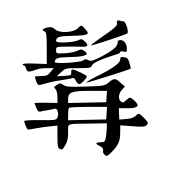
Entry: Ran
Kangxi Stroke Count: 14
Page 1452, Entry 43
According to the Extensive Rhymes (Guangyun), the Collected Rhymes (Jiyun), and the Rhyme Compilation (Yunhui), it is pronounced ran (level tone).
In the History of the Former Han (Qianhan shu), Biography of Emperor Gao, it says: Having a beautiful beard and whiskers. The commentary by Yan Shigu states: That which is on the chin is called a beard, while that which is on the cheeks is called a whisker.
According to the Explanations of Names (Shiming), it describes the appearance of hair that moves along with the motion of the mouth.
Also, according to the Extensive Rhymes (Guangyun) and the Collected Rhymes (Jiyun), it is pronounced ran (falling tone), which is the same sound as dye. It refers to the hair on the chin.
According to the Explanation of Simple and Compound Characters (Shuowen), this character refers to the whiskers on the cheeks.
Note: The modern common form written as ran is incorrect.