Zi Collection, Middle Volume
Radical: Person (rén)
Shi; Kangxi stroke count: 5; Page: Page 92, number 07
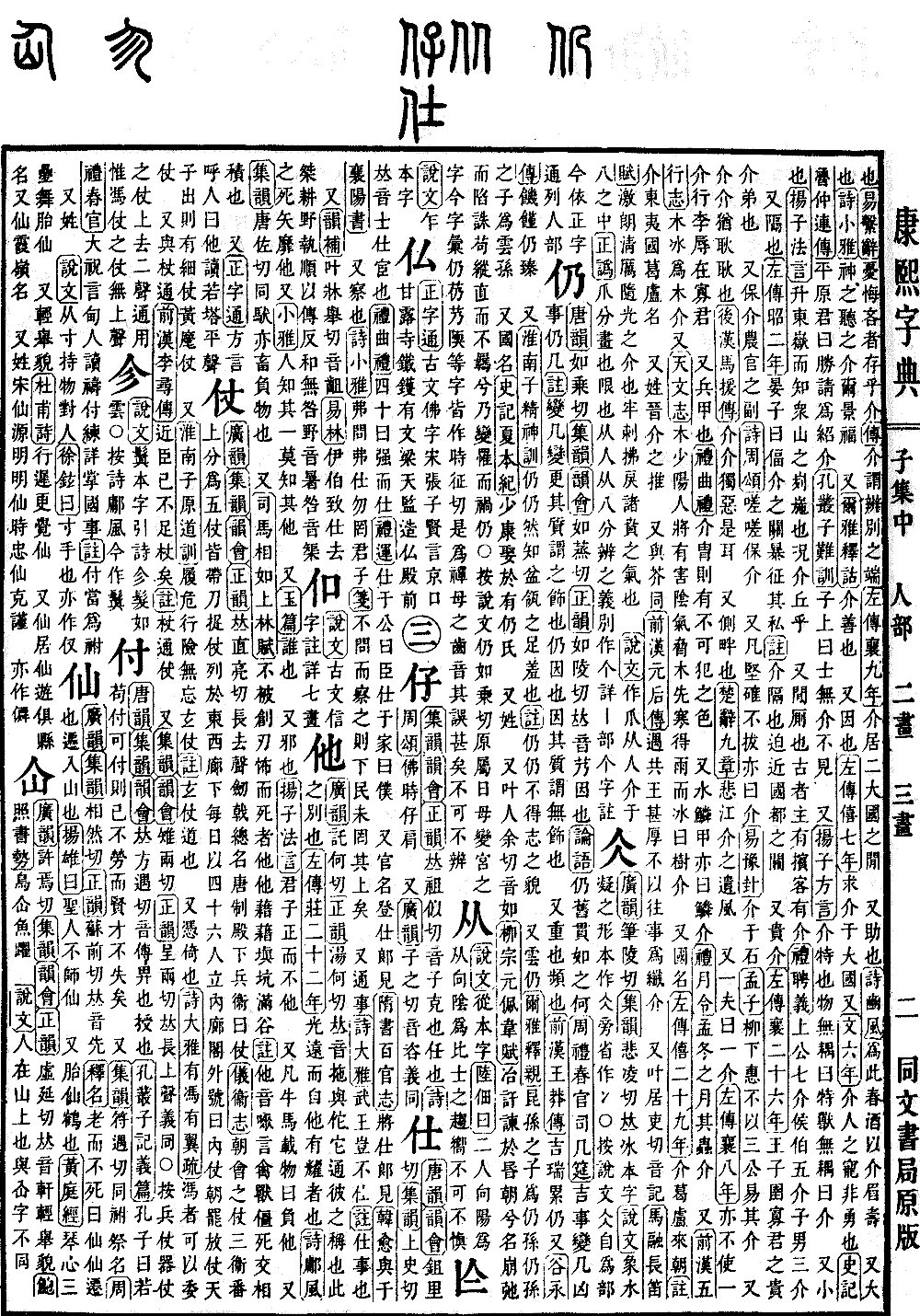
Tang Rhymes (Tangyun) and Rhyme Collection (Yunhui) provide the fanqie phonetic notation as a combination of the sounds chu and li. Collected Rhymes (Jiyun) provides the fanqie as a combination of shang and shi. The pronunciation is the same as the character shi. It refers to serving as an official or holding office. The Book of Rites (Liji) states in the Quli section that at age forty, one is described as strong and robust and may enter government service. The Liyun section of the Book of Rites states that one who serves in a public household is called a minister (chén), and one who serves in a private household is called a servant (pú). It is also used as a title for officials. For example, Gentleman for Rendering Service (dengshilang) is found in the History of Sui (Suishu), Treatise on Officials. Gentleman for Managing Affairs (jiangshilang) is found in Han Yu’s Letter to Yu of Xiangyang. It also carries the meaning of to investigate or examine. The Book of Odes (Shijing) states in the Xiaoya section that if one does not inquire and does not investigate, one should not deceive the gentleman. The commentary notes that if investigation is preceded by inquiry, then the people will not deceive their superiors. It is also interchangeable with the character for work or affairs (shi). The Book of Odes states in the Daya section: Did King Wu not perform his duties? The annotation explains that shi means to perform work. In the Rhyme Supplement (Yunbu), the rhyming pronunciation is given as the fanqie combination of chuang and ju, sounding like the character ju. The Forest of Changes (Yilin) states that Yi Bo resigned from office and retired, leaving the tyrant Jie of Xia to farm in the fields; by maintaining harmony to ensure continuity, he returned to a state of peace without fault. In this specific rhyme scheme, the word for field (ye) is pronounced like the word for heat (shu), and the word for fault (jiu) is pronounced like the word for carpenter’s square (ju).