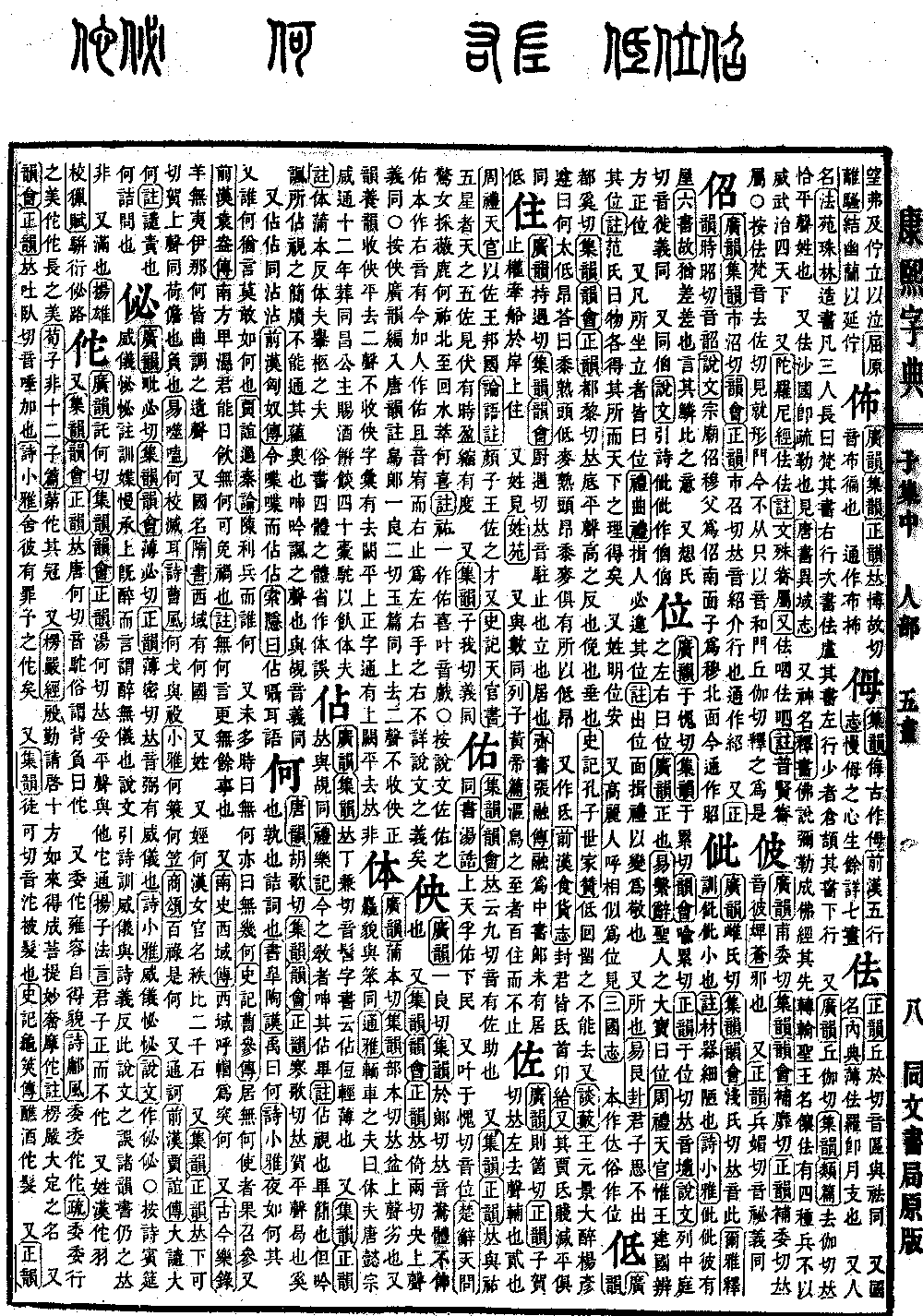
Zi Collection, Middle Volume. Radical: Person (rén). qiū. Kangxi Strokes: 7. Page 98, Position 03. Rhymes of Correct Diction (Zhengyun) records the pronunciation as qiū-yū-qiè, the same sound as qū. It has the same meaning as the character qū (to dispel). It also refers to the name of a country. The Buddhist Canon (Neidian) records Boqiuluo, which is the Yuezhi country. It is also used as a personal name. The Forest of Gems in the Garden of the Law (Fayuan Zhulin) records that there were three individuals who created writing. The eldest was Brahma (Fan), whose writing was written from right to left. The next creator of writing was Kharosthi (Qiulu), whose writing was written from left to right. The youngest was Cangjie, whose writing was written from top to bottom. Broad Rimes (Guangyun) records the pronunciation as qiū-jiā-qiè. Collected Rimes (Jiyun) and Classified Chapters (Leipian) record the pronunciation as qù-jiā-qiè, having the same sound as the level tone of qià. It is used as a surname. It also refers to the country of Qiusha, which is the country of Shule, as seen in the History of Tang: Records of Foreign Lands (Tangshu Yiyuzhi). It also refers to the name of a deity. According to the Buddhist text Sutra on Maitreya Achieving Buddhahood (Mille Chengfo Jing), the previous incarnation of Maitreya Buddha was a Universal Monarch named Rangqiu (Sankha). He possessed four types of military forces but governed the four quarters of the world without using force or intimidation. Furthermore, the Dharani Sutra (Tuoluoni Jing) contains the phrase qiū-qiū, which a note identifies as the attendants of the Bodhisattva Manjusri. It also contains the phrase qiū-xì-qiū-xì, which a note identifies as the attendants of the Bodhisattva Samantabhadra. Note: Regarding the character qiū, its pronunciation in Sanskrit (Fanwen) is qù-zuǒ-qiè according to the Jiuxingmen classification. This pronunciation is not followed here; the character is correctly explained only by the sound qiū-jiā-qiè.