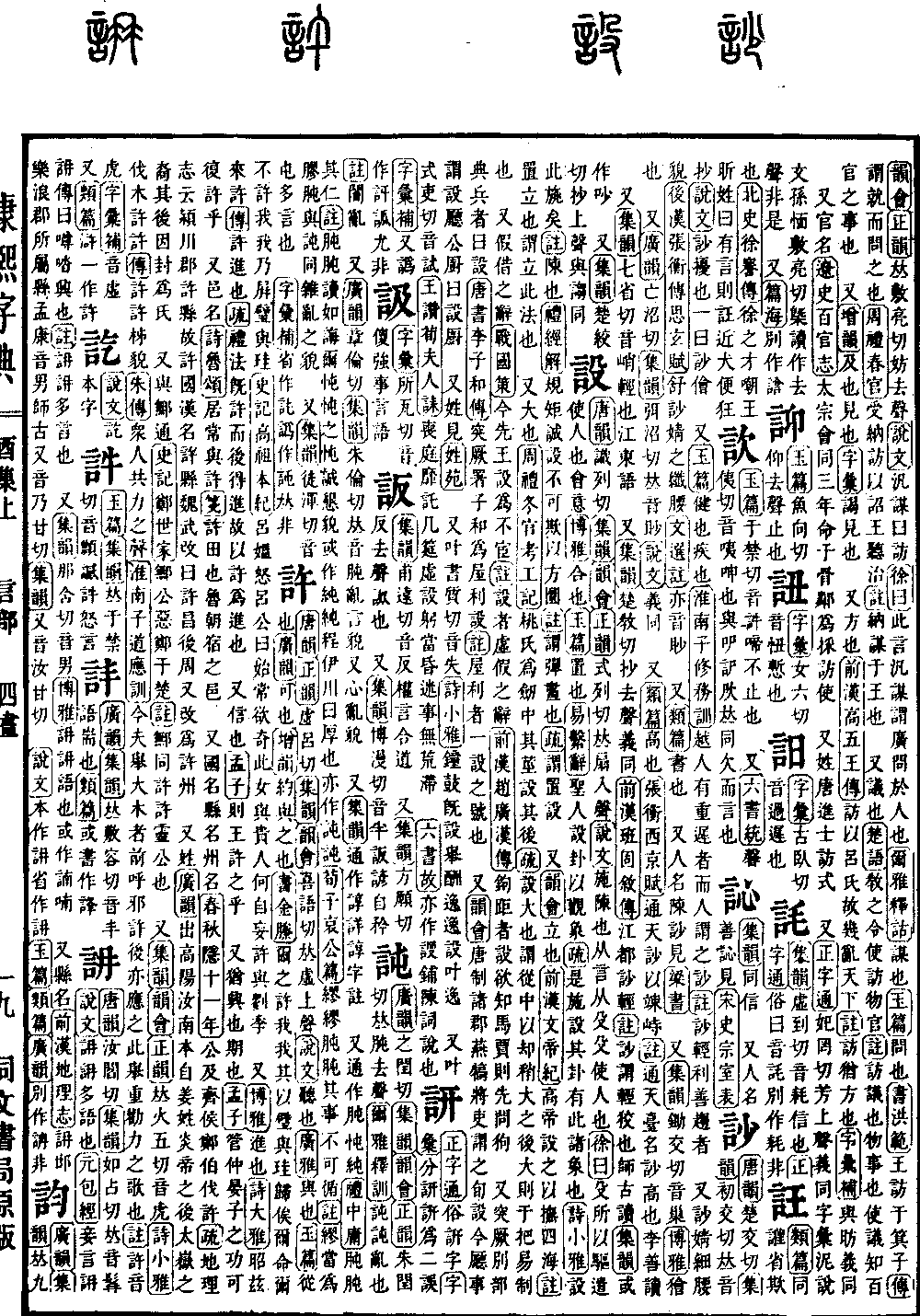
You Collection, Upper Volume
Radical: Speech (yán)
Kangxi Strokes: 11
Page 1151, Entry 01
Pronounced she.
Shuowen Jiezi (Explaining Single-component Characters and Analyzing Compound Characters): To set up or to implement. Composed of the radicals for speech and a weapon (shu). The component shu implies driving or sending a person. Xu Shen noted: The weapon (shu) is used to drive or send people. It is an ideogram.
Guangya (Expanded Glossaries): To join or to gather.
Yupian (Jade Chapters): To place or to arrange.
Book of Changes (Yijing), Commentary on the Appended Phrases: The sages set up the trigrams to observe the images. Commentary: This means to arrange the trigrams to display these various images.
Book of Odes (Shijing), Lesser Odes: Set up this banner. Commentary: To display.
Book of Rites (Liji), Classics Explained: Once the compass and square are correctly set, one cannot be deceived regarding roundness or squareness. Commentary: Refers to marking with an ink line. Commentary: Refers to setting up or arranging.
Also: To establish.
History of the Former Han (Hanshu), Annals of Emperor Wen: Emperor Gaozu established this to pacify the four seas. Commentary: To set up or establish; this refers to establishing this law.
Also: To be large.
Rites of Zhou (Zhouli), Winter Bureau, Records of Tradesmen: The Taoshi clan makes swords, centering the handle and making the rear part large. Commentary: She means large. It refers to starting from the center and gradually expanding towards the rear; being large makes it easier to handle and control.
Also: A term for a hypothetical or false premise.
Strategies of the Warring States (Zhanguoce): Now, sir, you pose a hypothetical situation about not holding office. Commentary: She is a term for a false or hypothetical statement.
History of the Former Han (Hanshu), Biography of Zhao Guanghan: The hook-and-trap method—for example, if one wants to know the price of a horse, one first asks about the price of a dog.
Also: A title for commanders of special detachments among the Tujue (Turkic) people.
Book of Tang (Tangshu), Biography of Li Zihe: The Tujue appointed Zihe as Wuli She. Commentary: Wuli is the specific title of this She.
Also: In Tang dynasty regulations, feasts provided for officials in the various prefectures were called xunshe; in contemporary usage, it is simply called she, and the official kitchen is called shechu.
Also: A surname, appearing in the Xingyuan (Garden of Surnames).
Also: Rhyming with zhi, pronounced shi.
Book of Odes (Shijing), Lesser Odes: The bells and drums have been arranged, the toasts are offered in leisurely succession. She rhymes with yi.
Also: Rhyming with li, pronounced shi.
Wang Zan, Eulogy for Lady Xun: The mourning hall has nothing to rely upon, the ritual mats are set in vain. Personally encountering confusion, there is no negligence in affairs.
Liushu Gu (Origins of the Six Writings): Also written as the character for speech. It means to spread words or to explain.
Verification: In Strategies of the Warring States, the original text says "sir" (xiansheng), which has been corrected from "former king" (xianwang).