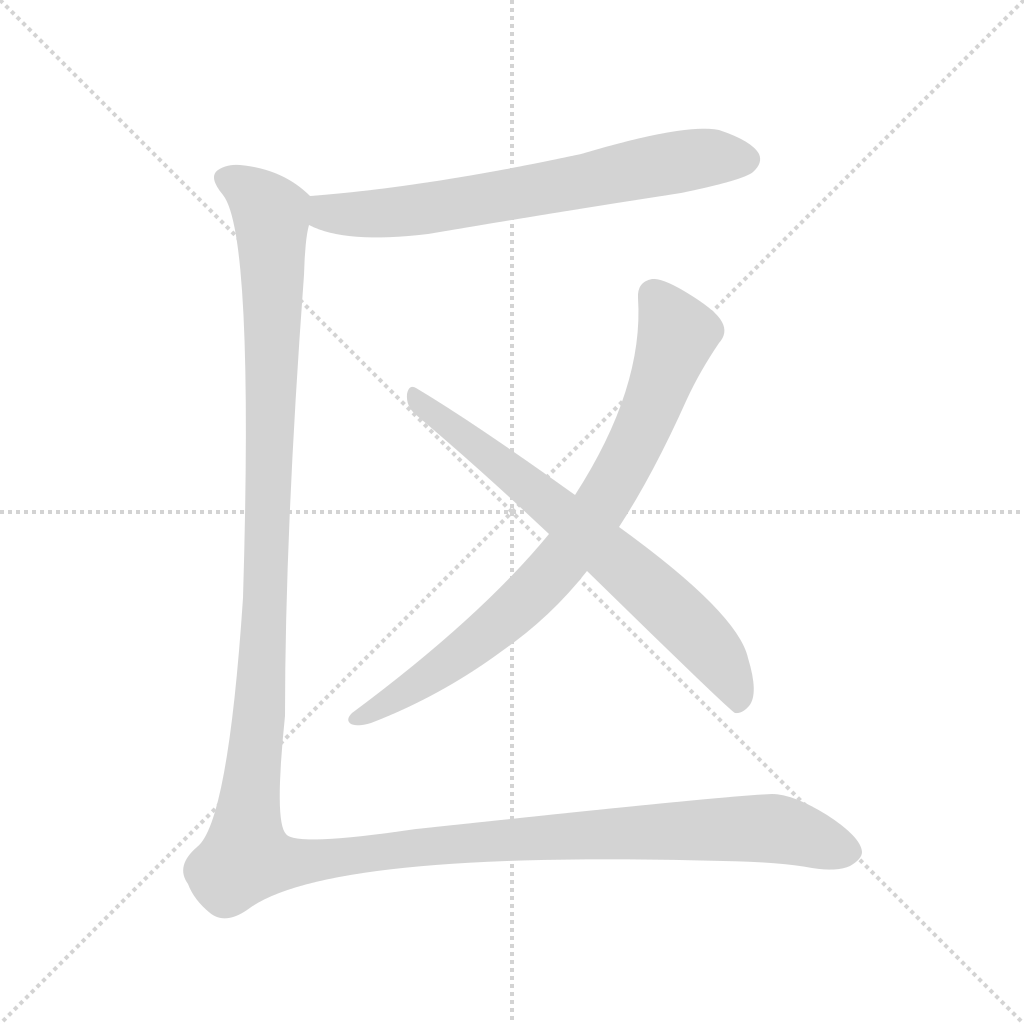
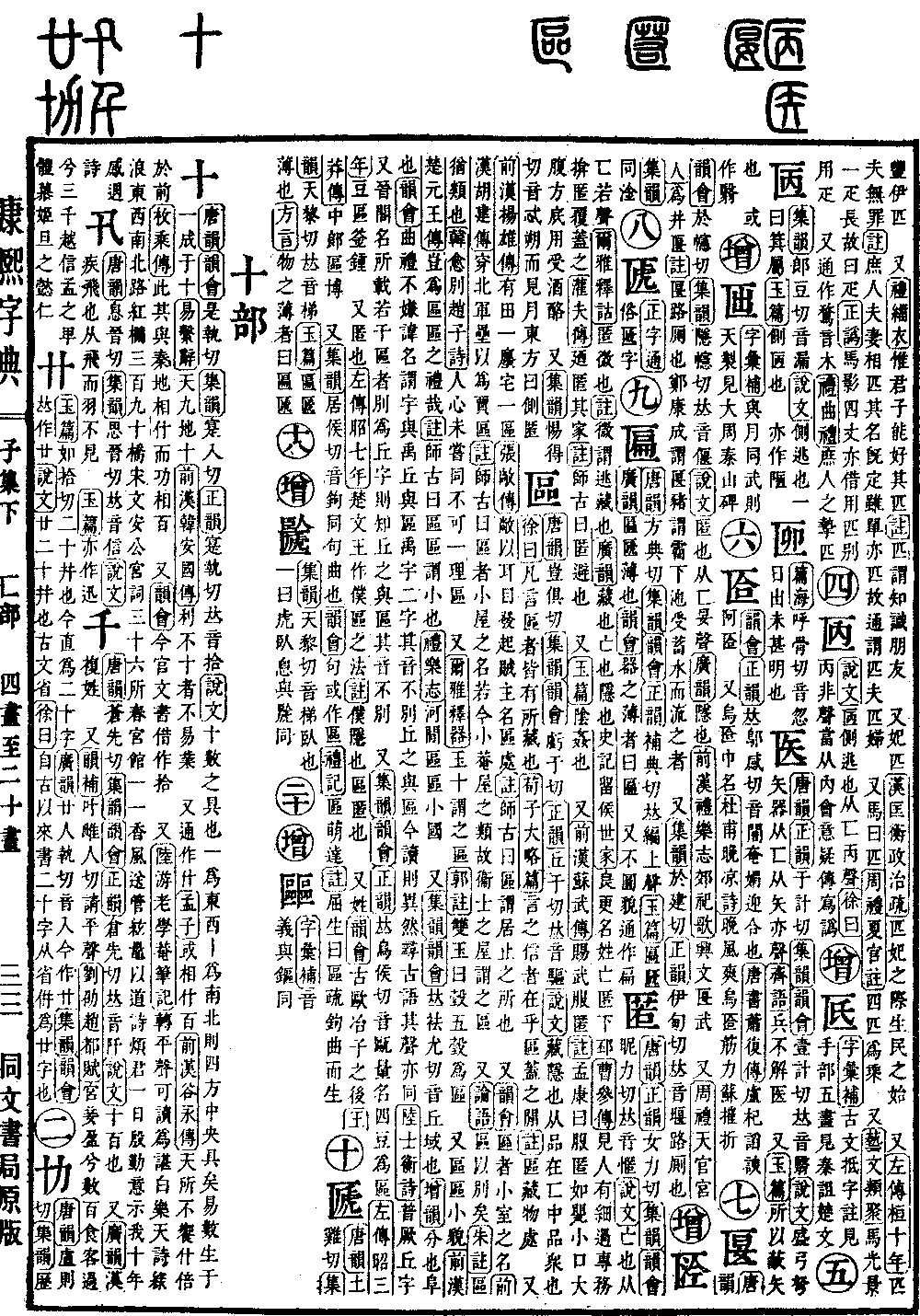
Zi Collection, Page Position: Lower. Radical: Hiding (xi). Qu. Kangxi strokes: 11. Page 155, Position 00.
In the Tang Rhymes (Tangyun), the reading is given as the fanqie pronunciation of the characters qi and ju. In the Collected Rhymes (Jiyun) and the Rhyme Assembly (Yunhui), the reading is given as the fanqie of kui and yu. In the Correct Rhymes (Zhengyun), it is the fanqie of qiu and yu. It has the same pronunciation as the character qu, meaning to drive.
The Analytical Dictionary of Characters (Shuowen Jiezi) explains the character as meaning to hide or to conceal. The character form is composed of the element for numerous items (pin) placed inside the radical for hiding (xi).
The scholar Xu Kai notes that generally, any context referring to qu contains the meaning of concealment.
Trustworthy speech lies in being able to distinguish between clear words and concealment — Xunzi (Xunzi), Great Outlines (Dalue) chapter. The commentary states that qu refers to a place where things are hidden.
Furthermore, it is recorded that one may have a small plot of land and a single dwelling (qu) — History of the Former Han (Qian Hanshu), Biography of Yang Xiong (Yang Xiong zhuan).
The Biography of Zhang Chang (Zhang Chang zhuan) states that Zhang Chang used informants and clues to track down the leader of the thieves and identified his dwelling place. The commentator Yan Shigu notes that qu refers to a place of residence.
Additionally, the Rhyme Assembly explains that qu is a name for a small room.
It is recorded that walls were cut through the northern army camp to establish small stalls (qu) for commerce — History of the Former Han, Biography of Hu Jian (Hu Jian zhuan). Yan Shigu notes that qu is the name for a small hut, similar to a small hermitage (an) today. Therefore, the huts used by guards are called qu.
They are distinguished by categories (qu) — Analects (Lunyu). The commentary by Zhu Xi notes that qu is used here to mean a category.
Human hearts have never been identical and cannot be categorized by a single principle — Han Yu, Poem for Parting with Zhao Zi (Bie Zhao Zi shi).
Ten pieces of jade are called a qu — Erya (Erya), Explaining Implements (Shiqi). The commentator Guo Pu notes that a pair of jades is called a jue, and five jue make one qu.
The term ququ describes something minute or insignificant.
Could it be for the sake of such a tiny (ququ) ritual? — History of the Former Han, Biography of King Yuan of Chu (Chu Yuanwang zhuan). Yan Shigu notes that ququ means small.
Hejian is a tiny (ququ) small state — Book of Rites (Liji), Records of Music (Yuezhi).
The Collected Rhymes and Rhyme Assembly also provide a reading similar to qiu, meaning a region or area.
The Supplemented Rhymes (Zengyun) explains it as a division or an earthen hill.
The Rhyme Assembly mentions that the Summary of Rituals (Quli) section of the Book of Rites states one does not need to avoid using homophones, such as yu and yu, or qiu and qu. There is no difference in the pronunciation of those two yu characters. Although qiu and qu have different pronunciations today, an investigation of ancient speech shows their sounds were originally the same.
A poem by Lu Shiheng contains the line: Pervading that hill and universe.
Furthermore, records of building names from the Jin Dynasty write certain instances of qu using the character for hill (qiu), showing that there was no difference in the ancient pronunciation of these characters.
The Collected Rhymes, Rhyme Assembly, and Correct Rhymes also provide a reading similar to ou, referring to a name for a measuring vessel. Four dou make one qu.
The dou, the qu, the fu, and the zhong — Zuo Commentary (Zuozhuan), Third Year of Duke Zhao.
The character also means concealment.
King Wen of Chu established the Law of Puju — Zuo Commentary, Seventh Year of Duke Zhao. The commentary explains that pu means to hide and qu means to conceal.
It is also a surname.
The Rhyme Assembly records it as the lineage of the descendants of the ancient swordsmith Ou Yezi.
The Biography of Wang Mang (Wang Mang zhuan) mentions a Palace Attendant named Qu Bo.
The Collected Rhymes also gives a reading similar to gou. It is synonymous with the character for hook (ju), meaning curved.
The Rhyme Assembly states that the character for hook is sometimes written as qu.
Curving (qu) sprouts emerge — Book of Rites. The commentary notes that growing in a curved manner is called qu. The sub-commentary states this refers to growing curved like a hook.