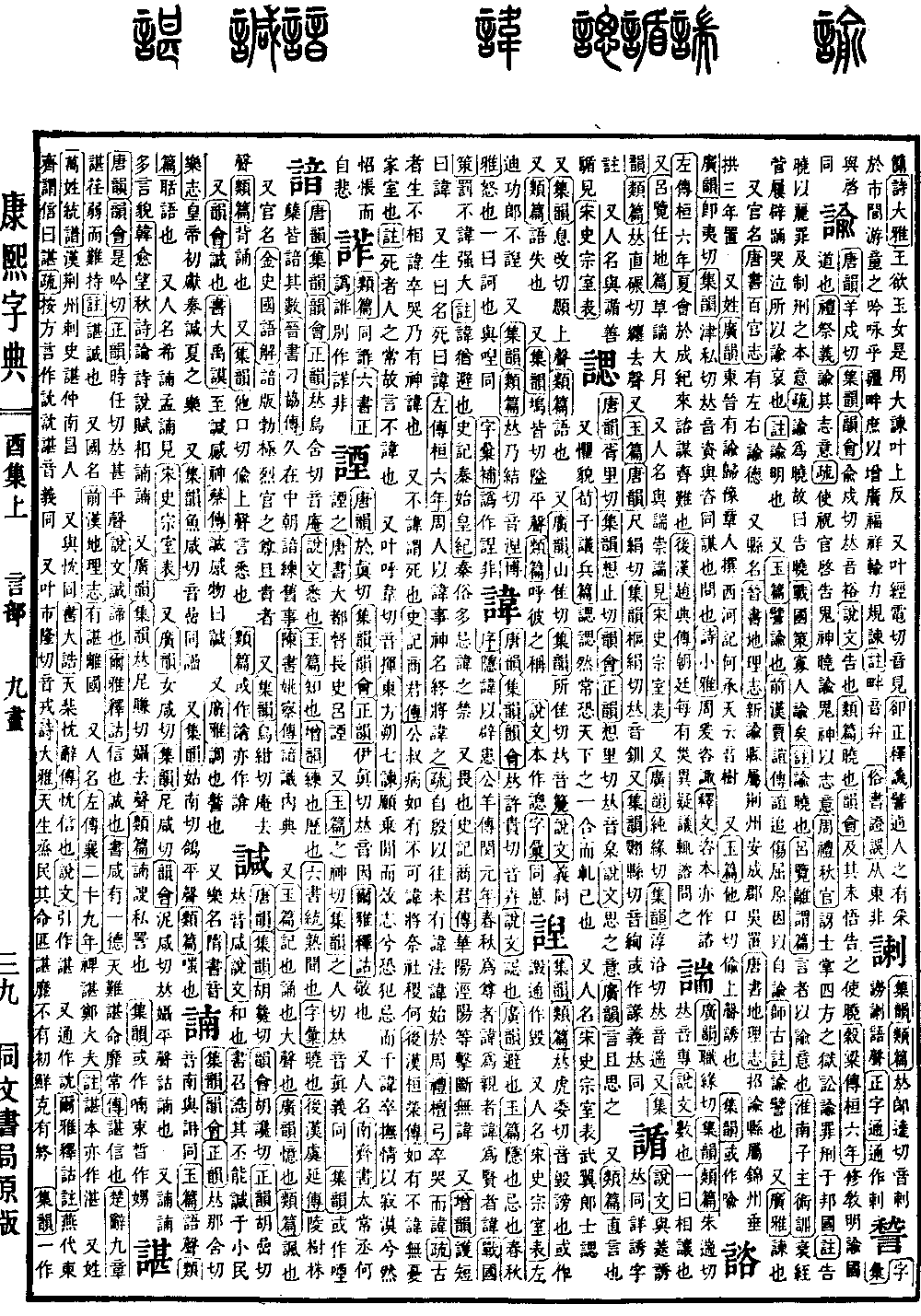
You Collection, Upper Volume
Radical: Speech (yán)
Kangxi Strokes: 16
Page 1171, Entry 15
Pronounced shen (level tone).
According to the Explaining Graphs and Analyzing Characters (Shuowen Jiezi), it means sincere or cautious.
According to the Er’ya (Erya), a dictionary of definitions, it carries the meaning of belief and sincerity.
In the Book of Documents (Shangshu), specifically the chapter on Virtue, it is said that the mandate of heaven is difficult to rely upon, as fate is impermanent. The commentary notes that this word signifies belief.
In the Verses of Chu (Chuci), in the Nine Chapters (Jiuzhang), it refers to the heart being truly weak and difficult to restrain. The commentary explains that it means sincerity.
It also refers to the name of a state. According to the Book of Han (Hanshu), specifically the Geography Treatise, there was a state called Shenli.
It is also used as a name. In the Zuo Tradition (Zuo Zhuan), under the twenty-ninth year of Duke Xiang, it refers to Pi Chen, a grandee of the state of Zheng. The commentary notes that this character is sometimes written in a variant form (zhàn).
It also serves as a surname. According to the Universal Genealogy (Wanxing Tongpu), Chen Zhong was an inspector of Jingzhou during the Han dynasty, a native of Nanchang.
It is the same as the character for sincerity (chén). In the Book of Documents (Shangshu), in the Great Announcement (Dagao), it speaks of heaven assisting the words of one who is truthful. The commentary notes that this refers to belief. The Explaining Graphs and Analyzing Characters (Shuowen Jiezi) cites this as the current character.
It is also interchangeable with a variant form (chén). According to the commentary on the Er’ya (Erya), in the regions of Yan, Dai, and eastern Qi, belief is referred to by this character. The sub-commentary notes that the Regional Expressions (Fangyan) writes it as a variant form (chén), and that both characters share the same pronunciation and meaning.
It also has a rhyme-group pronunciation similar to rong. In the Book of Odes (Shijing), in the Greater Odes (Daya), it is written that heaven gave birth to the masses, but its mandate cannot be truly relied upon. There is no one who does not have a good start, but few can persist until the end.
According to the Collection of Rhymes (Jiyun), it is sometimes also written in a variant form (shèn).