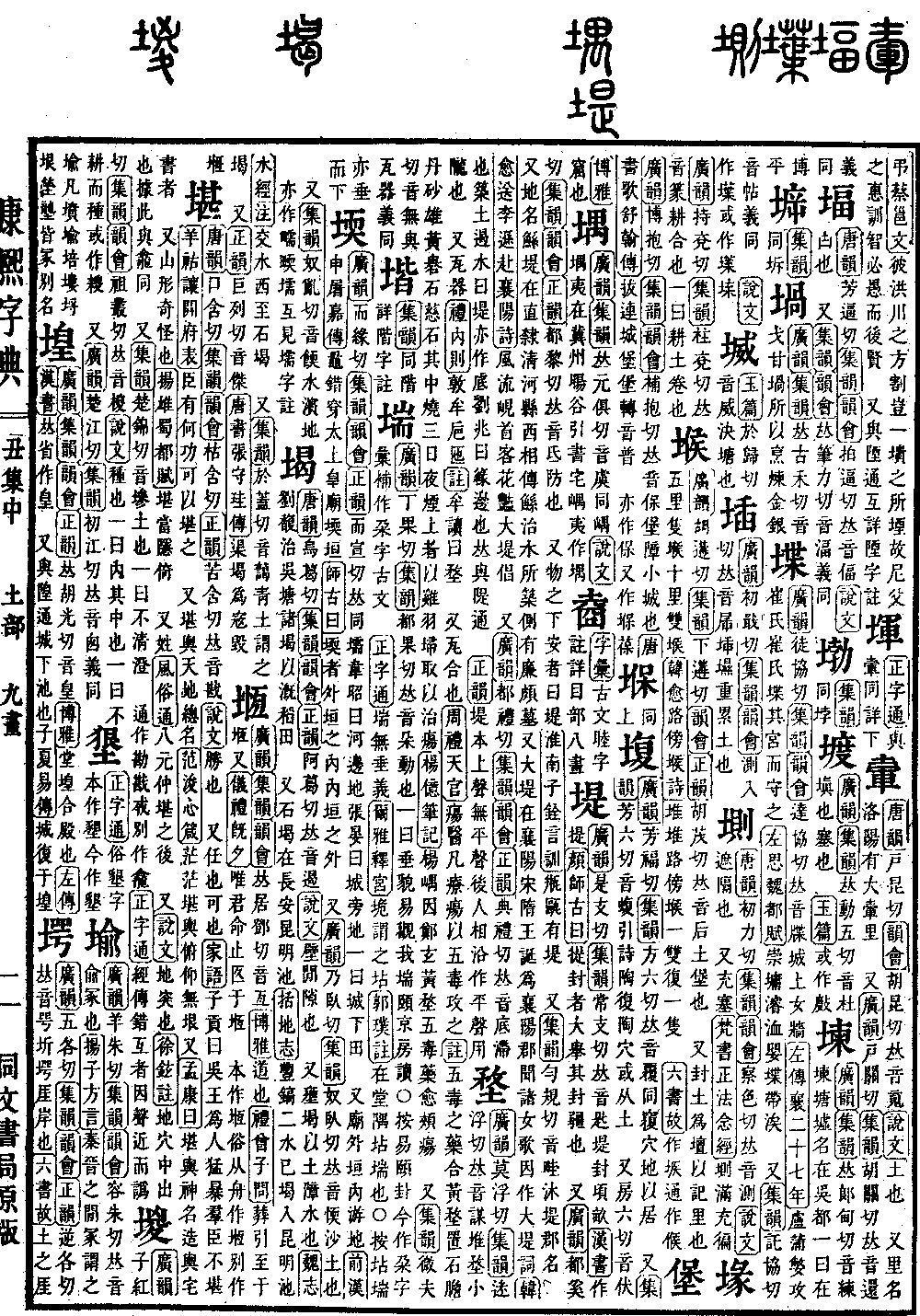
Chou Collection, Middle Volume
Radical: Earth (tǔ)
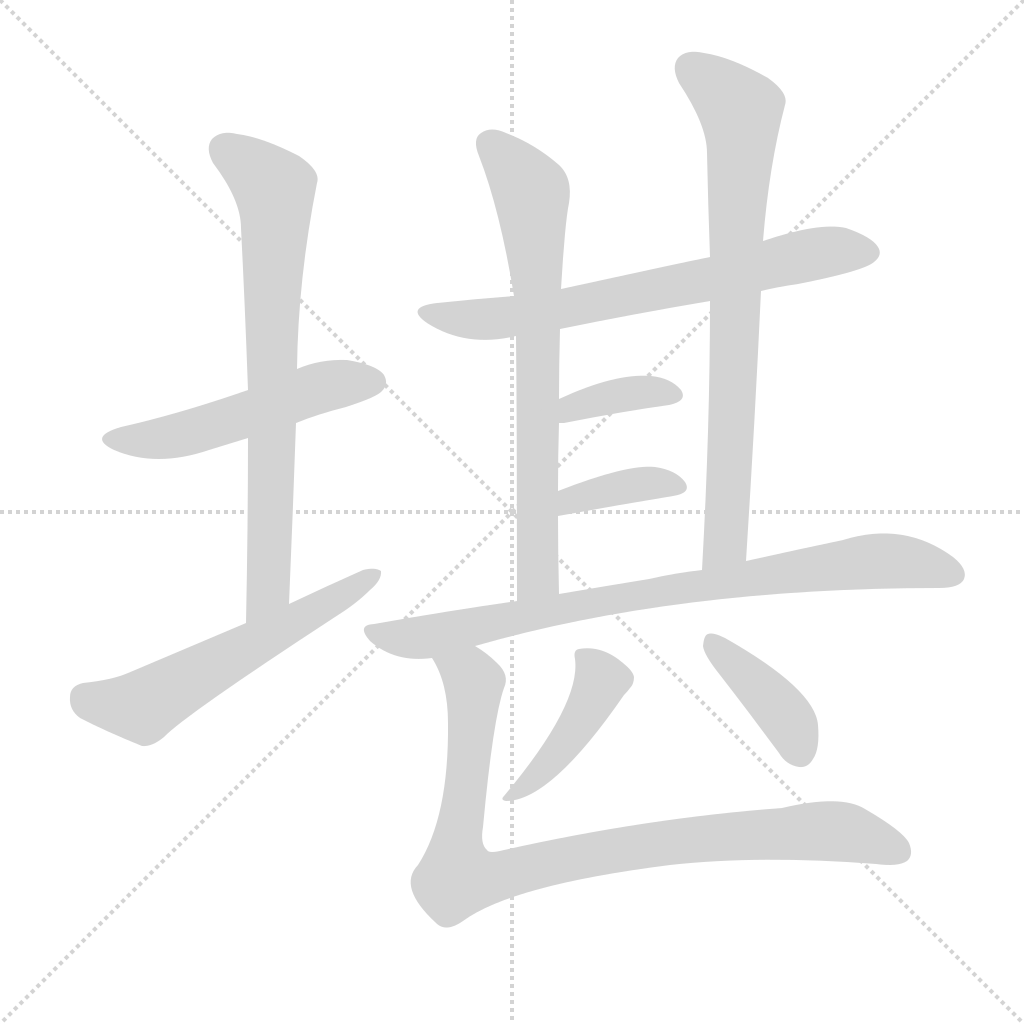
Entry: kan
Kangxi stroke count: 12
Page 233, Entry 27
Pronounced kan.
According to the Explaining Graphs and Analyzing Characters (Shuowen Jiezi), it means to overcome. It also means to sustain or to be capable of.
From the School Sayings of Confucius (Kongzi Jiayu): Zigong said, The King of Wu is violent by nature, and his subjects cannot endure it.
From the Petition to Decline the Opening of a Prefectural Office by Yang Hu: What merit do I possess that I could be equal to this?
It also refers to Kanyu, a general term for heaven and earth.
From the Heart Admonition by Fan Jun: The vastness of heaven and earth, looking up and down without limit.
According to Meng Kang, Kanyu is the name of a deity who created the books on site selection for dwellings and tombs.
It also refers to strange and unusual mountain formations.
From the Shu Capital Rhapsody by Yang Xiong: The mountains stand firm and lean against one another.
It is also a surname.
According to the Comprehensive Customs (Fengsu Tong), it refers to the descendants of Zhong Kan of the Eight Exemplary Ones.
According to the Explaining Graphs and Analyzing Characters (Shuowen Jiezi), it is the bulging of earth.
According to the commentary by Xu Xuan, it refers to something emerging from a hole in the ground; based on this, it is identical to the character for a shrine or niche.
According to the Collection of Rhymes (Jiyun), it is also pronounced chen (third tone), meaning earth. One source says it means not clear or transparent. It is used interchangeably with the characters for to investigate or to overcome. It is sometimes written as a variant form for a niche.
According to the Guide to Standard Characters (Zhengzitong), the interchangeable use of these terms in classical texts is due to errors arising from similar pronunciations.