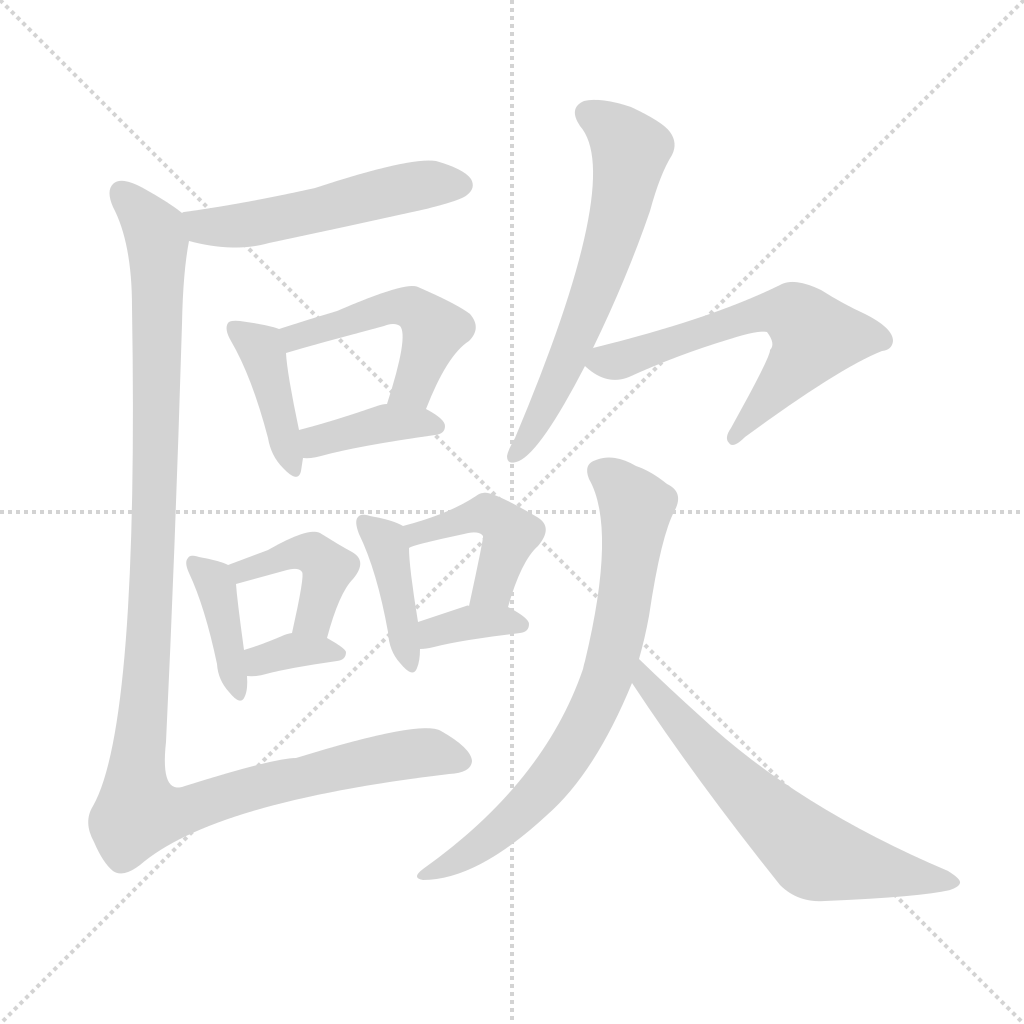
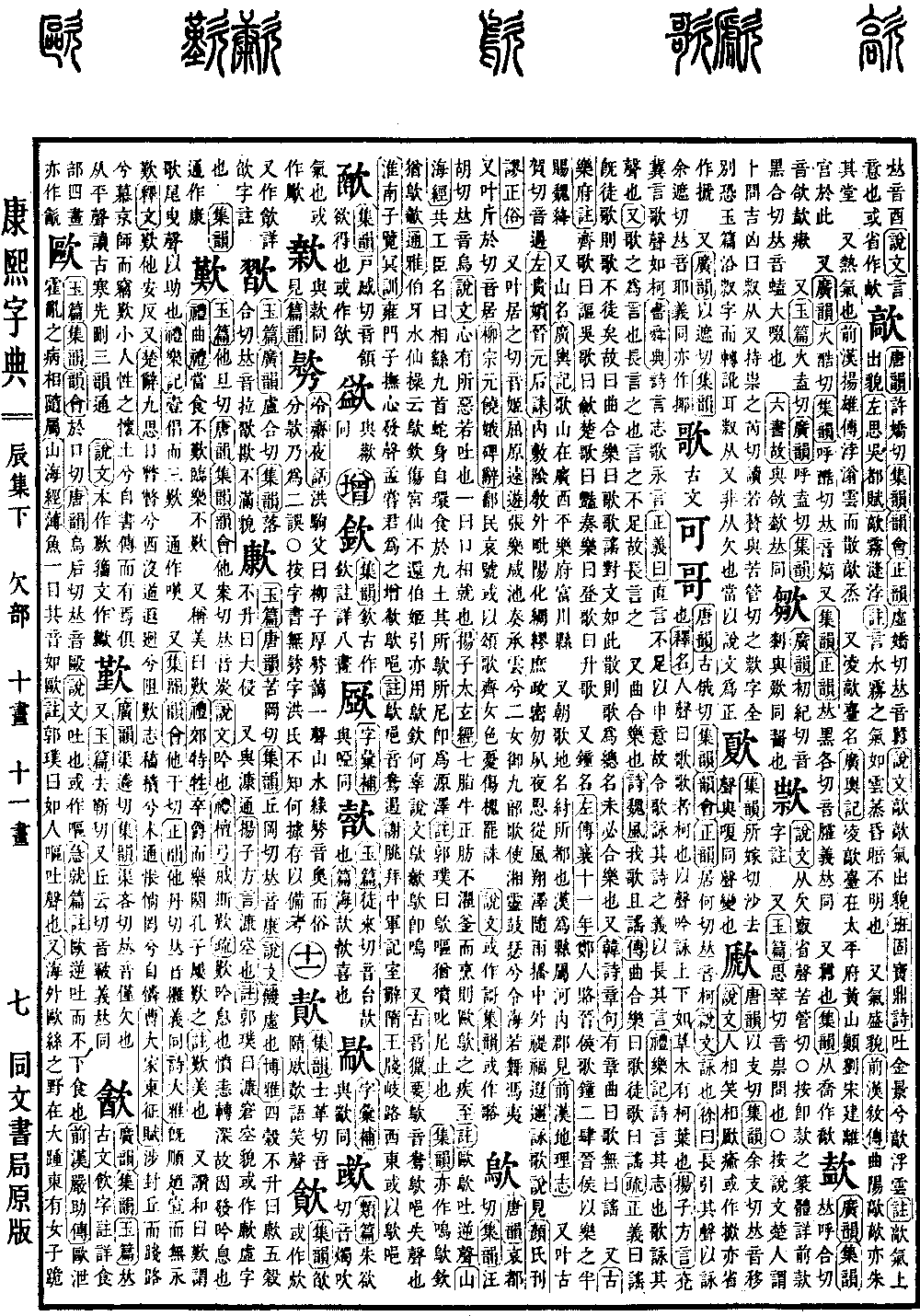
Chen Collection, Lower Volume
Radical: Lack (qiàn)
Kangxi strokes: 15
Page 571, Entry 27
Yu Pian (Jade Chapters), Jiyun (Rhyme Compilation), and Yunhui (Collection of Rhymes) state the pronunciation is ou (first tone). Tangyun (Tang Rhymes) states the pronunciation is ou (falling tone).
Shuowen Jiezi (Explaining Simple and Compounding Characters) defines it as to vomit. Sometimes written in a variant form (ǒu).
Commentary on the Emergency Relief Chapters (Jijiupian Zhu) states that ou-ni refers to vomiting and the inability to keep food down.
Book of Han (Qian Hanshu), Biography of Yan Zhu: Ou-xie, diseases such as cholera, followed one after another.
Classic of Mountains and Seas (Shanhaijing): The thin fish has one eye, and its sound is like ou. Commentary by Guo Pu: It sounds like the noise of a person vomiting.
Also: In the wilderness of Ou-si overseas, located east of the Great Heel, there are women who kneel and hold onto trees to spit out silk. Commentary by Guo Pu: It is said that they eat leaves and spit out silk, likely a species of silkworm.
Bai's Six Records (Baishi Liutie): Kneeling at the tree to spit out silk, growing mulberry to obtain cocoons.
Also functions interchangeably with ou (to strike); to beat or assault. Records of the Grand Historian (Shiji), Biography of the Marquis of Liu: Liang was startled and wanted to strike him.
Also in Guangyun (Broad Rhymes), Jiyun (Rhyme Compilation), Yunhui (Collection of Rhymes), and Zhengyun (Correct Rhymes), the pronunciation is ou (first tone). Equivalent to ou (to chant); the breath coming out as a song.
Also ou-ou, representing a sound. Wei Miao Xi, You She (Poem on Hunting): The chickens crow ou-ou, the lamps shine bright. Xi is pronounced zhi (falling tone).
Also a surname. Ou Yezi was an ancient master of sword forging; see Yuejue Shu (Lost Records of the State of Yue).
Also Ou-hou and Ou-yang are both double-character surnames; see Book of Han (Hanshu).
Also the name of a sword. Book of the Later Han (Hou Hanshu), Biography of Yu Xu: Better to submit to the ou blade to show those far and near. Commentary: The ou blade is a human-made sword.
Also a river name. Classic of Mountains and Seas (Shanhaijing): The Fu River flows east and pours into the Ou River. Jiyun (Rhyme Compilation) notes it is sometimes written in a variant form.