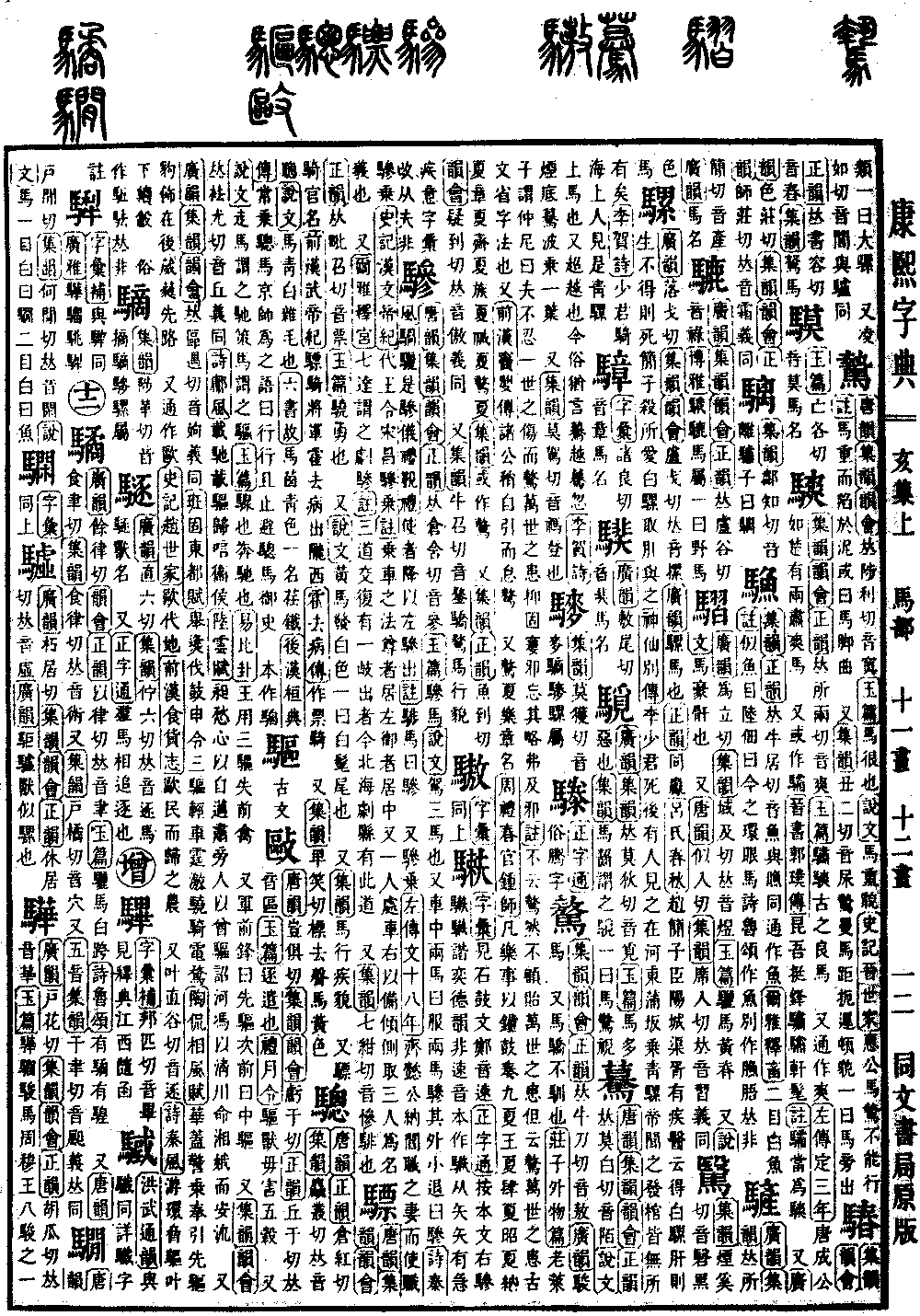
Hai Collection, Upper Volume
Radical: Horse (mǎ)
Drive; Kangxi stroke count: 21; Page 1444, Entry 24
Ancient form is driven (ōu)
Pronounced qu
In the Comprehensive Dictionary (Yupian), it means to chase or send away.
Book of Rites (Liji), Monthly Ordinances (Yueling): Drive away beasts so they do not harm the five grains.
Also, according to the Explaining Graphs and Analyzing Characters (Shuowen), to make a horse run is called gallop, to whip a horse is called drive.
In the Comprehensive Dictionary (Yupian), it means to gallop or run swiftly.
Book of Changes (Yijing), Closeness Hexagram (Bigua): The king utilizes three drives and loses the front game.
Also, the vanguard of an army is called the first drive, the secondary vanguard is called the middle drive.
Also pronounced qiu. The meaning is the same.
Book of Odes (Shijing), Odes of Yong (Yongfeng): Galloping and driving, returning to condole with the Duke of Wei.
Lu Yun's Rhapsody (Lu Yun Fu): Unfurling a worried heart to move forward, keeping attendants nearby to drive once more. Summoning the He Bo to clear the river, commanding the Xiang Goddess to settle the flow.
Also pronounced xu. The meaning is the same.
Ban Gu's Western Capital Rhapsody (Dongdu Fu): Raising drums and signaling, extending orders to the three drives. Light carriages strike like thunder, swift cavalry race like lightning.
Tao Kan's Rhapsody on the Wind (Xiangfeng Fu): The canopy alerts the carriage, the vanguard leads the way. Leopard decorations follow behind, luxuriant and grand on the path.
Also interchangeable with drive (ōu).
Records of the Grand Historian (Shiji), House of Zhao (Zhaoshijia): Drive (ōu), a region in Dai.
History of the Former Han (Qianhan), Treatise on Food and Money (Shihuozhi): Drive (ōu) the people and return them to agriculture.
Also rhyming with zhu; pronounced zhu.
Book of Odes (Shijing), Odes of Qin (Qinfeng): Winding ring at the side drive. Rhymes with xu and gu.
Commonly written as drive (qū), which is incorrect.