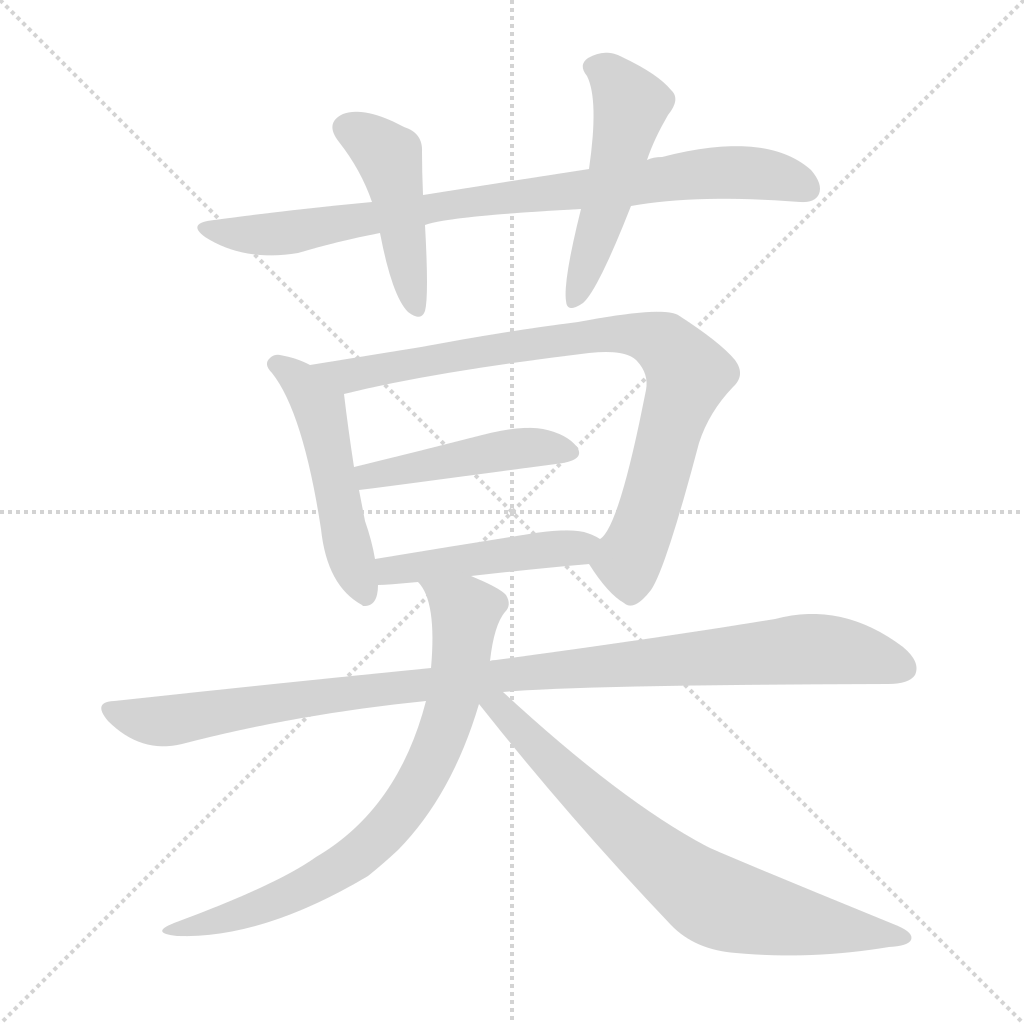
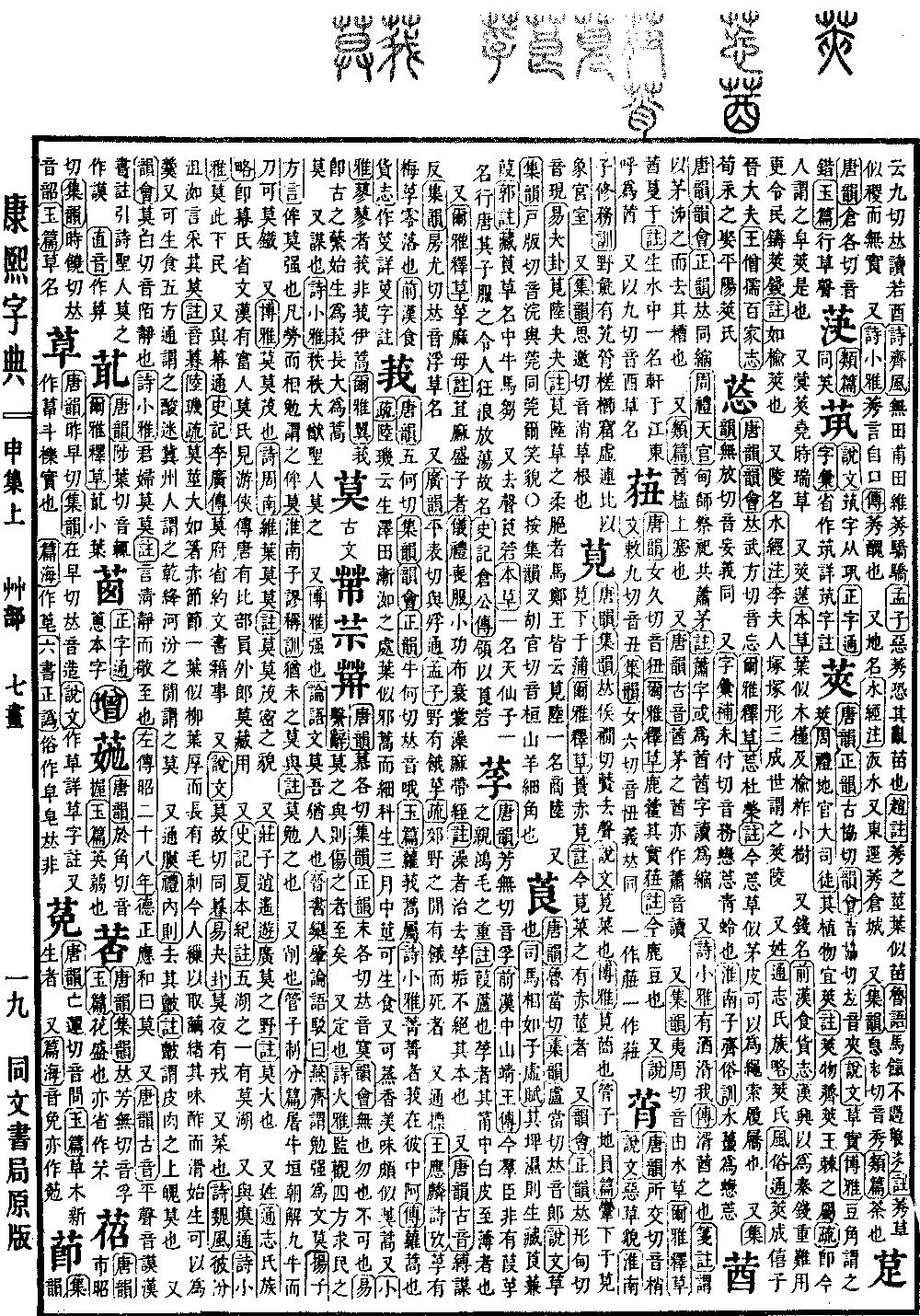
Shen Collection, Upper Volume
Radical: Grass (cǎo)
Page 1035, Entry 13
Ancient characters.
Pronounced mo.
Pronounced mo.
Pronounced mo.
None, do not, must not.
Book of Changes (Yijing): If no one interacts with him, those who would harm him will come.
Stability.
Book of Odes (Shijing): Observing the four quarters, seeking the stability of the people.
To plan.
Book of Odes (Shijing): With orderly and calm paths, the sage plans them.
To exert effort.
Analects (Lunyu): In literary expression and exertion of effort, I am perhaps like others.
Records of Jin (Jinshu): In the Yan and Qi regions, to exert effort is called wen-mo.
Regional Dialects (Fangyan): Mou-mo means to exert effort; whenever people labor and encourage one another, it is called mou-mo.
Book of Huainan (Huainanzi): Not yet has anyone encouraged him. Commentary: Mo means to encourage him.
To scrape or pare.
Guanzi: Tu Niutan could dismantle nine oxen in a single morning, yet his blade could still scrape iron.
Luxuriant.
Book of Odes (Shijing): The leaves are luxuriant. Commentary: Mo-mo, the appearance of being dense.
Book of Zhuangzi (Zhuangzi): A vast and desolate wilderness. Commentary: Mo means vast.
A surname.
Records of Clans (Tongzhi): This is the Mu surname with a component removed. During the Han dynasty, there was a wealthy individual named Mo, appearing in the Biographies of Wandering Knights. In the Tang dynasty, there was a Vice Director of the Bureau of Justice named Mo Cangyong.
Records of the Grand Historian (Shiji): One of the Five Lakes is Lake Mo.
Interchangeable with mo (illness/distress).
Book of Odes (Shijing): These common people have no distress.
Interchangeable with mu (tent/curtain).
Records of the Grand Historian (Shiji): The general's headquarters simplified documents and administrative ledgers.
Pronounced mu.
The same as mu (dusk/evening).
Book of Changes (Yijing): There is a struggle at dusk.
A type of vegetable.
Book of Odes (Shijing): In the low, damp marshes of the Fen River, gathering that Mo vegetable. Commentary: Pronounced mu. Lu Ji's commentary: Mo has a stem as thick as a chopstick, with red joints, and one leaf per joint; it resembles a willow leaf, is thick and long, and has thorny hairs. People today use it to reel silk from cocoons. Its taste is sour and slippery; when young, it can be made into soup or eaten raw. It is commonly known in various regions as suan-mi, in Jizhou it is called gan-jiang, and between the He and Fen rivers it is called Mo.
Interchangeable with mo (membrane).
Book of Rites (Liji): Remove its membrane. Commentary: Referring to the thin membrane on skin and flesh.
Pronounced mo.
Quiet and peaceful.
Book of Odes (Shijing): The mistress of the house is quiet and respectful. Commentary: This speaks of being extremely clear, quiet, and respectful.
Commentary on the Zuo (Zuo Zhuan): To have upright virtue and harmonious responsiveness is called mo.
Flat tone, pronounced mo. The commentary on the History of Han (Hanshu) cites the Book of Odes (Shijing) where the sage plans it is written as mo.