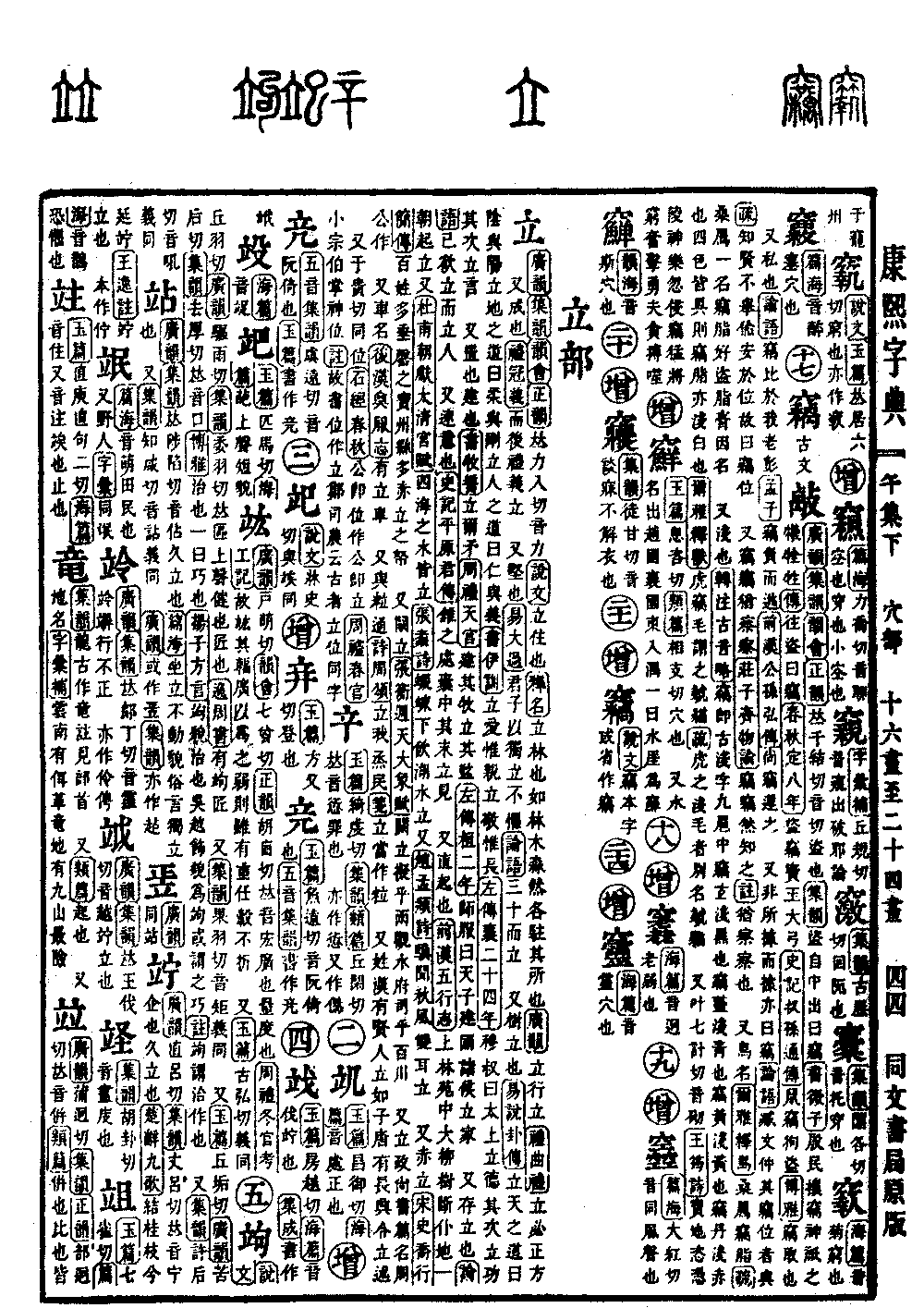
Wu Collection, Lower Volume
Radical: Stand (lì)
Kangxi Strokes: 5
Page 870, Entry 17
Broad Rhymes (Guangyun), Collected Rhymes (Jiyun), Rhyme Meetings (Yunhui), Correct Rhymes (Zhengyun): Pronounced li (entering tone).
Shuowen Jiezi: Stand means to stop.
Explanation of Names (Shiming): Stand means forest-like, as if trees stand upright, each remaining in its place.
Broad Rhymes (Guangyun): Stand, to walk and stand.
Book of Rites (Liji): When standing, one must face squarely.
Also, to succeed.
Book of Rites (Liji): Only then are ritual and righteousness established.
Also, to be firm.
Book of Changes (Yijing): The noble man stands alone without fear.
Analects (Lunyu): At thirty, I stood firm.
Also, to establish.
Book of Changes (Yijing): Establishing the way of Heaven is called Yin and Yang. Establishing the way of Earth is called softness and hardness. Establishing the way of man is called benevolence and righteousness.
Book of Documents (Shujing): Establishing love begins with one's parents, establishing respect begins with one's elders.
Zuo Commentary (Zuozhuan): Mu Shu said, the highest is to establish virtue, next is to establish merit, next is to establish words.
Also, to place or build.
Book of Documents (Shujing): Set up your spears.
Rites of Zhou (Zhouli): Establish their overseers, appoint their inspectors.
Zuo Commentary (Zuozhuan): Shi Fu said, the Son of Heaven establishes states, the feudal lords establish families.
Also, to exist.
Analects (Lunyu): Desiring to establish oneself, one also establishes others.
Also, to be rapid.
Records of the Grand Historian (Shiji): An awl placed in a bag will immediately be revealed.
Also, to rise straight up.
History of the Former Han (Qianhan Shu): In the Shanglin Garden, a large willow tree broke and fell, but in one morning it rose upright.
Du Fu: The waters of the four seas all rose up.
Zhang Zhu: The rainbow descends to drink from the lake, rising upright.
Zhao Mengfu: The thoroughbred hears the autumn wind, its ears standing upright.
Also, naked or bare.
History of the Song (Song Shi): The common people were left with nothing, and the state treasuries were completely empty.
Also, Que-Li.
Zhang Heng: The towers stand like the two palace observances, and the water palace governs the hundred rivers.
Also, Li Zheng, a chapter title in the Book of Documents (Shujing), composed by the Duke of Zhou.
Also, a type of carriage.
History of the Later Han (Houhan Shu): There is the standing carriage.
Also, interchangeable with grain.
Book of Odes (Shijing): Nourishing my common people.
Commentary: Stand should be read as grain.
Also, a surname. During the Han dynasty, there was a virtuous man named Li Ruzi. During the Tang dynasty, there was a magistrate of Changxing named Li Shu.
Also, pronounced wei. Identical to the word for position.
Stone Classics Spring and Autumn Annals (Shijing Chunqiu): The Duke ascended the throne, written as the Duke ascended to his position.
Rites of Zhou (Zhouli): The Junior Minister of Religion manages the divine positions.
Annotation: In the ancient texts, the character for position was written as the character for stand. Zheng Sinong said, in ancient times, the characters for stand and position were the same.