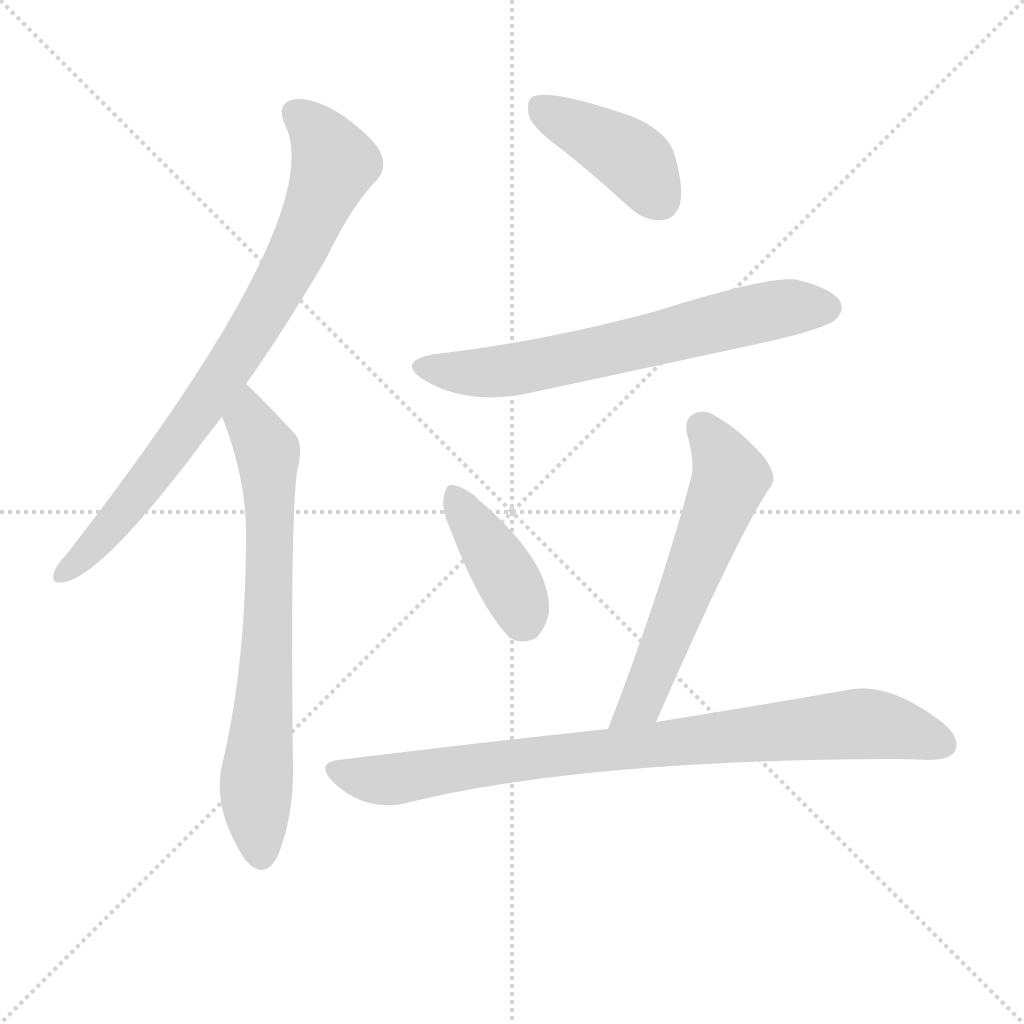
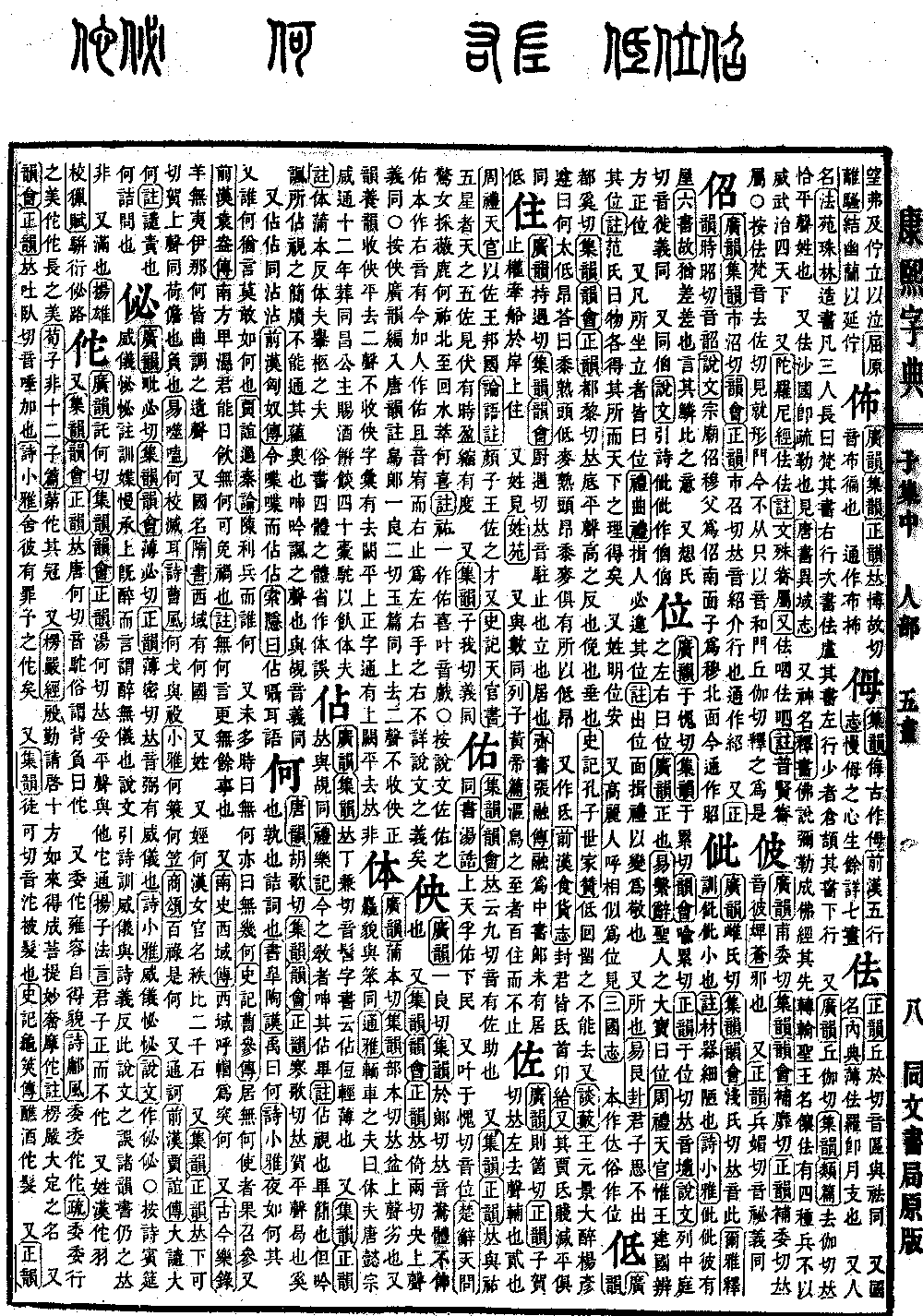
Zi Collection, Middle Volume
Radical: Person (rén)
Stroke count: 7
Page 98, Entry 07
Pronounced wei (falling tone).
Shuowen Jiezi (Shuowen): Columns arranged on the left and right of a courtyard are called wei.
Guangyun (Guangyun): To correct.
Book of Changes (Yijing), Appended Remarks (Xici): The great treasure of the sage is called wei.
Rites of Zhou (Zhouli), Office of Heaven: When the king establishes a state, he distinguishes the directions and corrects the wei.
Also, wherever one sits or stands is called wei.
Book of Rites (Liji), Summary of the Rules of Propriety (Quli): When bowing to someone, one must step aside from one's wei. Commentary: Stepping out of one's wei to bow is a ritual change to express respect.
Also, a location.
Analects of Confucius (Lunyu): A gentleman does not think outside his wei. Zhu Xi's commentary: Fan says: When all things obtain their proper place, the principles of the world are attained.
Also, a surname. Mentioned in the Ming dynasty, Wei An.
Also, people of Goryeo call something similar wei. Seen in Records of the Three Kingdoms (Sanguozhi).
Originally written as a variant form. Commonly written as wei. The original character was engraved with person radical and standing component.
Textual corrections:
Book of Rites (Liji), Summary of the Rules of Propriety (Quli): When bowing to someone, one must step aside from one's wei. Commentary: The original text read face-bowing, which has been corrected to step-aside-and-bow.
Book of Changes (Yijing), Gen Hexagram: A gentleman does not think outside his wei. Commentary: Note that Fan's commentary belongs to the Analects of Confucius and not to the Book of Changes. The three characters for Book of Changes Gen Hexagram have been changed to Analects of Confucius, and the character for Zhu has been added to the commentary.