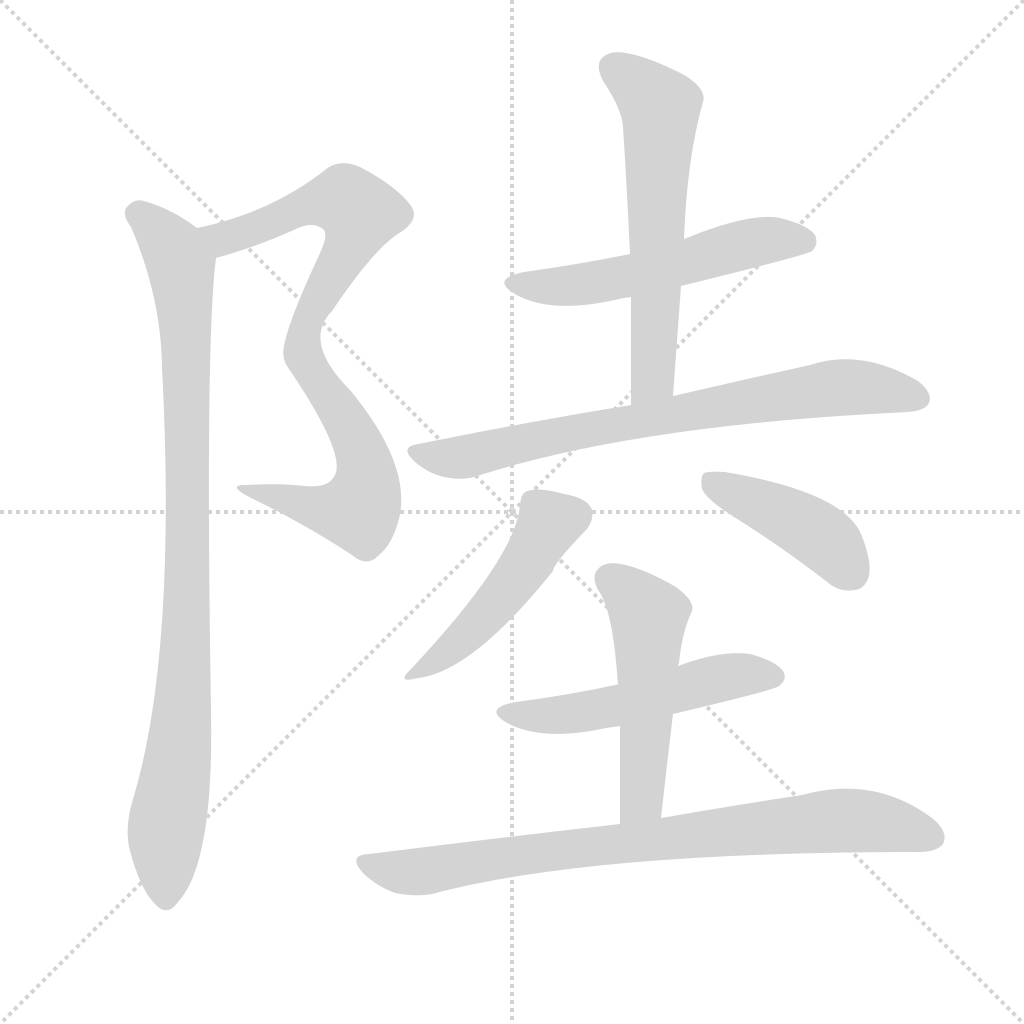
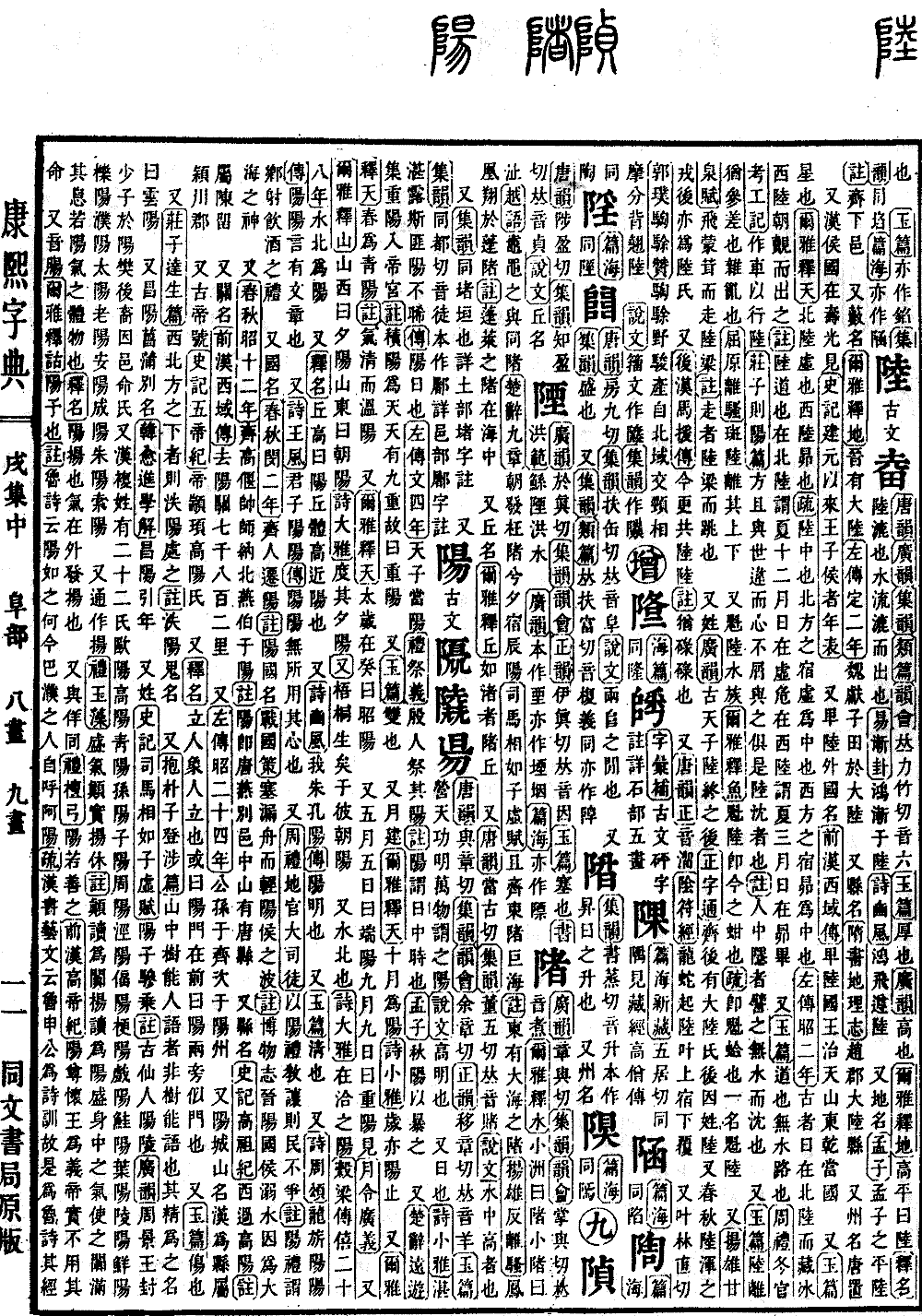
Xu Collection, Middle Volume. Radical: Mound (fu). Lu. Kangxi Stroke Count: 16. Page 1355, Number 01.
Ancient script form. In the Tang Rhymes (Tangyun), Broad Rhymes (Guangyun), Collected Rhymes (Jiyun), Classified Chapters (Leipian), and Rhyme Assembly (Yunhui), the pronunciation is formed from the initial of li and the final of zhu, sounding like liu.
In the Jade Chapters (Yupian), it means thick. In the Broad Rhymes, it means high. In the Approaching the Elegant (Erya) section Explaining Earth, high and level ground is called lu. In the Explaining Names (Shiming), lu means to drain, referring to water flowing and draining away. In the Book of Changes (Yijing), Hexagram Jian, the wild goose gradually advances to the high plateau. In the Book of Odes (Shijing), Odes of Bin, the wild goose flies along the high plateau.
Also a place name. In the Mencius (Mengzi), Mencius went to Pinglu. The commentary notes this was a lower township in the state of Qi.
Also the name of a marsh. In the Approaching the Elegant, the state of Jin has a place called Dalu. In the Zuo Tradition (Zuozhuan), Year 2 of Duke Ding, Wei Xianzi hunted at Dalu.
Also a county name. In the Book of Sui (Suishu) Geographical Records, there is Dalu County in Zhao Commandery.
Also a prefecture name, established during the Tang Dynasty.
Also a marquisate during the Han Dynasty located in Shouguang. See the Table of Marquises from the Jianyuan Era Onward in the Records of the Grand Historian (Shiji).
Also the name of a foreign state. In the Book of Han (Hanshu) Traditions of the Western Regions, the King of Lu ruled at Qiandang in the Tianshan Mountains.
In the Jade Chapters, it refers to a star. In the Approaching the Elegant section Explaining the Heavens, the Northern Plateau (Beilu) is the mansion of Xu. The Western Plateau (Xilu) is the mansion of Mao. The sub-commentary states that lu means the center. Among the northern mansions, Xu is the center. Among the western mansions, Mao is the center. In the Zuo Tradition, Year 2 of Duke Zhao, in ancient times, when the sun was in the Northern Plateau, ice was stored; when it appeared in the Western Plateau at dawn, the ice was brought out. The commentary states that lu means path. Being in the Northern Plateau refers to the sun being in the mansions of Xu and Wei during the twelfth month of the Xia calendar. Being in the Western Plateau refers to the sun being in the mansions of Mao and Bi during the third month of the Xia calendar.
In the Jade Chapters, it also means a road or a path where there is no water. In the Rites of Zhou (Zhouli) Records of Examination of Craftsmen, it mentions making carriages to travel on land. In the Zhuangzi, Zeyang chapter, it describes one who is out of step with the world and whose mind disdains to follow it as one who has sunken on dry land (lushen). The commentary notes this refers to a hermit among people, likened to someone sinking where there is no water.
In the Jade Chapters, luli describes something variegated, uneven, or scattered. In Qu Yuan's On Encountering Sorrow (Lisao), the variegated splendor (luli) moved up and down.
Also kuilu, an aquatic creature. In the Approaching the Elegant section Explaining Fish, kuilu is the modern cockle (han). The sub-commentary states it is the blood clam (kuihe), also known as kuilu.
In Yang Xiong's Rhapsody on the Sweet Springs (Ganquan Fu), the phrase describes flying through tangled brush and leaping across high ridges (luliang). The commentary defines luliang as leaping and jumping while running.
Also a surname. In the Broad Rhymes, they are descendants of the ancient Son of Heaven, Lu Zhong. In the Correcting Character Weaknesses (Zhengzitong), it is noted that descendants of the state of Qi included the Dalu clan, who later took the surname Lu. Additionally, the Luhun tribe of the Spring and Autumn period also became the Lu clan.
In the Book of the Later Han (Houhanshu) Biography of Ma Yuan, it mentions being mediocre or busy (lulu) together. The commentary notes this is the same as the term lulu.
In the Correct Rhymes of the Tang (Tangyun Zheng), it is pronounced like liu. In the Scripture of the Hidden Accord (Yinfujing), it says dragons and snakes rise from the land, rhyming with the preceding and following words.
Also rhymes with lin and zhi, sounding like zhi. In Guo Pu's Encomium on the Taotu Horse, the Taotu is described as a wild steed from the northern regions, rubbing necks and prancing across the high land.
In the Explaining Graphs and Analyzing Characters (Shuowen), the Large Seal script form is given. In the Collected Rhymes, a variant form is provided. It was originally written with the radical mound (fu) or sometimes the same as the Large Seal script character for lu.