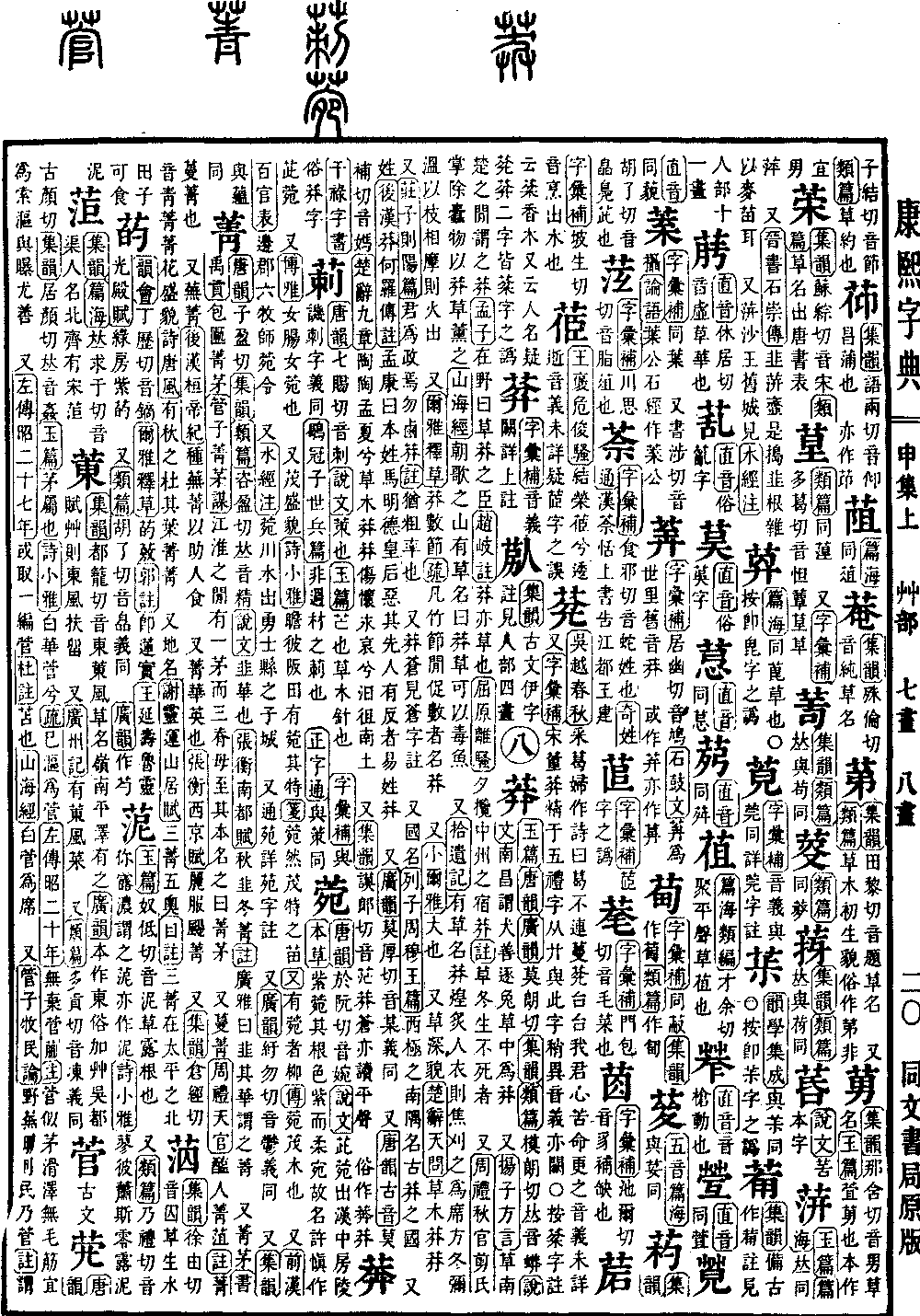
Shen Collection, Upper Volume
Radical: Grass (cǎo)
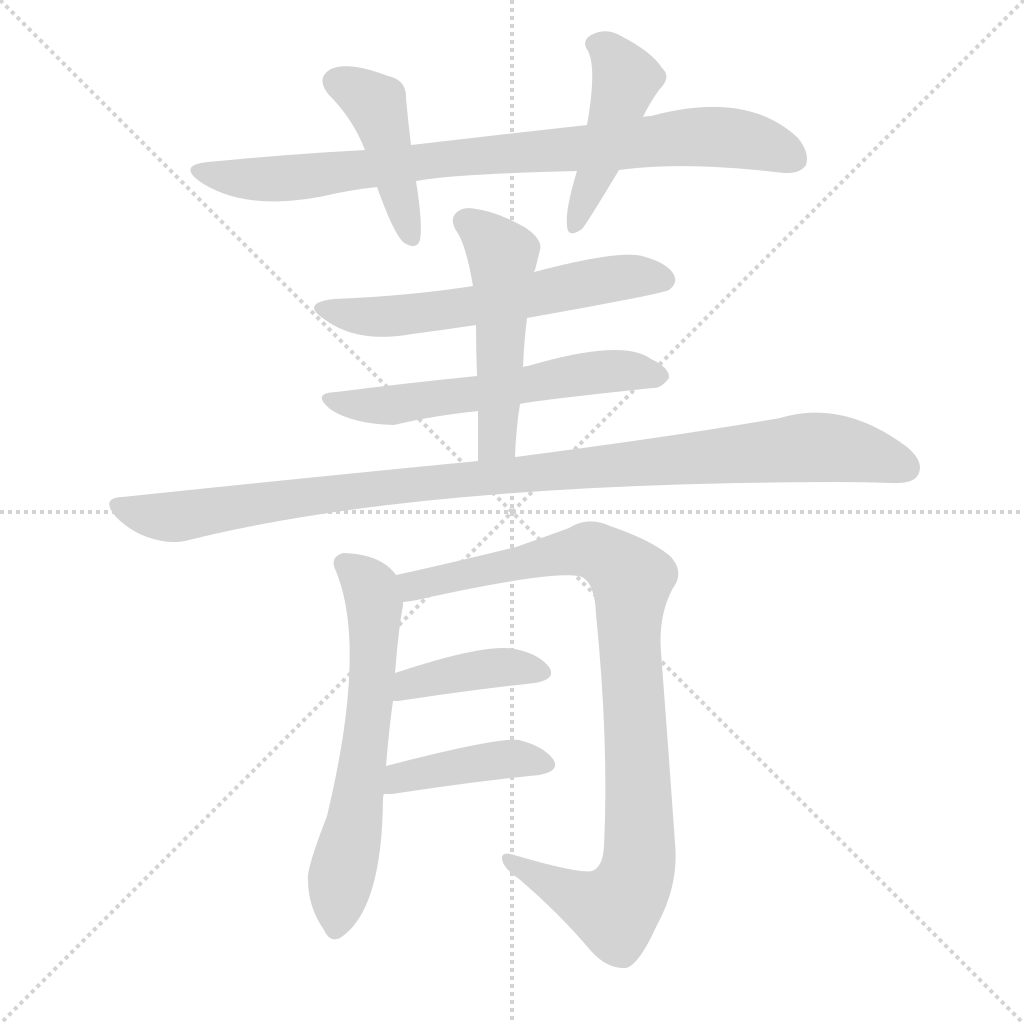
Jing
Kangxi stroke count: 14
Page 1036, Entry 45
Pronounced jing.
Explains it as the flower of the Chinese chive.
Zhang Heng's Southern Capital Rhapsody (Nandu fu) mentions autumn chives and winter jing.
Commentary: Guangya states that the flower of the Chinese chive is called jing.
Also refers to jing-mao (a type of sedge).
The Book of Documents (Shangshu), Tribute of Yu (Yugong) records wrapped jing-mao.
Guanzi, Light and Heavy (Qingzhong ding) states: Between the Yangtze and Huai rivers, there is a type of sedge that grows with three ridges extending down to the roots, which is named jing-mao.
Also refers to turnip.
The Rites of Zhou (Zhouli), Offices of Heaven (Tianguan) mentions jing-zu (pickled turnip) under the official duties of the meat-pickler.
Commentary: Jing is synonymous with turnip.
Also refers to field mustard. The Book of the Later Han (Houhan shu), Annals of Emperor Huan, records the planting of field mustard to assist the people in resolving food shortages.
Also refers to the essence or flowers. Zhang Heng's Western Capital Rhapsody (Xijing fu) includes the phrase wearing beautiful clothing and displaying essence.
Also pronounced qing. Jing-jing describes the appearance of flowers in full bloom.
The Book of Odes (Shijing), Odes of Tang (Tangfeng) states: That solitary pear tree, its leaves are lush and flourishing.
Also refers to a place name. Xie Lingyun's Rhapsody on Living in the Mountains (Shanju fu) mentions the Three Jings and Five Aus.
Self-commentary: The Three Jings are located to the north of Taiping.
Textual Research:
In the entry for Guanzi, the chapter name Jingmao mou has been corrected to Guanzi, Light and Heavy (Qingzhong ding) based on the original book.
In the entry for the Book of Odes (Shijing), Odes of Tang (Tangfeng), the character left has been corrected to pear tree based on the original text.