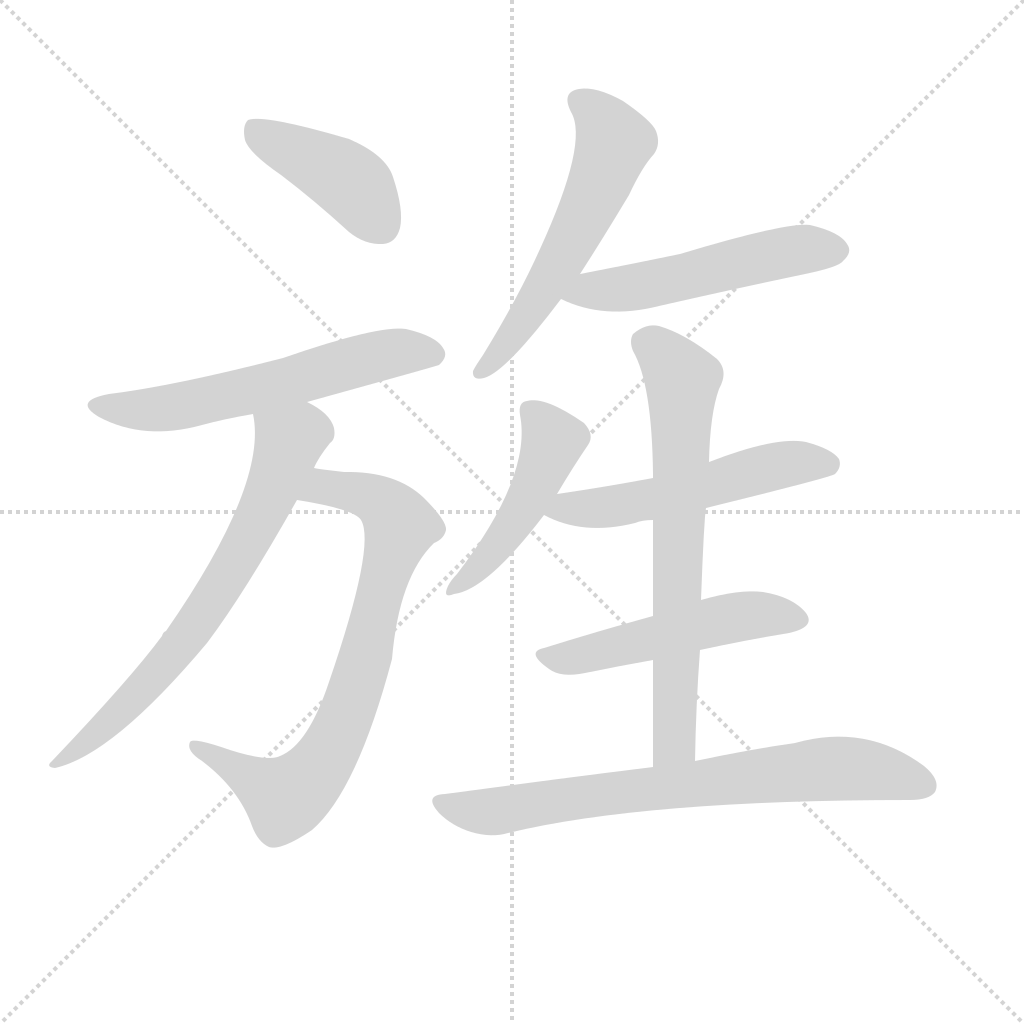
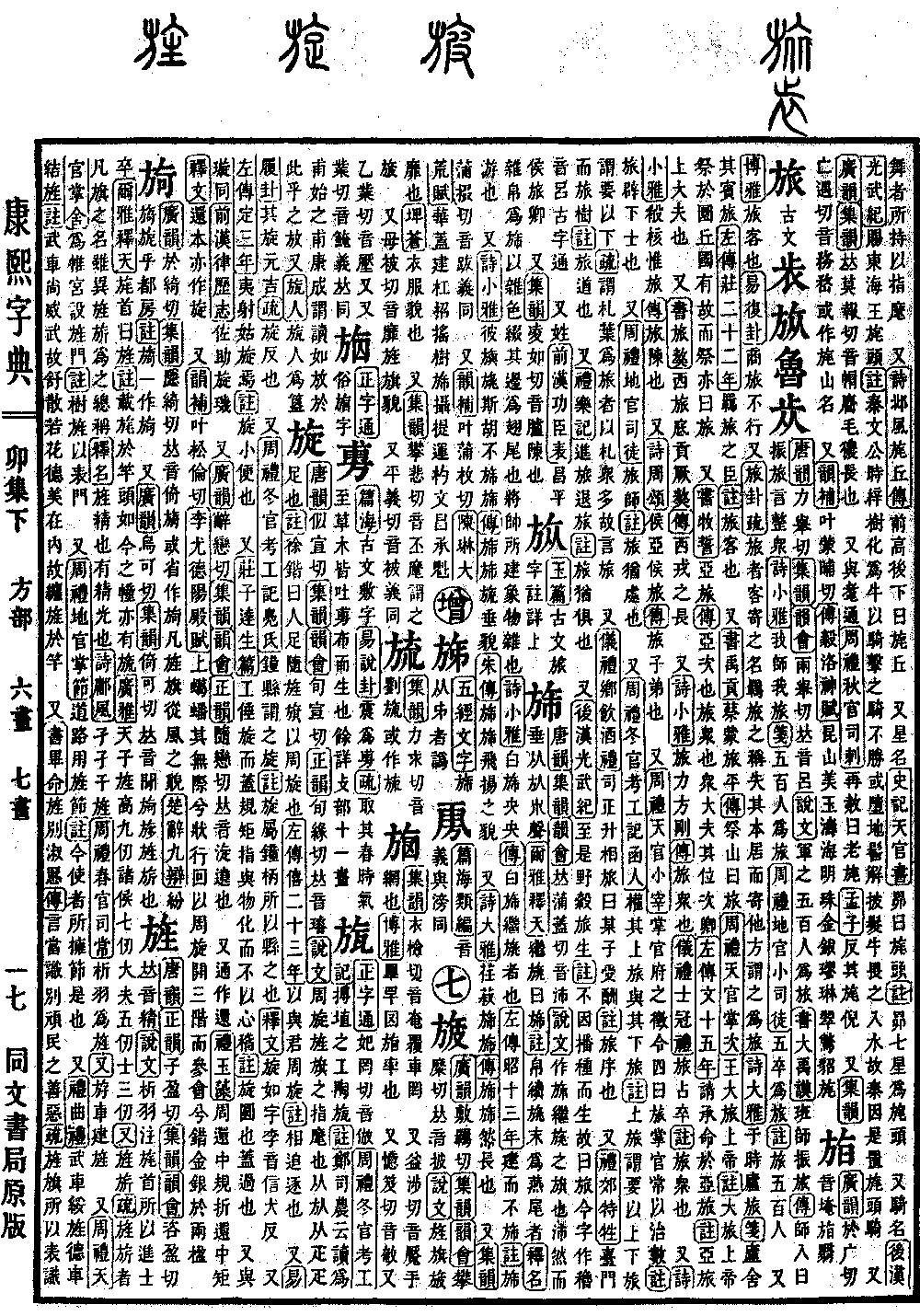
Mao Collection, Lower Volume
Radical: Square (fāng)
Kangxi Strokes: 11
Page 483, Entry 19
Tang Rhymes (Tangyun), Orthodox Rhymes (Zhengyun): Pronounced jing. Collected Rhymes (Jiyun), Rhyme Compendium (Yunhui): Pronounced jing.
Shuowen Jiezi (Shuowen): Feathers split and attached to the top of a pole with yak tails; used to signal soldiers.
Erya (Erya), Interpretation of Heaven (Shitian): The pole top decorated with yak tails is called a jing. Commentary: Yak tails are mounted on the top of the pole, similar to a banner (chuang) of the present day, and also have streamers (liu).
Also: jingqi (banners). Commentary: Although the names of flags differ, jingqi is the general term for them.
Guangya (Guangya): The emperor's banner is nine ren in height, a feudal lord's is seven ren, a grand master's is five ren, and a scholar's is three ren.
Shiming (Shiming): Jing means essence (jing). It signifies brilliance and light.
Book of Odes (Shijing), Odes of Yong (Yongfeng): The flickering banner pole.
Rites of Zhou (Zhouli), Spring Offices (Chunguan), Master of Standards (Sichang): Split feathers to make a jing.
Also: Traveling carriages bear the jing.
Also: Rites of Zhou (Zhouli), Heaven Offices (Tianguan), Director of Lodgings (Zhangshe): Set up a jing gate for the curtained palace. Commentary: Erect a jing to mark the gate.
Also: Rites of Zhou (Zhouli), Earth Offices (Diguan), Keeper of Credentials (Zhangjie): Use jing credentials on the road. Commentary: This refers to the credentials held by modern envoys.
Also: Book of Rites (Liji), Summary of the Rules of Propriety (Quli): For a martial carriage, allow the jing to hang loose; for a virtuous carriage, bind the jing. Commentary: The martial carriage prizes force, so it is spread out like a flower. The virtue of a virtuous carriage is held within, so the jing is wrapped around the pole.
Also: Book of Documents (Shujing), Charge to Bi (Biming): Distinguish the virtuous from the wicked (jingbie shutè). Commentary: This means one should identify the good and evil among the stubborn people. Commentary: Since banners are used to distinguish rank, the commentary uses the word jing to mean to identify (shi).
Also: Zuo Tradition (Zuozhuan), Year 28 of Duke Zhuang: And to recognize (jing) the ruler's military achievements. Commentary: Jing means to manifest (zhang).
Also: Discourses of Zhou (Zhouyu): Therefore, create carriages and garments to honor (jing) them. Commentary: Jing means to signify (biao).
Also: History of the Later Han (Hou Hanshu), Biography of Hu Guang: Virtue serves to honor (jing) the worthy. Commentary: Jing means to enlighten (ming).