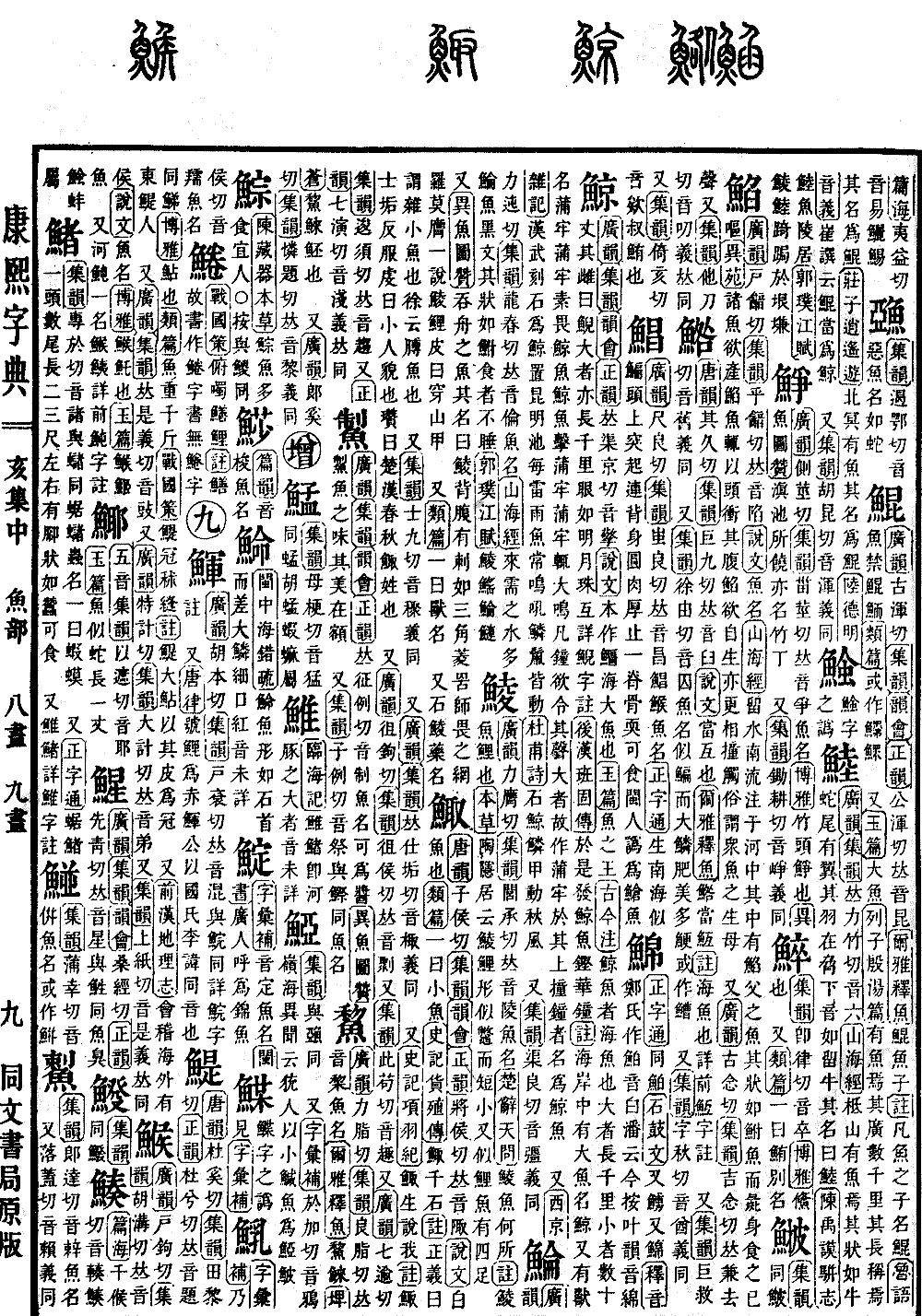
Hai Collection, Middle Volume
Radical: Fish (yú)
Entry: Whale (jīng)
Kangxi Strokes: 19
Page 1473, Entry 12
Broad Rimes (Guangyun), Collected Rimes (Jiyun), Dictionary of Rimes (Yunhui), and Orthodox Rimes (Zhengyun): pronounced qing.
Explanation of Writing (Shuowen): Originally written as a variant form; refers to a large sea fish.
Jade Chapters (Yupian): The king of fish.
Commentary on Past and Present (Gujin Zhu): The whale is a sea fish. Large specimens reach a length of one thousand li, while smaller ones measure several tens of zhang. The female is called ni; large ones are also one thousand li long, with eyes like bright moon pearls. See the entry for ni for further details.
Biography of Ban Gu in the History of the Later Han (Hou Hanshu): Thereupon, he struck the whale fish, making the magnificent bells resound. Commentary: On the seacoast, there is a large fish named the whale. There is also a beast named pulao. The pulao has a natural fear of the whale; when the whale strikes the pulao, the pulao lets out a loud cry. Generally, those who wish for a bell to sound loudly fashion a pulao on top of it, and the striker of the bell is known as the whale.
Miscellaneous Records of the Western Capital (Xijing Zaji): Emperor Wu of Han carved a stone into the shape of a whale and placed it in the Kunming Pond. Whenever there was thunder and rain, the fish would often roar, and its scales and mane would move.
Poem by Du Fu: The stone whale's scales and armor stir in the autumn wind.
Collected Rimes (Jiyun): Pronounced qiang. Same meaning.