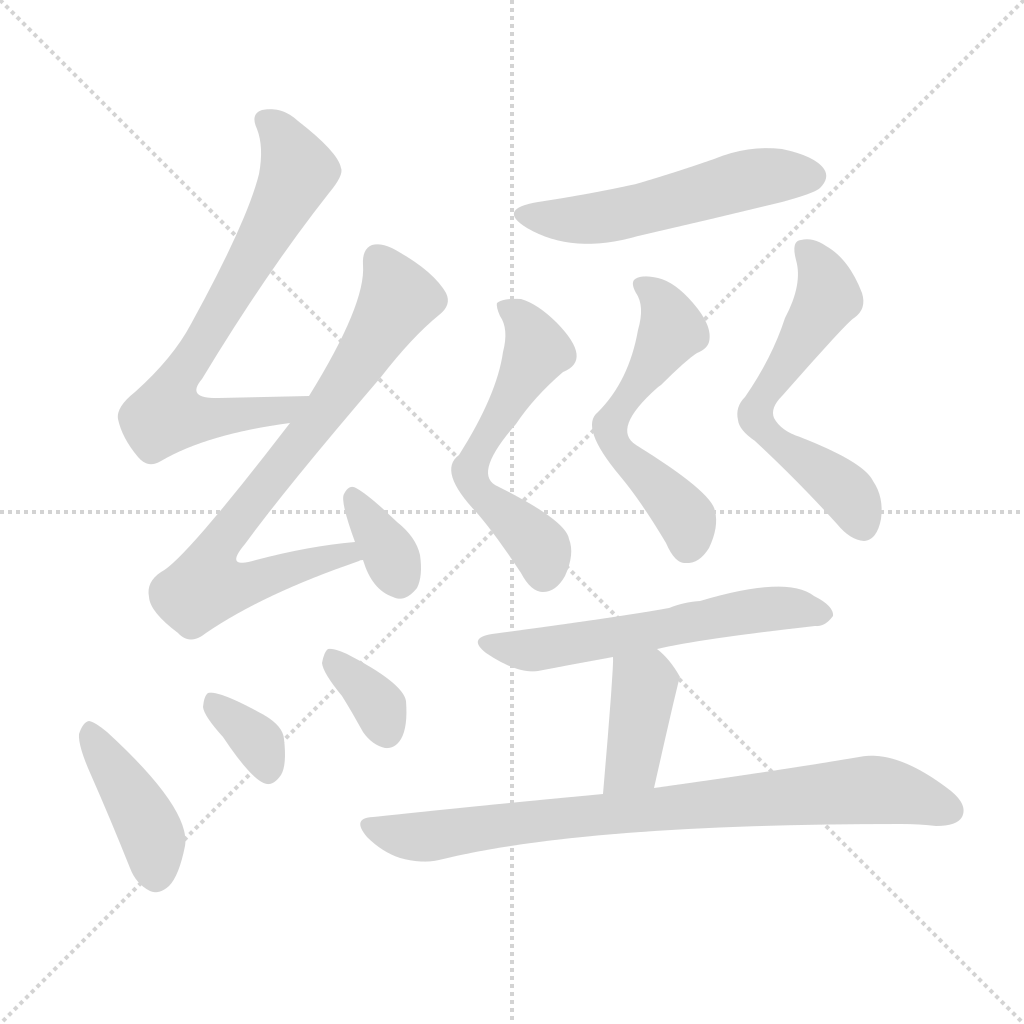
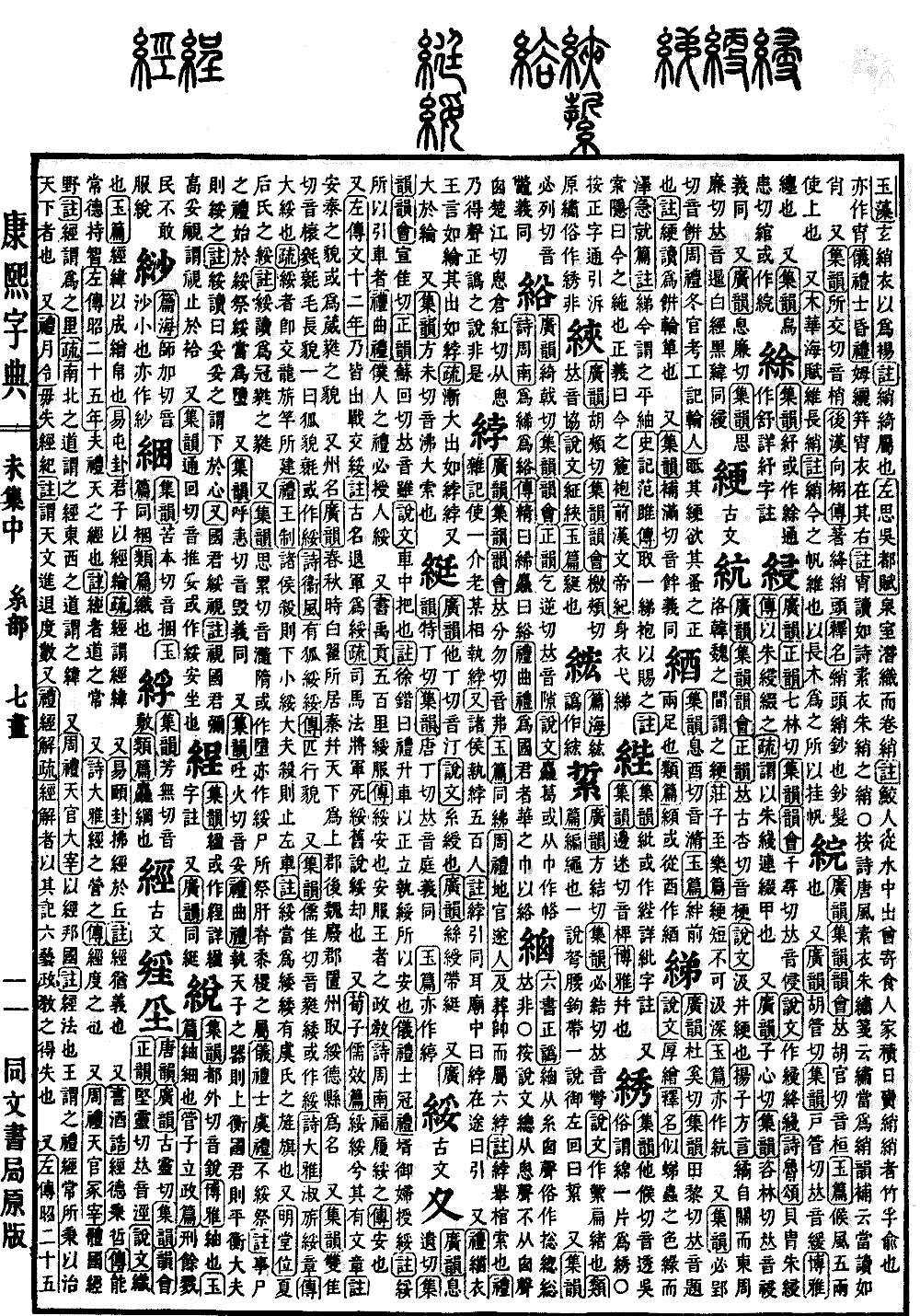
Wei Collection, Middle Volume
Radical: Silk (mì)
Kangxi stroke count: 13
Page 925, Entry 24
Ancient form: Di
Pronounced jing.
Shuowen Jiezi (Dictionary of Explaining Characters and Analyzing Compounds): To weave.
Yupian (Jade Chapters): To warp and weft, in order to create silk fabrics.
Book of Changes (Yijing), Hexagram Tun: The superior man thereby organizes and manages. Commentary: To organize means to warp and weft.
Book of Changes (Yijing), Hexagram Yi: To brush against the constant principles on the hill. Note: Constant principles are the same as righteousness.
Book of Documents (Shujing), Announcement on Wine (Jiugao): Maintain virtue and hold to wisdom. Commentary: To be able to maintain constant virtue and hold to wisdom.
Zuo Tradition (Zuozhuan), 25th Year of Duke Zhao: Ritual is the constant principle of Heaven. Note: Constant principles refer to the norms of the Way.
Book of Odes (Shijing), Greater Odes: To survey and to plan. Commentary: To plan means to measure.
Rites of Zhou (Zhouli), Offices of Heaven: To organize the state and divide the fields. Note: Organizing refers to establishing the borders. Commentary: The paths running north to south are called warp (jing), and the paths running east to west are called weft (wei).
Rites of Zhou (Zhouli), Offices of Heaven: To organize the states and kingdoms. Note: To organize means to establish laws. This refers to the ritual constants that a king upholds to govern the world.
Book of Rites (Liji), Monthly Ordinances: Do not lose the constant records. Note: This refers to the progression and retrogradation of astronomical figures.
Book of Rites (Liji), Commentary on the Explication of the Classics: Explication of the Classics refers to recording the successes and failures of the six arts and government teachings.
Zuo Tradition (Zuozhuan), 25th Year of Duke Zhao: Making a distinction between husband and wife, inside and outside, to regulate these two spheres. Note: The husband manages the outside, and the wife manages the inside, each regulating their respective spheres.
Analects of Confucius: To hang oneself in a drainage ditch, and no one knows of it. He Yan's Note: To die by hanging in a ditch.
Discourses of the States (Jin Yu): To hang oneself in the temple of the New City.
Shiming (Explanation of Names): To bend the neck and stop breathing is called hanging; it is done like a pheasant.
Pronounced jing. To warp and weft. Also, to weave.
Chu Ci (Songs of Chu), Wang Yi's Note: To pass through, or a path.
Shiming (Explanation of Names): To pass through, or a path. Like a road, it connects everywhere and can be used constantly.
Yunbu (Supplement to the Rhyme Dictionary): Pronounced liang. Han Yu's poem, This Day is Indeed Worth Regretting: Closing the door to study history books, a clear breeze cools the windows. Daily I wish for your visit, do you know my feelings? Parting has not been long, yet I have experienced many hardships. Note: Feelings is pronounced xiang.
Five Classics Characters: The author is in error.