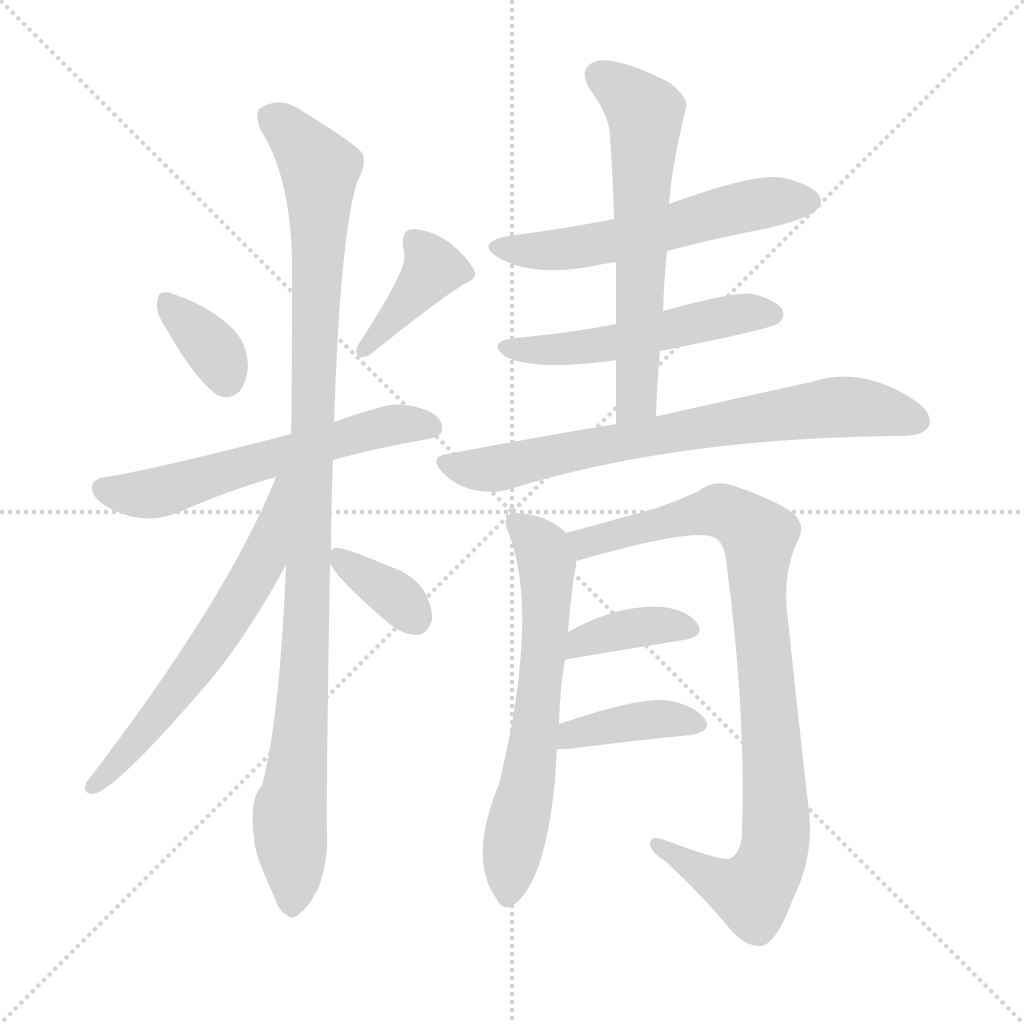
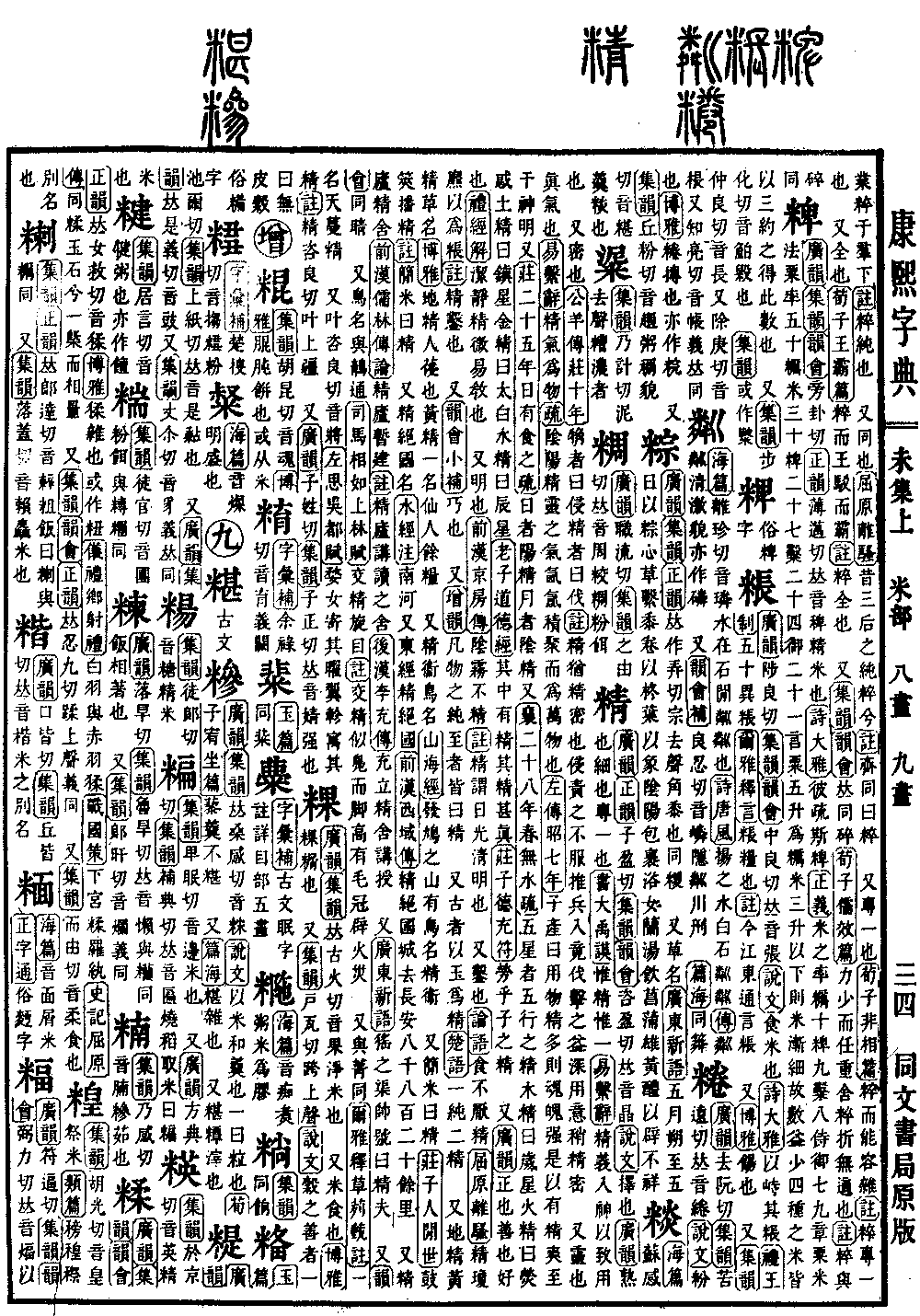
Wei Collection, Upper Volume
Radical: Rice (mǐ)
Kangxi Strokes: 14
Page 910, Entry 10
Pronounced jing.
According to the Broad Rhymes (Guangyun) and Orthodox Rhymes (Zhengyun), it is to choose, to select.
According to the Broad Rhymes, it is cooked, it is fine, it is focused.
According to the Classic of History (Shushu), one must be focused and unified.
According to the Book of Changes (Yijing), by refining the meaning to enter the state of divine, one may apply it to all things.
It also means dense or detailed.
According to the Gongyang Commentary (Gongyangzhuan), that which is rough is called invasion, that which is detailed is called attack. The commentary notes that detailed means precise; invasion means to blame those who do not submit and enter their territory with weapons; attack means to strike more deeply, with the intention being more precise.
It also means spiritual, or the true vital force.
According to the Book of Changes, vital energy forms objects. The commentary explains that the spiritual essence of yin and yang accumulates to form all things.
According to the Zuo Commentary (Zuozhuan), Zichan stated that if one uses many spiritual substances, then the soul becomes strong, leading to spiritual clarity and divine intelligence.
According to the Zuo Commentary, the sun is the essence of yang, and the moon is the essence of yin.
According to the Zuo Commentary, the five planets are the essence of the five elements: the wood essence is the Jupiter, the fire essence is Mars, the earth essence is Saturn, the metal essence is Venus, and the water essence is Mercury.
According to the Dao De Jing by Laozi, within it there is an essence, which is very true.
According to the Zhuangzi, you toil your spirit.
According to the Broad Rhymes, it means correct, good, or excellent.
According to the Book of Rites (Liji), that which is pure, still, refined, and subtle is easy to teach.
It also means bright.
According to the History of the Former Han (Qianhan Shu), the yin fog was not clear. The commentary notes that clear refers to the brightness of sunlight.
It also means to husk or refine.
According to the Analects (Lunyu), one does not tire of refined food.
According to the Li Sao by Qu Yuan, he refined the jade to make food. The commentary notes that refined here means to husk.
According to the Rhyme Compendium Supplement (Yunhui Xiaobu), it means ingenious.
According to the Supplemented Rhymes (Zengyun), anything that is extremely pure is called refined.
In ancient times, jade was considered refined.
According to the Discourses of the States (Guoyu), one pure, two refined.
Also, Earth Refined and Yellow Refined are names of herbs.
According to the Broadening Elegance (Boya), Earth Refined is ginseng. Yellow Refined is also known as Immortal's Surplus Grain.
Also, Jingwei is the name of a bird.
According to the Classic of Mountains and Seas (Shanhaijing), there is a bird on Mount Fajiu named Jingwei.
Rice is also called refined.
According to the Zhuangzi, they thresh and winnow the refined rice. The commentary notes that rice is called refined.
Jingjue is the name of a kingdom.
According to the Commentary on the Classic of Water (Shuijingzhu), the Southern River flows east past the Jingjue Kingdom.
According to the History of the Former Han, the city of Jingjue Kingdom is over eight thousand eight hundred li from Chang'an.
Jinglu and Jingshe are terms for study halls.
According to the History of the Former Han, a study hall was temporarily established. The commentary notes that a study hall is a place for teaching and reading.
According to the History of the Later Han (Houhan Shu), Li Chong established a study hall to lecture.
According to the New Accounts of Guangdong (Guangdong Xinyu), the chieftain of the Yao people is called a Jingfu.
According to the Rhyme Compendium, it is the same as eyeball.
It is also a name for a bird and is interchangeable with a variant form (jing).
According to the Shanglin Rhapsody by Sima Xiangru, the jiaojing bird swivels its eyes. The commentary notes that the jiaojing resembles a wild duck but has long legs and a crested crown; it wards off fire disasters.
It is also interchangeable with the character (jing).
According to the Erya, it is also known as the creeping refined vine.
Also, rhyming with the sound jiang.
According to the Rhapsody on the Capital of Wu (Wudufu) by Zuo Si, the Weaving Maid (a star) rests her brilliance there, and the Wings and Chariot stars harbor their refined essence.
Pronounced jing. It means strong.