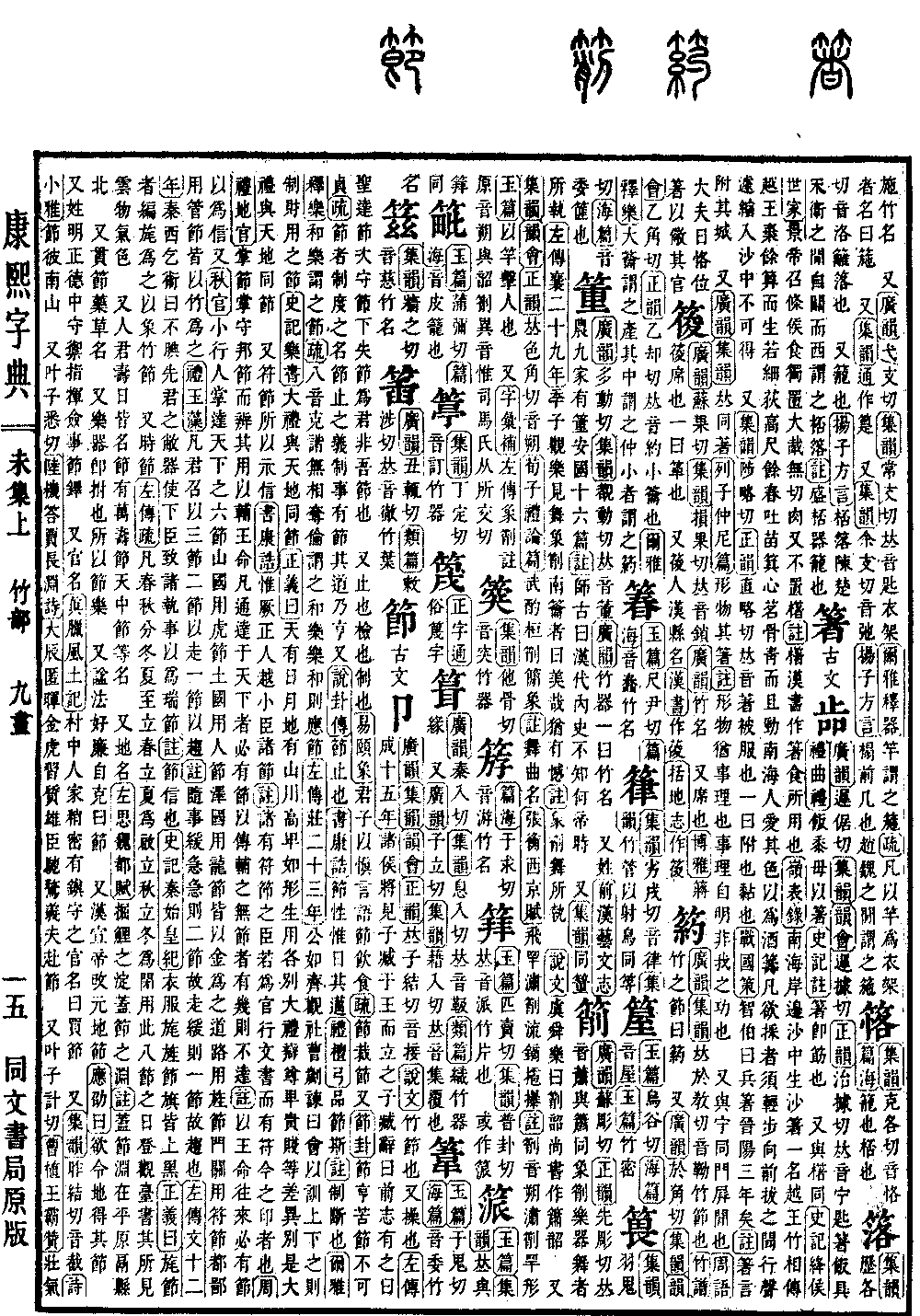
Wei Collection, Upper Volume
Radical: Bamboo (zhú)
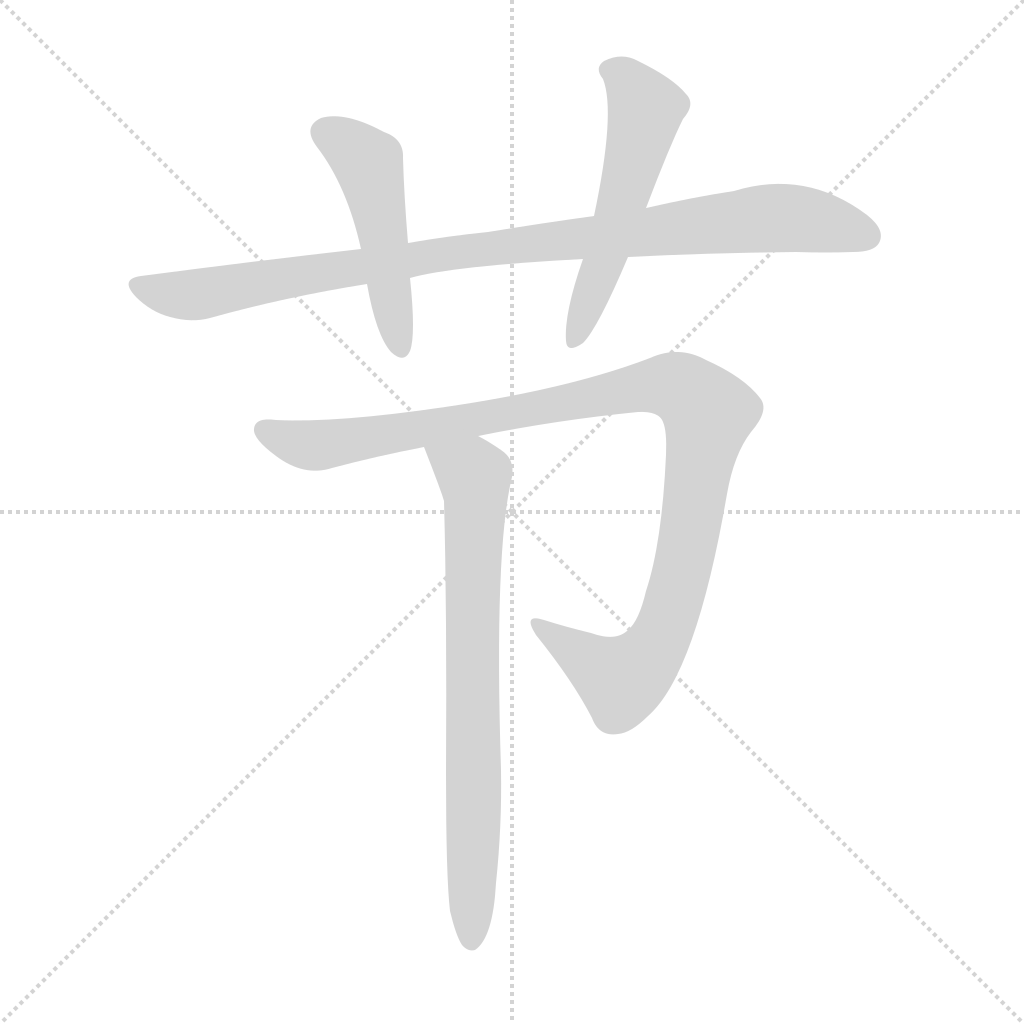
Jie (節)
Kangxi Strokes: 15
Page 891, Entry 01
Ancient form: Jie (jié).
According to Guangyun, Jiyun, Yunhui, and Zhengyun, the pronunciation is jie.
According to the Shuowen Jiezi, it refers to the nodes of bamboo.
It also refers to moral integrity or conduct.
According to the Zuo Zhuan (Chronicle of Zuo), in the 15th year of Duke Cheng, the nobles were about to meet the King and appoint an heir. Zuo Cang declined, saying: Past records say: The sage achieves perfect integrity, the next maintains integrity, and the lowest loses integrity. To act as a lord is not my integrity.
It also refers to stopping, restraining, or regulating.
According to the Book of Changes (Yijing), in the commentary on the Yi hexagram: The superior man is careful with his speech and regulates his eating and drinking. The commentary explains: Jie means to regulate and limit.
Also, in the Jie hexagram: Jie brings success. But severe restriction is not to be persisted in. The commentary explains: Jie is the name for a system or institution, the meaning of stopping or restricting; when matters are regulated with jie, the Way will prevail.
Also, in the Shuo Gua Zhuan (Appended Sayings of the Book of Changes): Jie means to stop.
According to the Book of Documents (Shangshu), in the Kang Gao chapter: Regulate your nature, and day by day you will advance.
According to the Book of Rites (Liji), in the Tan Gong chapter: [One must] define and regulate this. The commentary notes: It means to govern and restrict.
According to the Erya (Approaching Elegance), in the chapter on music: Harmonious music is called jie. The commentary explains: When the eight types of musical instruments are in harmony and there is no violation of the order, this is called harmonious music; when music is harmonious, it follows the rhythm (jie).
According to the Zuo Zhuan, in the 23rd year of Duke Zhuang: The Duke went to Qi to watch the altar rituals. Cao Gui advised: The gathering is meant to instruct on the rules for superiors and inferiors, and to regulate the economy of resources.
According to the Records of the Grand Historian (Shiji), in the chapter on music: The Great Rites have the same rhythm (jie) as Heaven and Earth. The commentary says: Heaven has the sun and moon, and Earth has mountains and rivers; just as their forms differ, their functions of life also vary. The Great Rites distinguish between the honored and the lowly, and between differences in rank; this is why the Great Rites correspond to the rhythm of Heaven and Earth.
It also refers to tally or token, used to represent proof of identity or authority.
According to the Book of Documents, in the Kang Gao chapter: You and your upright officials, and all those holding tallies. The commentary notes: Those officials who hold tallies, like those who have authorization when performing official duties, are like the seals of today.
According to the Rites of Zhou (Zhouli), in the Ministry of Earth: The Master of Tallies is in charge of managing the state's tallies, distinguishing their uses to assist the King's mandates. Whenever anyone travels throughout the realm, they must have a tally to serve as a pass. Those without a tally, if there are checkpoints, will not be able to pass. The commentary notes: When traveling on the King's business, one must carry a tally to serve as proof of identity.
Also, in the Ministry of Autumn: The Lesser Diplomat manages the six tallies of the realm: mountain states use tiger tallies, earthen states use human tallies, and marsh states use dragon tallies, all made of metal. Roadways use banner tallies, gateways and passes use seal tallies, and capital districts use pipe tallies, all made of bamboo.
According to the Book of Rites, in the Yu Zao chapter: When the lord summons someone, he uses three types of tallies: two tallies for running, one tally for walking quickly. The commentary notes: Depending on the urgency of the matter; if urgent, use two tallies, hence running. If not urgent, use one tally, hence walking quickly.
According to the Zuo Zhuan, in the 12th year of Duke Wen: Qin's Xi Qishu said: I humbly bring these, the simple vessels of my former lord, to present to your ministers, to serve as a token tally. The commentary notes: Jie means belief or trust.
According to the Records of the Grand Historian, in the Annals of the First Emperor of Qin: Clothing, banners, tallies, and flags were all predominantly black. The commentary says: The tallies with animal hair were made by weaving hair to resemble the nodes of bamboo.
It also refers to seasonal periods.
According to the Zuo Zhuan commentary: In the spring and autumn equinoxes, the winter and summer solstices, the beginning of spring, and the beginning of summer are called the openings. The beginning of autumn and the beginning of winter are called the closings. On these eight seasonal days, climb the observatory to record observations of weather and color.
Also, the birthdays of monarchs are called jie, such as the Longevity Jie and the Mid-Heaven Jie.
It also refers to place names.
According to the Rites of Wei by Zuo Si: Digging the Jue-Li marshes, and covering the abyss of Jie. The commentary notes: The Jie abyss is located north of Ge County in Pingyuan.
It also refers to a plant name, the Guan-Jie.
It also refers to a musical instrument, the fu (a percussion instrument used to set the rhythm).
It also refers to posthumous titles, where those who are fond of frugality and self-control are titled Jie.
Also, Emperor Xuan of Han changed the era name to Jie (Jie Di). Ying Shao says: He wished for the land to obtain its regulation.
It also refers to a surname. During the Zhengde era of the Ming dynasty, there was a guard commander named Jie Duo.
It also refers to an official title. According to the Zhen Fengtu Ji: In villages where households were dense, there was a garrison official called Mai Jie.
According to Jiyun, the pronunciation is jie.
According to the Book of Odes (Shijing), in the Minor Odes: Tall is that southern mountain.
Also, rhymes with the pronunciation jie.
In the poem by Lu Ji: The Great Star hides its radiance, the Golden Tiger exerts its quality. The heroic ministers gallop, the righteous man fulfills his integrity.
Also, rhymes with the pronunciation jie.
In the praise by Cao Zhi: His robust spirit rises above the clouds, he stands forth and exerts his integrity. What he conquers is sure to be taken, his strategies shine and bequeath kindness.