Mao Collection, Middle Volume
Radical: Hand (shǒu)
Kangxi Strokes: 13
Page 444, Entry 05
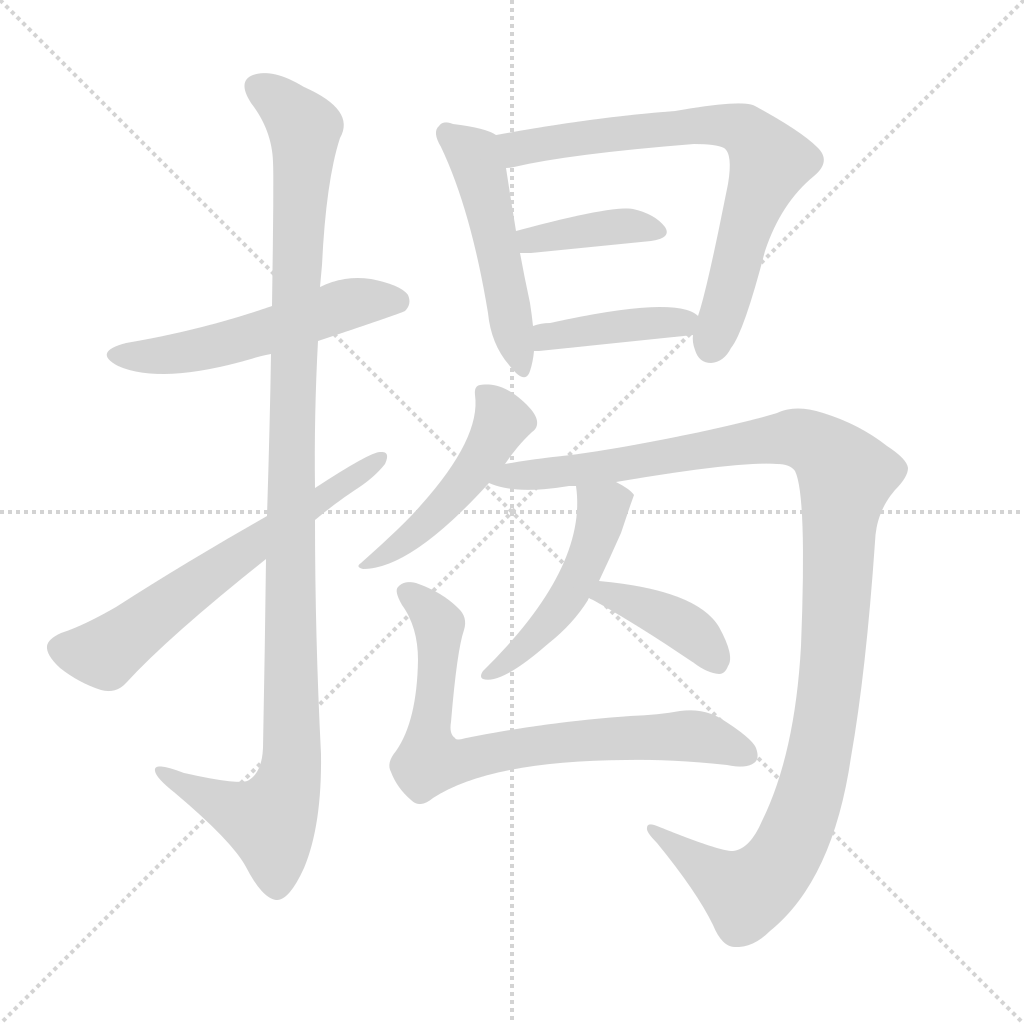
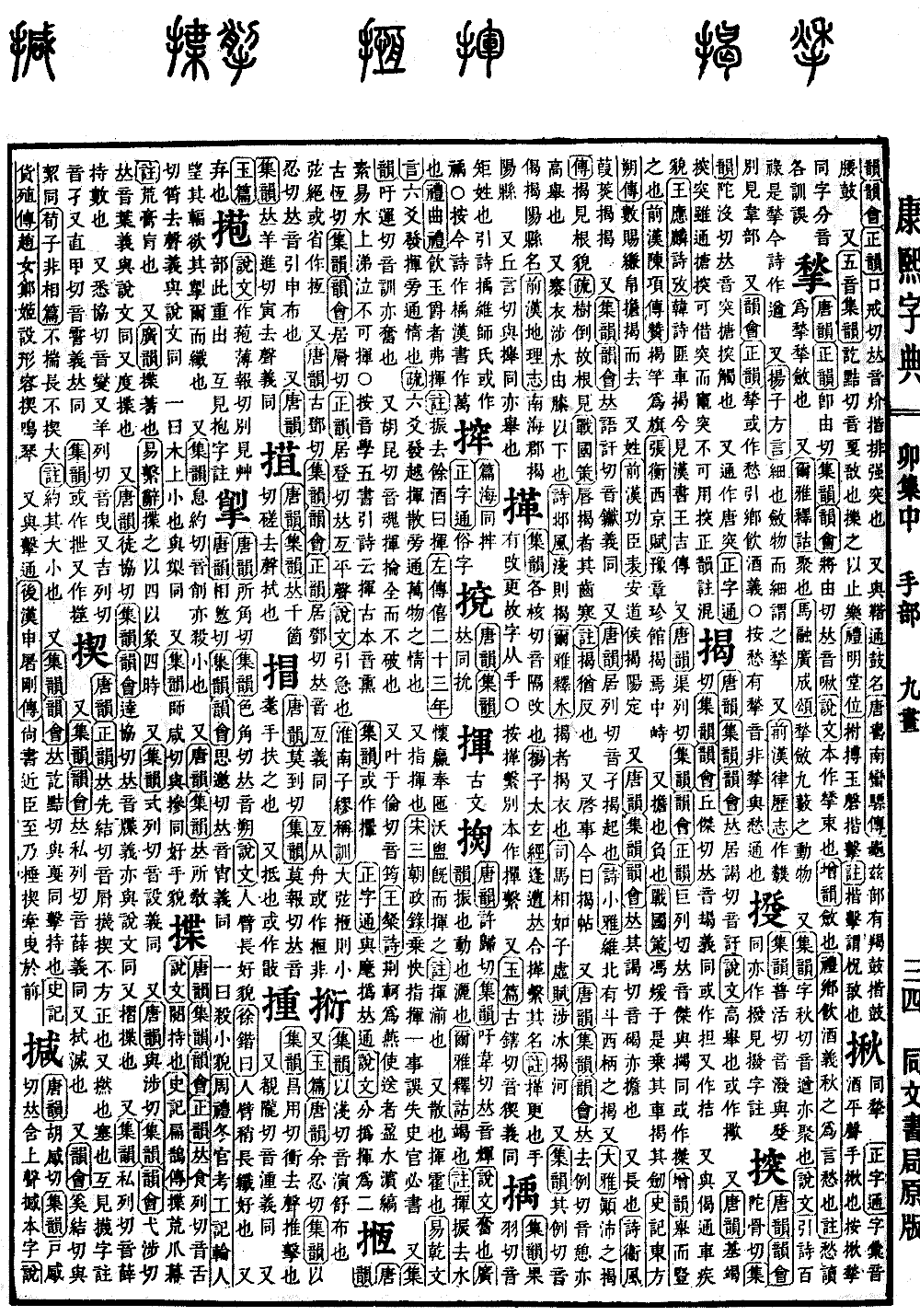
Pronounced jie. Pronunciation is identical to jie (accusation). Explained in Explaining Graphs and Analyzing Characters (Shuowen Jiezi) as lifting high. Sometimes written in a variant form.
Pronounced qie. Pronunciation is identical to qie. Meaning is the same. Sometimes written as dan or jie. It also shares the same meaning as jie (vigorous). Describes the appearance of a vehicle moving quickly. As noted in Wang Yinglin’s Examination of the Odes (Shikao), the Han Odes contain the phrase, not a cart lifted high, which appears in the Biography of Wang Ji in the History of the Former Han (Hanshu).
Pronounced jie. Pronunciation is identical to jie (heroic). Same as the variant form. Sometimes written as zhe. Defined in Additional Rhymes (Zengyun) as lifting up and standing something upright. In the Records of the Historian (Shiji), Biography of Chen She and Xiang Ji, it is written: lifted a pole to serve as a flag. In Zhang Heng’s Rhapsody on the Western Capital (Xijing Fu), it is written: the precious halls of Yuzhang stand tall in the center. It also carries the meaning of carrying or bearing. In Strategies of the Warring States (Zhanguo Ce), it is written: Feng Xuan then rode his carriage, carrying his sword. In the Biography of Dongfang Shuo in the Records of the Historian (Shiji), it is written: he received many rewards of silk, which he carried away. It is also a surname. In the History of the Former Han (Hanshu), Table of Meritorious Officials, it is written: Marquis of Andao, Jie Yangding.
Pronounced jie. Pronunciation is identical to jie (stele). Also means to carry. It also means long. In the Book of Odes (Shijing), Odes of Wei, it is written: the reeds and rushes are long.
Pronounced yue. Pronunciation is identical to yue. Meaning is the same.
Pronounced jie. Pronunciation is identical to jie (small). Means to lift up. In the Book of Odes (Shijing), Minor Odes of the Kingdom, it is written: the northern dipper has its handle pointing west. Also in the Greater Odes of the Kingdom, it is written: the root of the fallen tree is exposed. The commentary states: the root of the tree is revealed. The sub-commentary explains: the tree has fallen, thus the roots are exposed. In the Strategies of the Warring States (Zhanguo Ce), it is written: if the lips are turned up, the teeth will be cold. The annotation explains: the term is similar to the meaning of turning something inside out. It also refers to a public notice, now known as a posted notice (jietie).
Pronounced qi. Pronunciation is identical to qi (rest). Also means to lift high. Also refers to lifting up one's garments to wade through water where the depth is below the knees. In the Book of Odes (Shijing), Odes of Bei, it is written: if shallow, lift the hem. In the Progressive Dictionary of Water Terms (Erya, Shishui), it is defined as: lifting the clothes. In Sima Xiangru’s Rhapsody on the Imperial Park (Shanglin Fu), it is written: wading through ice and lifting the hem to cross the river.
Pronounced jie. Pronunciation is identical to jie. Jieyang is the name of a county. In the History of the Former Han (Hanshu), Treatise on Geography, it is noted: Jieyang County in Nanhai Commandery.
Pronounced qi. Same as the variant form. Also means to lift.