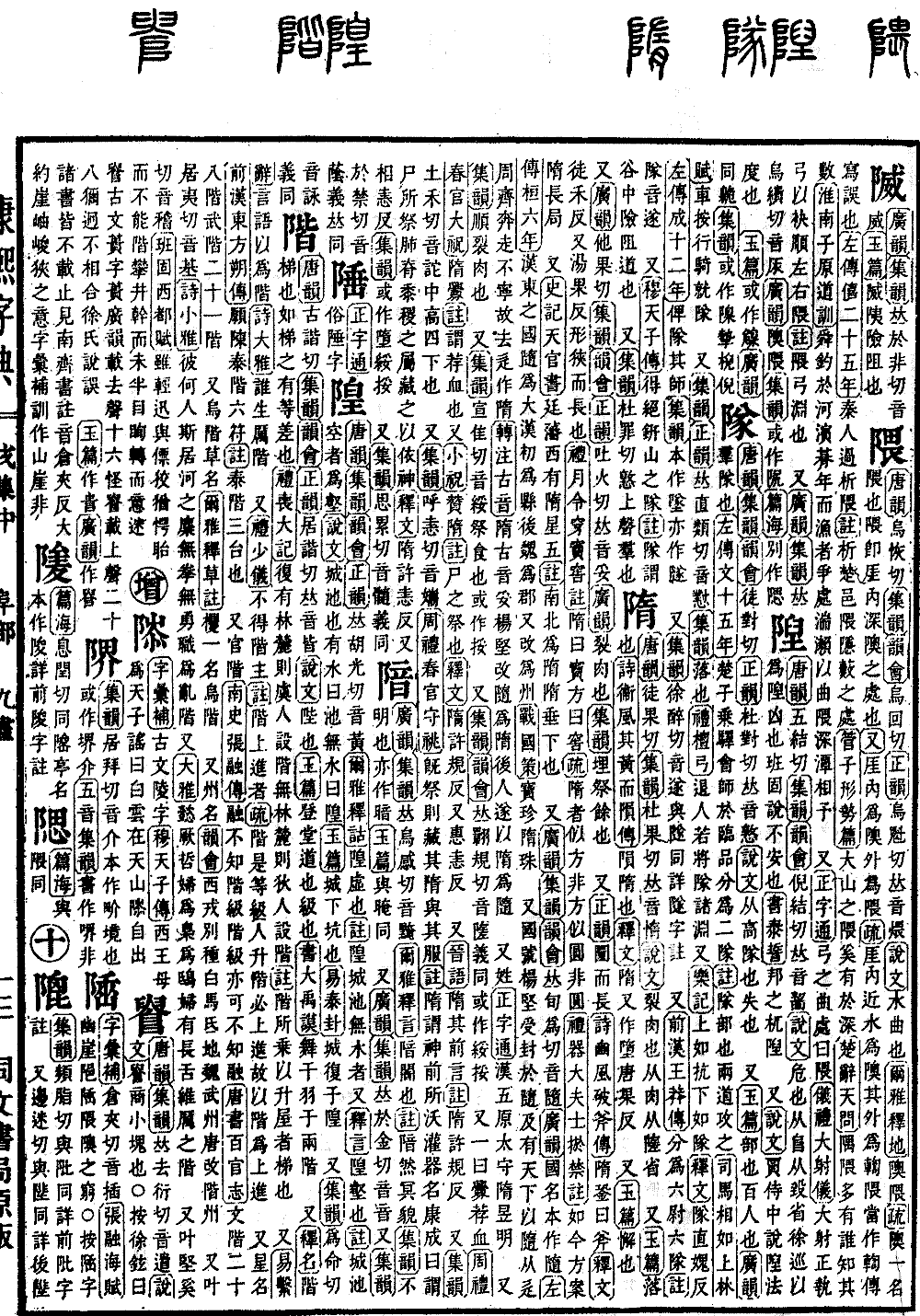
Xu Collection, Middle Volume
Radical: Mound (fù)
Kangxi Stroke Count: 17
Page Number: 1357, Entry 09
From Tang Rhyme (Tángyùn), Jiyun (Jíyùn), Yunhui (Yùnhuì), and Zheng Rhyme (Zhèngyùn), all pronounced jiē. Shuowen Jiezi (Shuōwén Jiězì) says it refers to steps to a throne. Yupian (Yùpiān) defines it as a path to ascend a hall, a level. Book of Documents (Shàngshū) — The Counsels of Yu (Dàyǔmó): “Performing the shield and feather dance on both sides of the steps.” Shiming (Shìmíng) says: “Jiē means ladder, like a ladder having different levels.” Book of Rites (Lǐjì) — Greater Record of Mourning Rites (Sāng Dàjì): “If there is a forest, the forest official sets up the steps. If there is no forest, the barbarian official sets up the steps.” The commentary explains: “Jiē are things used to ascend to the roof, meaning a ladder.” Book of Changes (Yìjīng) — Appended Remarks (Xìcí): “Speech serves as a means (to progress).” Book of Odes (Shījīng) — Major Odes (Dàyǎ): “Who brought about these calamities?”
Book of Rites (Lǐjì) — Minor Rules of Conduct (Shǎoyí): “One must not step over the host.” The commentary states: “Jiē means to advance.” The sub-commentary adds: “Jiē refers to steps or ranks. When a person ascends steps, they must move upwards, hence jiē is used to mean ‘to advance’.”
Also a star name. Book of Han (Hànshū) — Biography of Dongfang Shuo (Dōngfāng Shuò Zhuàn): “I wish for the six talismans of Taijiē.” The commentary notes: “Taijiē refers to the Three Terraces (sāntái) constellation.”
Also official ranks. History of the Southern Dynasties (Nánshǐ) — Biography of Zhang Rong (Zhāng Róng Zhuàn): “Rong did not know the ranks; the ranks also could do without knowing Rong.” Book of Tang (Tángshū) — Monograph on Officials (Bǎiguān Zhì): “Twenty-eight ranks for civil officials, twenty-one ranks for military officials.”
Also wujiē, a plant name. Erya (Ěryǎ) — Explanations of Plants (Shì Cǎo) commentary: “Qu (qú) is also called wujiē.”
Also a prefecture name. Yunhui (Yùnhuì): “A separate branch of the Western Rong (Xīróng) people, the land of the Baima Di (Báimǎ Dī), established as Wuzhou by Wei, and renamed Jie Prefecture (Jiēzhōu) by Tang.”
Another rhyming sound, pronounced jī. Book of Odes (Shījīng) — Minor Odes (Xiǎoyǎ): “What kind of men are those, dwelling in the marshes of the River? Without strength or courage, they are merely agents of disorder.” Book of Odes (Shījīng) — Major Odes (Dàyǎ): “Alas for the wise woman, she is an owl, she is an eagle. A woman with a long tongue is an agent of calamity.”
Another rhyming sound, pronounced jī. Ban Gu (Bān Gù)'s Rhapsody on the Western Capital (Xīdū Fù): “Though nimble and agile, they stared in astonishment and could not ascend. Halfway up the well-frames, their eyes spun and their minds became confused.”