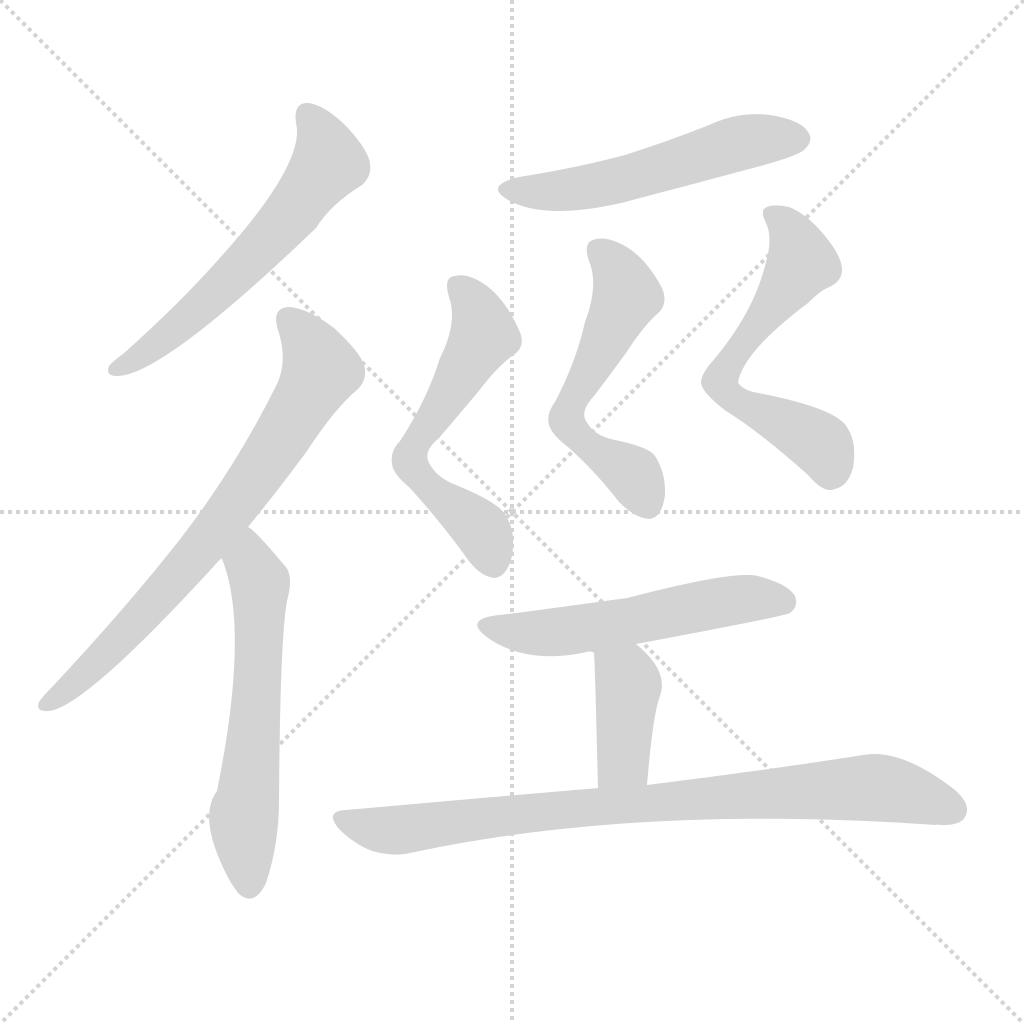
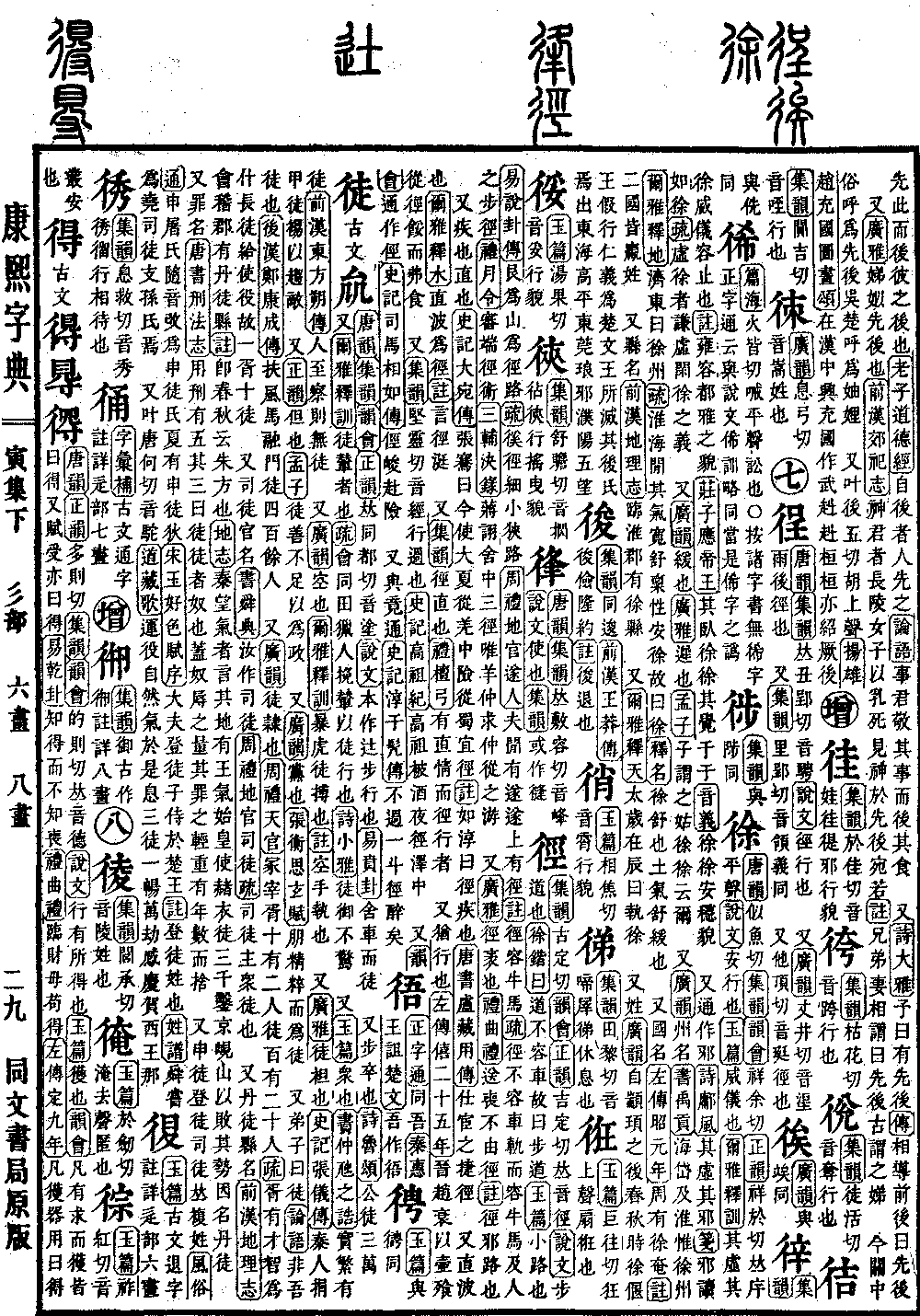
Yin Collection, Lower Volume
Radical: Step (chì)
Kangxi stroke count: 10
Page 367, Entry 19
Compiled Rhymes (Jiyun) says: pronounced jing (falling tone).
Collection of Rhymes (Yunhui) and Correct Rhymes (Zhengyun) say: pronounced jing (falling tone).
In Explanation of Simple and Compound Characters (Shuowen): a footpath.
Xu Kai says: a path not wide enough for a carriage, therefore called a footpath.
In Jade Chapters (Yupian): a small road.
In Book of Changes (Yijing), Commentary on the Trigrams (Shuogua Zhuan): The trigram Gen is mountain, and it is a mountain path.
Commentary (Shu) says: a narrow and small road.
In Rites of Zhou (Zhouli), Earth Officers (Diguan), Suiren: Between husbandmen there are irrigation ditches, and above the ditches are paths.
Commentary (Zhu) says: a path that can accommodate oxen and horses.
Commentary (Shu) says: a path that cannot accommodate carriage ruts, but can accommodate oxen, horses, and human foot traffic.
In Book of Rites (Liji), Monthly Ordinances (Yueling): Examine the straightness of the path and the method.
In Records of the Three Capitals (Sanfu Juelu): Jiang Xu had three paths in his dwelling; only Yang Zhong and Qiu Zhong followed him to wander there.
Also, in Broad Elegant (Guangya): jing means length.
In Book of Rites (Liji), Pattern of Conduct (Quli): When escorting a funeral, do not take the path.
Commentary (Zhu) says: jing means an indirect or crooked road.
Also: fast, or straight.
In Records of the Grand Historian (Shiji), Account of Dayuan (Dawan Zhuan): Zhang Qian said: To send an envoy to Daxia, going through the Qiang territory is treacherous; taking the path through Shu is direct.
Commentary (Zhu) says: Ru Chun states that jing means fast.
In Old Book of Tang (Tangshu), Biography of Lu Cangyong: A shortcut to official rank.
Also: a straight ripple.
In Er'ya, Explaining Water (Shishui): A straight ripple is called a jing.
Commentary (Zhu) says: it means a straight, extended flow.
Also, in Compiled Rhymes (Jiyun): jing means straight.
In Book of Rites (Liji), Tan Gong: There are those with straightforward feelings who act in a direct manner.
Also: similar to the word for travel.
In Zuo Commentary (Zuozhuan), 25th Year of Duke Xi: Zhao Cui of Jin followed with a meal of millet, walked past, and though hungry, did not eat.
Also, in Compiled Rhymes (Jiyun): pronounced jing (level tone), meaning to walk past.
In Records of the Grand Historian (Shiji), Annals of Gaozu: Gaozu, having been drinking, walked through the marsh at night.
Also, in Collection of Rhymes (Yunhui): often written in the variant form jing.
In Records of the Grand Historian (Shiji), Biography of Sima Xiangru: walking straight up a steep incline.
Also: interchangeable with the character meaning finally or to finish (jing).
In Records of the Grand Historian (Shiji), Biography of Chunyu Kun: No more than one dou, and he was finally drunk.