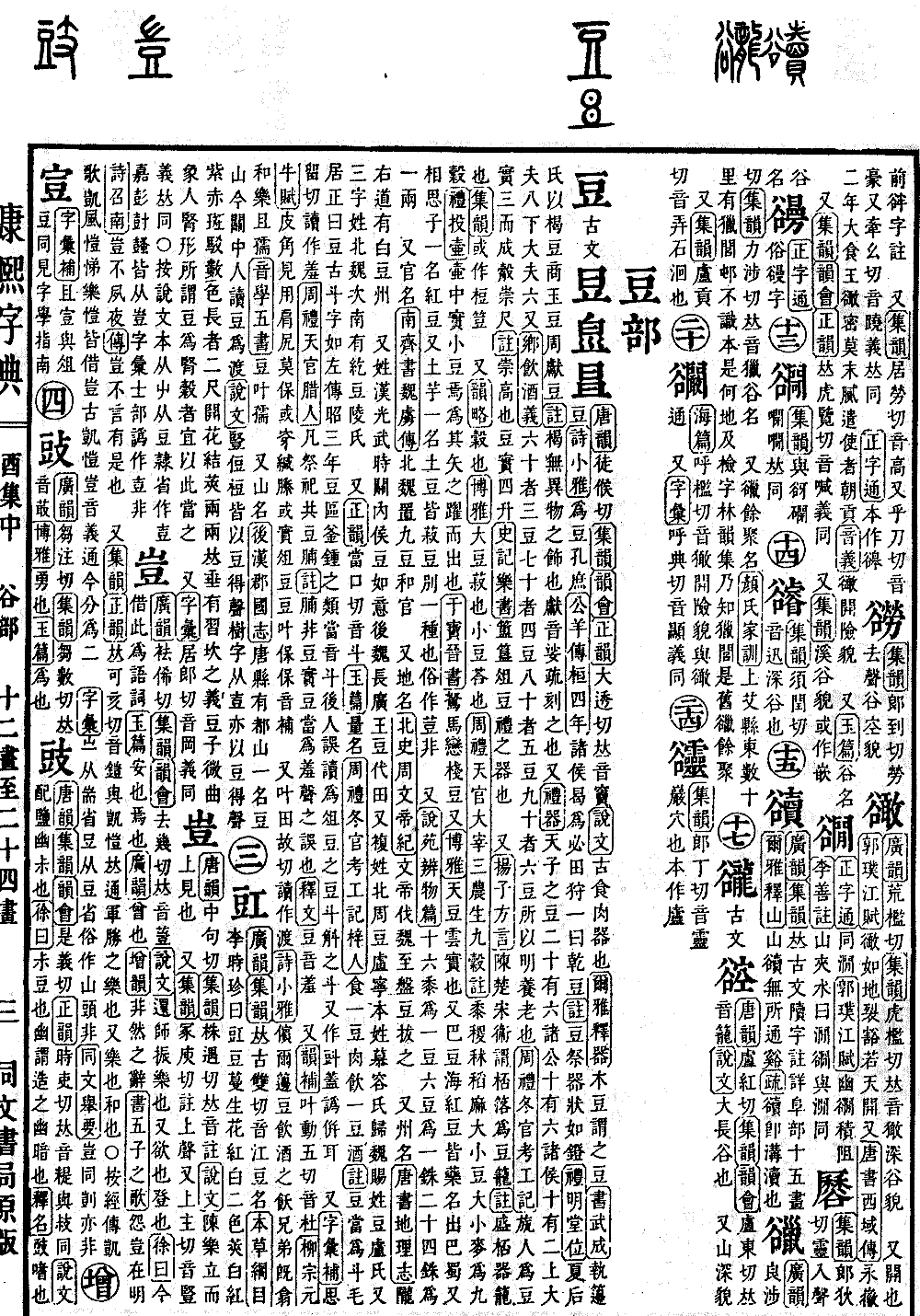
You Collection, Middle Volume
Radical: Bean (dòu)
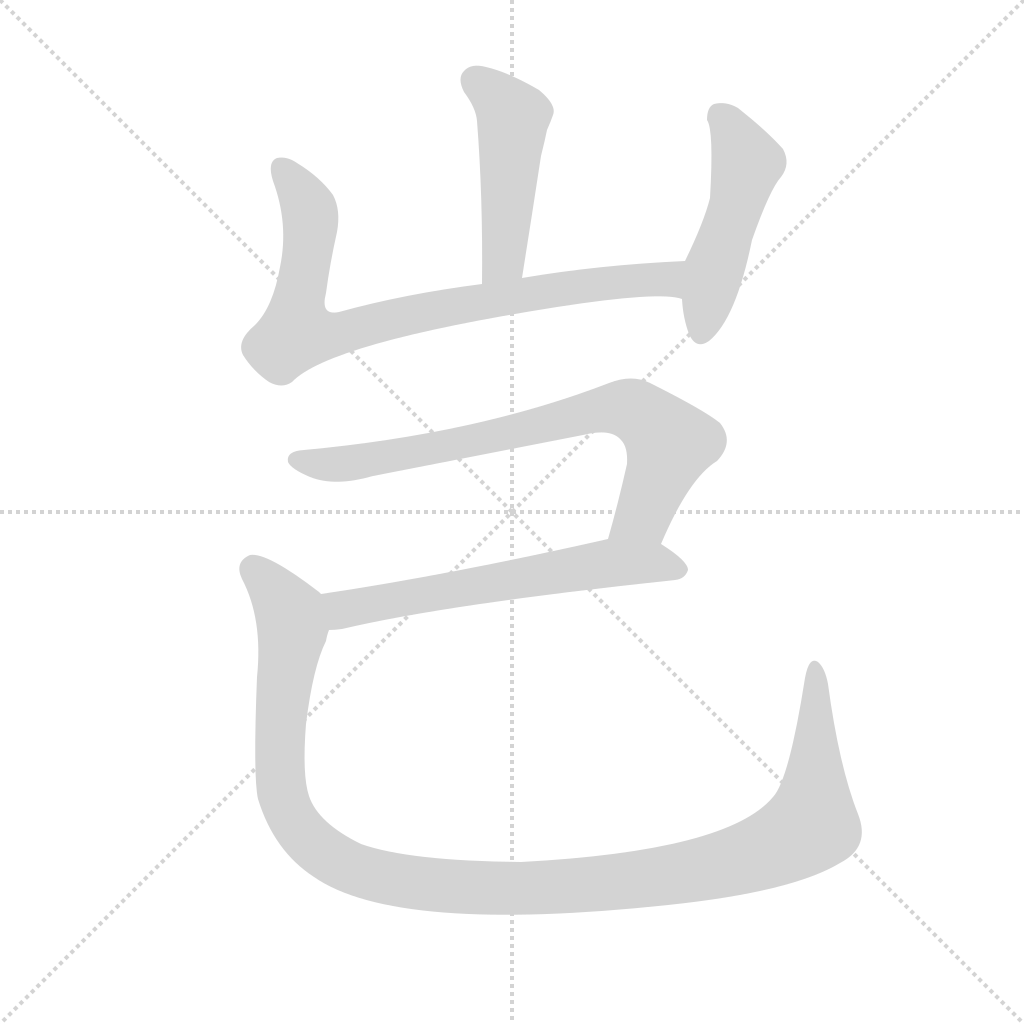
Character: qi
Kangxi strokes: 10
Page 1191, Entry 02
Pronounced qi (falling tone).
In the Explanation of Characters (Shuowen Jiezi), it refers to the military music played when an army returns in triumph. It also expresses hope, desire, or the act of ascending or climbing. Xu states that currently, this character is borrowed as a modal particle.
In the Jade Chapters (Yupian), it denotes composure, how, or where.
In the Extensive Rhymes (Guangyun), it denotes once or surprisingly.
In the Added Rhymes (Zengyun), it functions as a word indicating negation.
Book of Documents (Shujing), Song of the Five Sons: Can it be that resentment only exists when it is manifest?
Book of Odes (Shijing), Shao Nan: Is it not that one wishes to go morning and evening?
Commentary: Is it not, means that such a situation indeed exists.
Also pronounced kai (falling tone). Interchangeable with kai (victory) and kai (joyful). It denotes music of military victory. It also denotes joy or harmony. According to the classics and commentaries, the terms for victory song, victory breeze, harmonious, and joyful all borrow the character qi. In ancient times, the pronunciations and meanings of kai, kai, and qi were interchangeable; now they are divided into two distinct characters.
Dictionary of Characters (Zihui): The mountain-like component at the top is derived from the abbreviation of zhuan. The mouth component below is derived from the abbreviation of dou. Common writing forms it with a mountain top, which is incorrect.
Essentials of Uniform Scripts (Tongwen Juyao): The claim that qi is identical to gai is also incorrect.
Textual research: In the Explanation of Characters (Shuowen Jiezi), it refers to the military music played when an army returns in triumph. Following the original text, the character for army (lü) has been added after the character for vibrate (zhen).