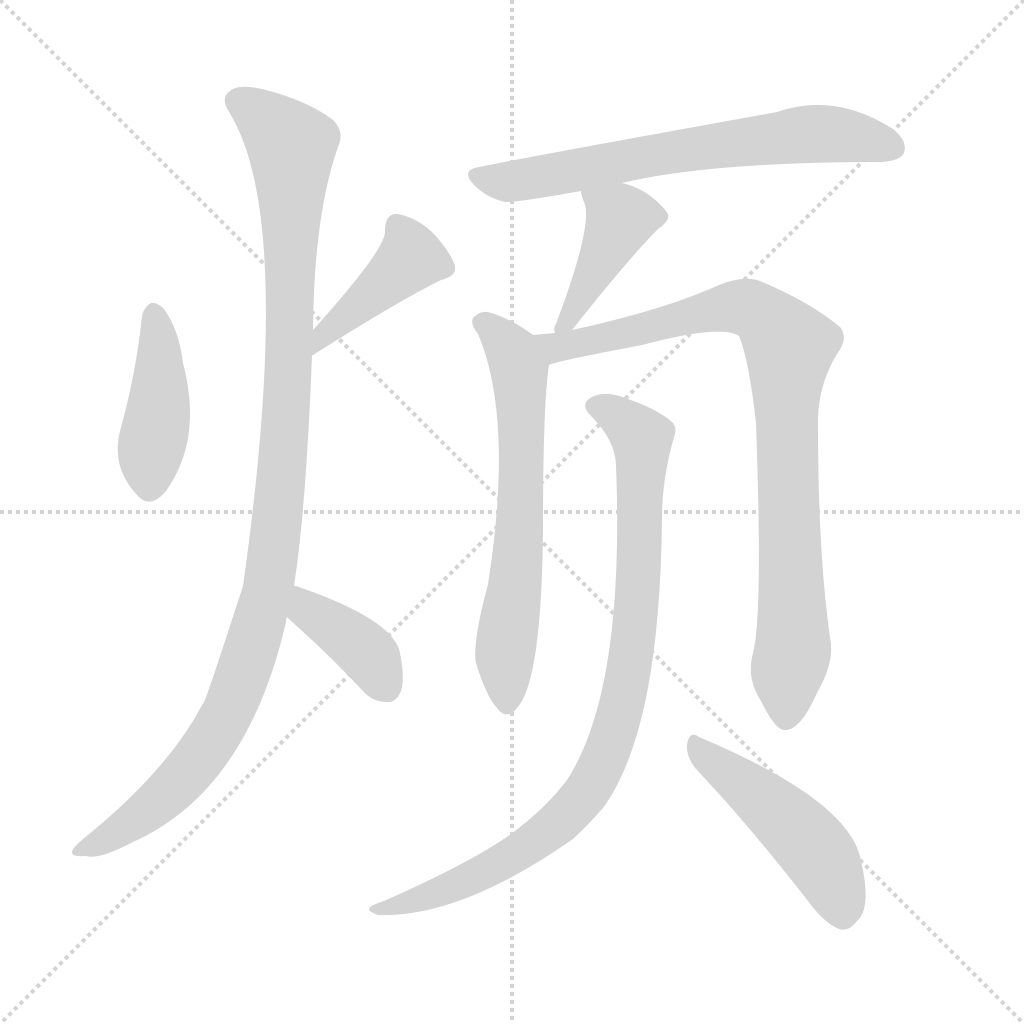
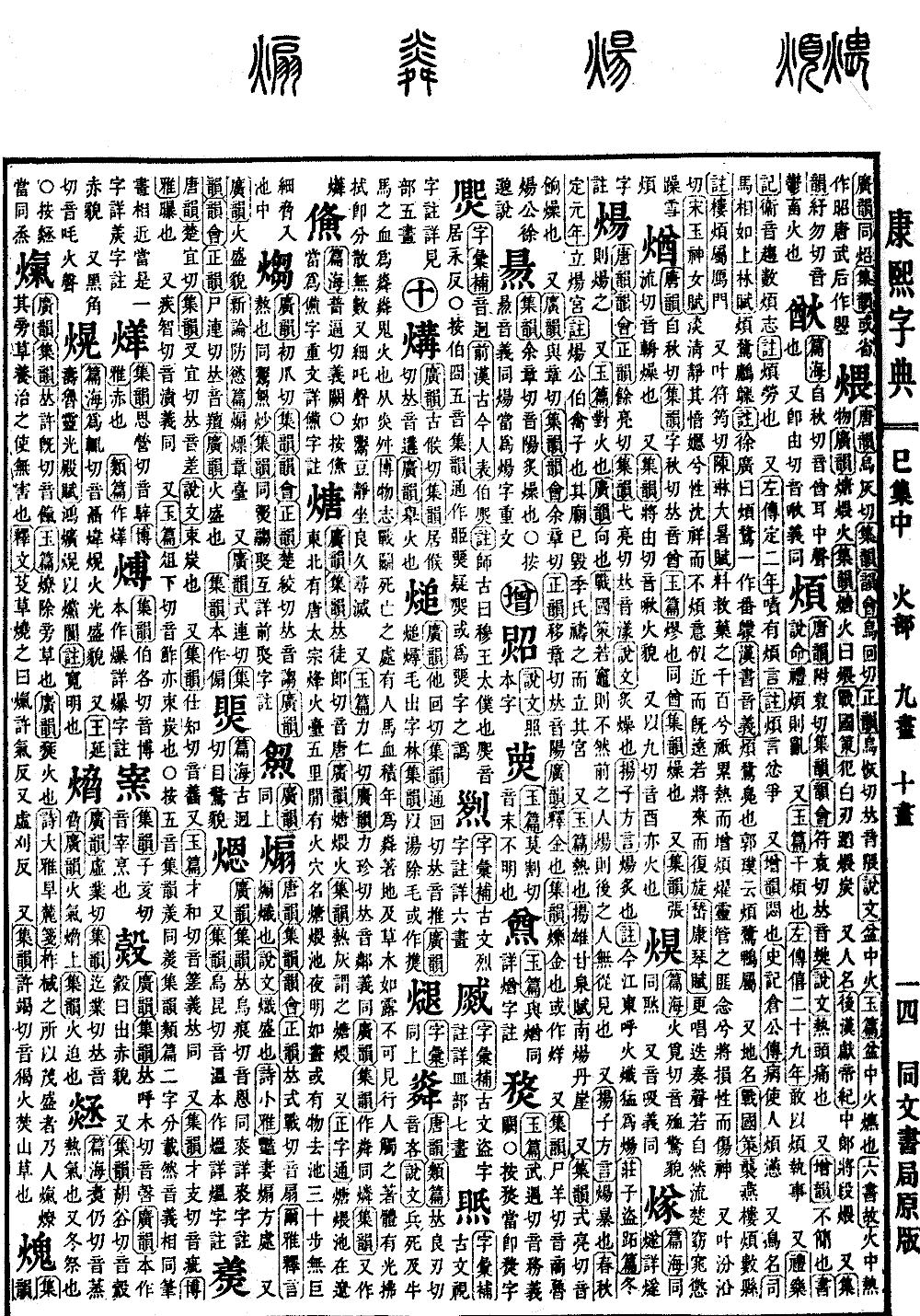
Si Collection, Middle Volume. Radical: Fire (huǒ). Kangxi stroke count: 13. Page 678, Entry 01.
Pronounced fan.
In the Tang Rhyme (Tangyun), it is pronounced fan; in the Collected Rhymes (Jiyun) and the Rhyme Collection (Yunhui), it is also pronounced fan.
According to the Explaining Graphs and Analyzing Characters (Shuowen), it refers to a feverish headache.
Additionally, according to the Expanded Rhymes (Zengyun), it means not at all. In the Book of Documents (Shangshu), chapter Sayings of Yue (Shuoming), it is said, "If rituals are cumbersome, there will be disorder."
According to the Jade Chapters (Yupian), it means to trouble or harass. In the Zuo Tradition (Zuozhuan), twenty-ninth year of Duke Xi, it states, "I dare to trouble the officials."
In the Record of Music (Yueji) of the Book of Rites (Liji), it says, "The music of Wei is fast, hurried, and disturbs the aspirations." The commentary states that here, it means to labor or to be weary.
In the Zuo Tradition (Zuozhuan), second year of Duke Ding, it says, "There were complaints and contentious words." The commentary states that here, it refers to angry disputes.
According to the Expanded Rhymes (Zengyun), it means to be vexed or stifled. In the Records of the Grand Historian (Shiji), Biography of Master Cang, it states, "The illness makes people vexed and depressed."
It is also the name of a bird. In the Rhapsody of the Imperial Park (Shanglin Fu) by Sima Xiangru, it mentions the fanwu bird. The commentary by Xu Guang says that fanwu is also written as fan. The Sound and Meaning of the Han Book (Hanshu Yinyi) states that the fanwu is a type of wild duck. Guo Pu states that the fanwu belongs to the duck family.
It is also a place name. In the Strategies of the Warring States (Zhanguoce), it mentions attacking the districts of Loufan in Yan. The commentary states that Loufan belongs to Yanmen.
It also rhymes with yun. In the Rhapsody on the Great Heat (Dashu Fu) by Chen Lin, it is written: "Though a thousand medicines are gathered for aid, they only accumulate heat and increase vexation. When the spirit is not mindful of its essence, it will impair the nature and wound the spirit."
It also rhymes with qia. In the Rhapsody on the Goddess (Shennu Fu) by Song Yu, it is written: "Calm, pure, and quiet is her reserved elegance, her nature is deep and auspicious without vexation, her intentions seem near yet are already distant, as if coming yet again circling back." In the Rhapsody on the Lute (Qin Fu) by Ji Kang, it states: "With repeated singing and alternating performances, the sounds are as if natural; flowing and resonant, refined and delicate, they purge impatience and wash away vexation."