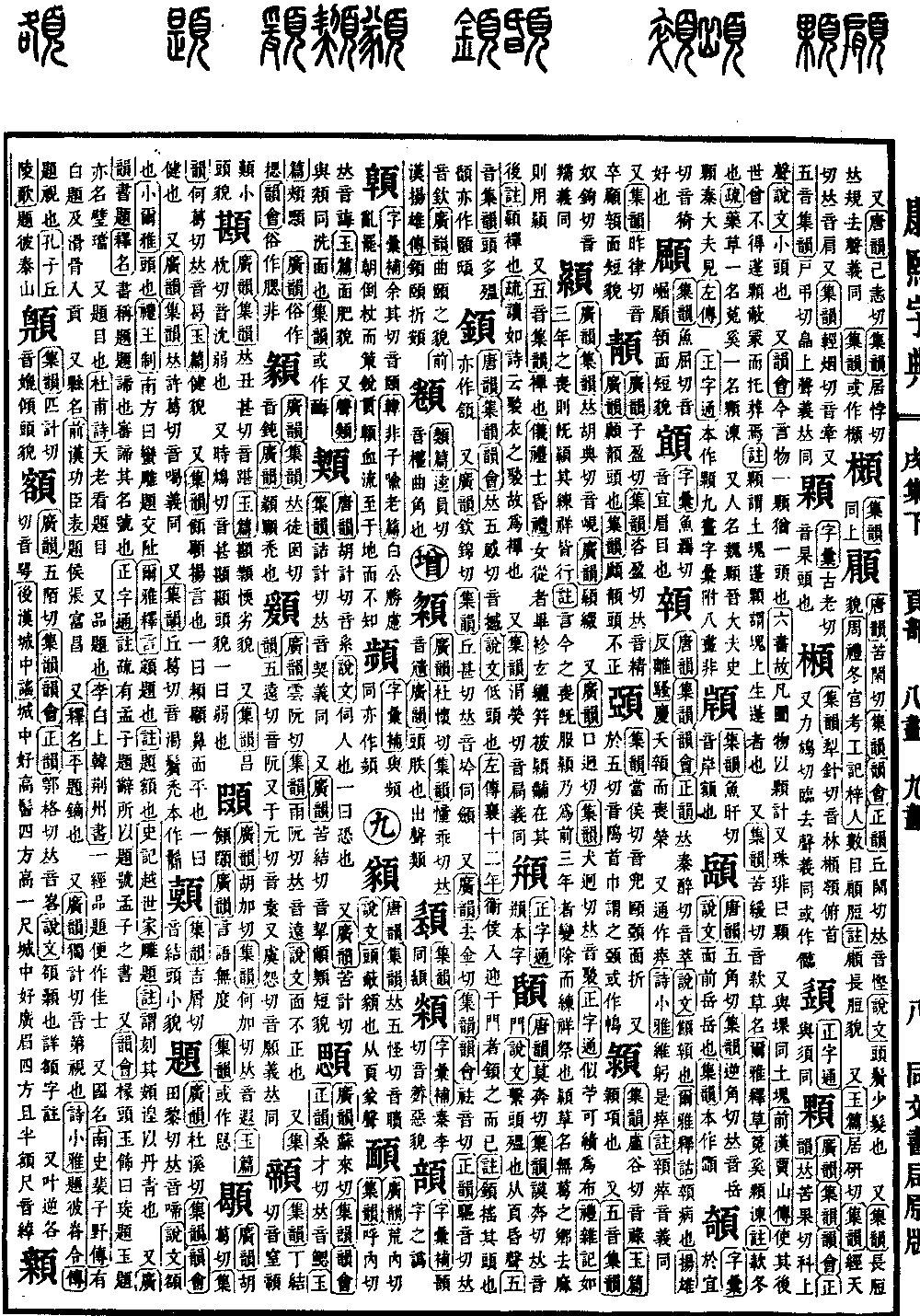
Xu Collection, Lower Volume
Radical: Page (yè)
Kangxi Radical Strokes: 18
Page 1406, Entry 01
According to the Guangyun (a rhyme dictionary), pronounced ti. According to the Jiyun (a rhyme dictionary) and the Yunhui (a dictionary of rhymes), pronounced ti. According to the Shuowen Jiezi (Explanation of Simple and Compound Characters), it means the forehead.
According to the Xiao Erya (Small Er Ya), it means the head.
According to the Book of Rites (Liji), Wangzhi (Royal Regulations): The southern regions are called Man, where they carve patterns on their foreheads and have overlapping toes.
According to the Erya (Approaching Elegance), Shiyan (Explaining Words): Ni means ti. Commentary: Ti means forehead.
According to the Records of the Grand Historian (Shiji), Yue Shijia (Hereditary House of Yue): Carved forehead. Commentary: This refers to carving the forehead and dyeing it with cinnabar and blue-green pigments.
Also, according to the Guangyun: The title of a book. According to the Boya (Broad Elegant): A book's title is called ti. Ti means to scrutinize; it means to carefully examine its name and designation.
According to the Zhengzitong (Correction of Characters): The commentaries include the Preface to the Mencius (Mengzi Tici), which is used to title the book of Mencius.
Also, according to the Yunhui: The jade ornaments on the ends of rafters are called xuan-ti or yu-ti, also known as bi-dang.
Also, it means a topic. In a poem by Du Fu: Heaven's elders examine the topics.
Also, it means to evaluate or critique. In Li Bai's Letter to Han Jingzhou (Shang Han Jingzhou Shu): Once critiqued (by you), one becomes a talented scholar.
Also, the name of a state. In the History of the Southern Dynasties (Nan Shi), Biography of Pei Ziye: The states of Baitie and Huagu came to pay tribute.
Also, the name of a county. In the History of the Former Han (Qian Han Shu), Table of Meritorious Officials: The Marquis of Ti, Zhang Fuchang.
Also, according to the Shiming (Explaining Names): Ping-ti refers to an arrowhead.
Also, according to the Guangyun: Pronounced di. It means to look at. In the Book of Odes (Shijing), Xiaoya (Lesser Odes): Look at that wagtail. Commentary: Ti means to look at.
In the Kongzi Qiuling Ge (Confucius' Hill Song): Look at Mount Tai.
Verification: In the Records of the Grand Historian (Shiji), Yue Shijia (Hereditary House of Yue): Carved forehead. Commentary: This refers to carving the forehead and dyeing it with cinnabar and blue-green pigments. Following the original text, the character huang has been corrected to nie.
According to the Shiming (Explaining Names): Ping-ti refers to an arrowhead. Verification: This phrase originates from the Boya (Broad Elegant); the citation has been corrected from Shiming to Boya.