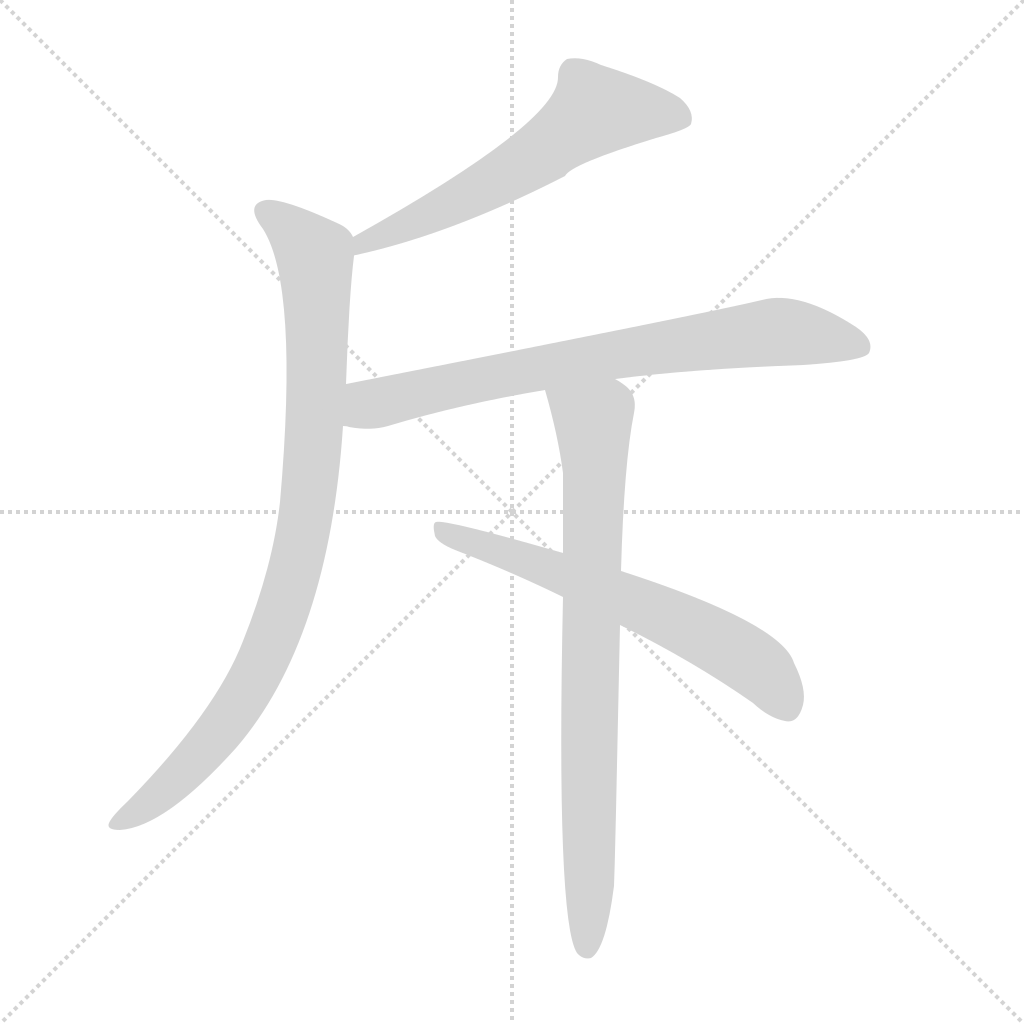
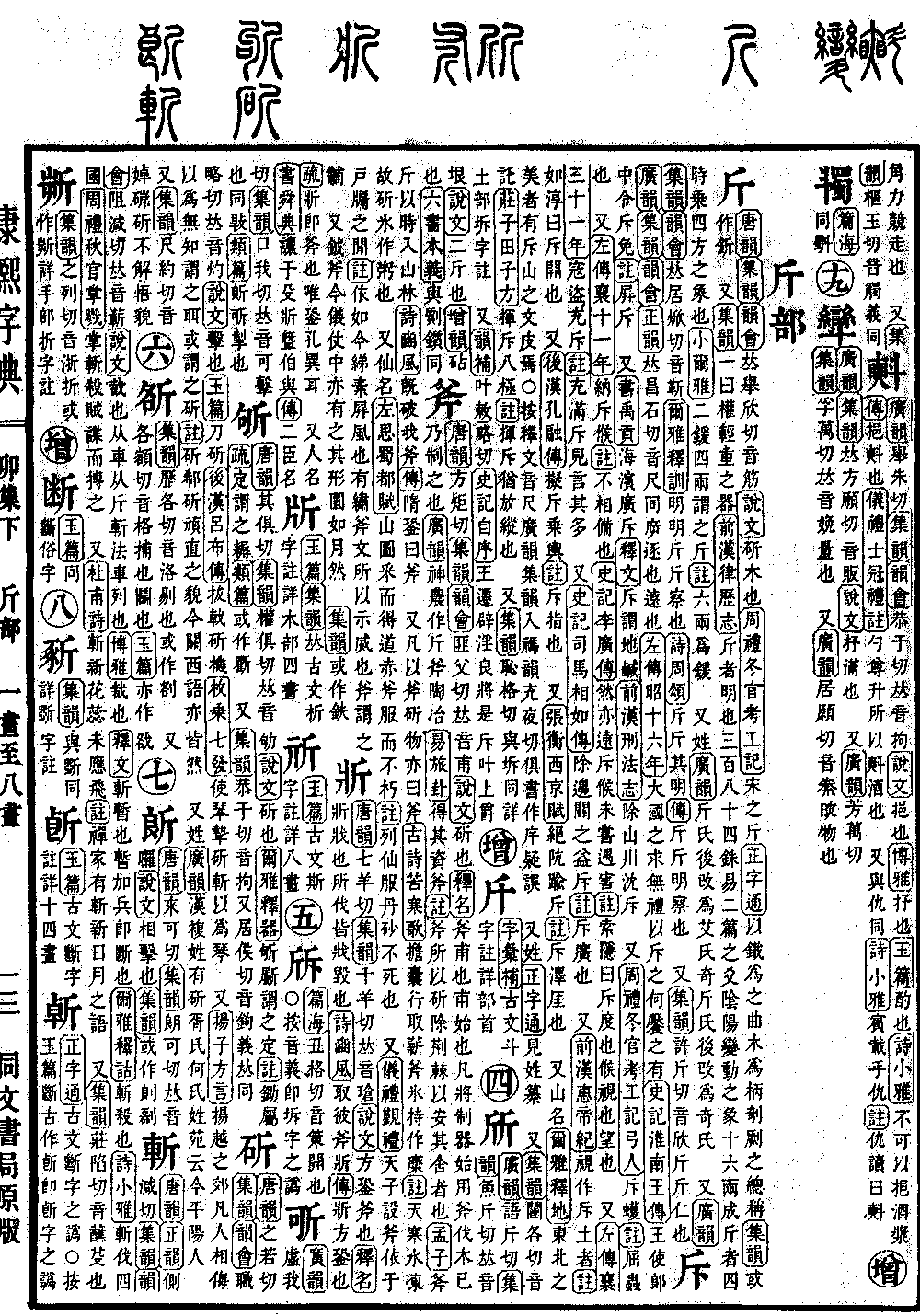
Mao Collection, Lower Volume
Radical: Axe (jīn)
Page 479, Entry 05
Pronounced chi. Meaning identical to the variant form. Indicates expulsion or alienation.
Commentary in Zuo Zhuan (Zuo Zhuan): When powerful states make demands, if one does not use protocol to repel them, how could they ever be satisfied?
Records of the Grand Historian (Shiji), Biography of the Prince of Huainan: The Prince of Huainan commanded the Chief of the Gentlemen of the Household to expel and dismiss certain officials.
Commentary: This refers to casting aside or dismissing.
Also, Classic of History (Shujing), Tribute of Yu: The coastal regions contain vast areas of salt-alkaline land that cannot be farmed.
Explanation of Texts: The term refers to land containing salt and alkali.
History of the Former Han (Qianhan), Treatise on Punishments and Law: Removing the areas of mountains, rivers, and low-lying salt-alkaline land.
Also, Rites of Zhou (Zhouli), Winter Offices, Record of Artificers, The Bow Maker: Refers to an inchworm, a type of insect that moves by arching and stretching its body.
Also, Zuo Zhuan (Zuo Zhuan): To introduce gaps.
Commentary: This refers to things that are incomplete or lacking.
Also, Records of the Grand Historian (Shiji), Biography of Li Guang: However, they also maintained long-range reconnaissance and surveillance, and never suffered harm.
Commentary: The Records of the Grand Historian Suoyin commentary states: The term implies estimating or measuring. The following character refers to watching, observing, or scouting.
Also, Zuo Zhuan (Zuo Zhuan): Thieves and bandits are numerous, appearing everywhere.
Commentary: This refers to filling every space so that they can be seen, describing a great multitude.
Also, Records of the Grand Historian (Shiji), Biography of Sima Xiangru: To extend and expand the boundaries of the frontier.
Commentary: The term means to enlarge.
Also, History of the Former Han (Qianhan), Annals of Emperor Hui: Treating those who open up land.
Commentary: Ru Chun states: The term means to open up or pioneer.
Also, History of the Later Han (Houhan), Biography of Kong Rong: To compare or refer to the imperial chariot.
Commentary: The term refers to pointing at or designating.
Also, Zhang Heng, Western Capital Rhapsody: Crossing the edges of deep pits and marshes.
Commentary: The term refers to the shore of a marsh.
Also, the name of a mountain. Erya (Erya), Explanation of Locations: Among the fine products of the Northeast, there are patterned animal skins produced at Mount Chi.
Note: The Explanation of Texts records the pronunciation as chi. The Comprehensive Rhymes (Guangyun) and Collected Rhymes (Jiyun) place this under the rhyme category ma, with the pronunciation as chong-ye, both writing the character as the variant; this is likely an error.
Also, a surname. See the Surname Compendium (Xingzuan) as cited in Correct Meanings of Characters (Zhengzitong).
Also, in Collected Rhymes (Jiyun), pronounced tuo. Same as the word meaning to entrust. Zhuangzi (Zhuangzi), Tian Zifang: The spirit roams freely to the extreme reaches of the eight directions.
Commentary: The phrase to wave and release means to be unrestrained or free-spirited.
Also, in Collected Rhymes (Jiyun), pronounced chi. The same as the word for split or crack. See the detailed entry under Radical: Earth (tǔ), for the character meaning to crack.
Also, in Rhyme Supplement (Yunbu), rhymed with the pronunciation chi-lue. Records of the Grand Historian (Shiji), Preface of the Grand Historian: The monarch was wayward and licentious, and the capable general was therefore dismissed. Rhymes with the word jue in the preceding text.