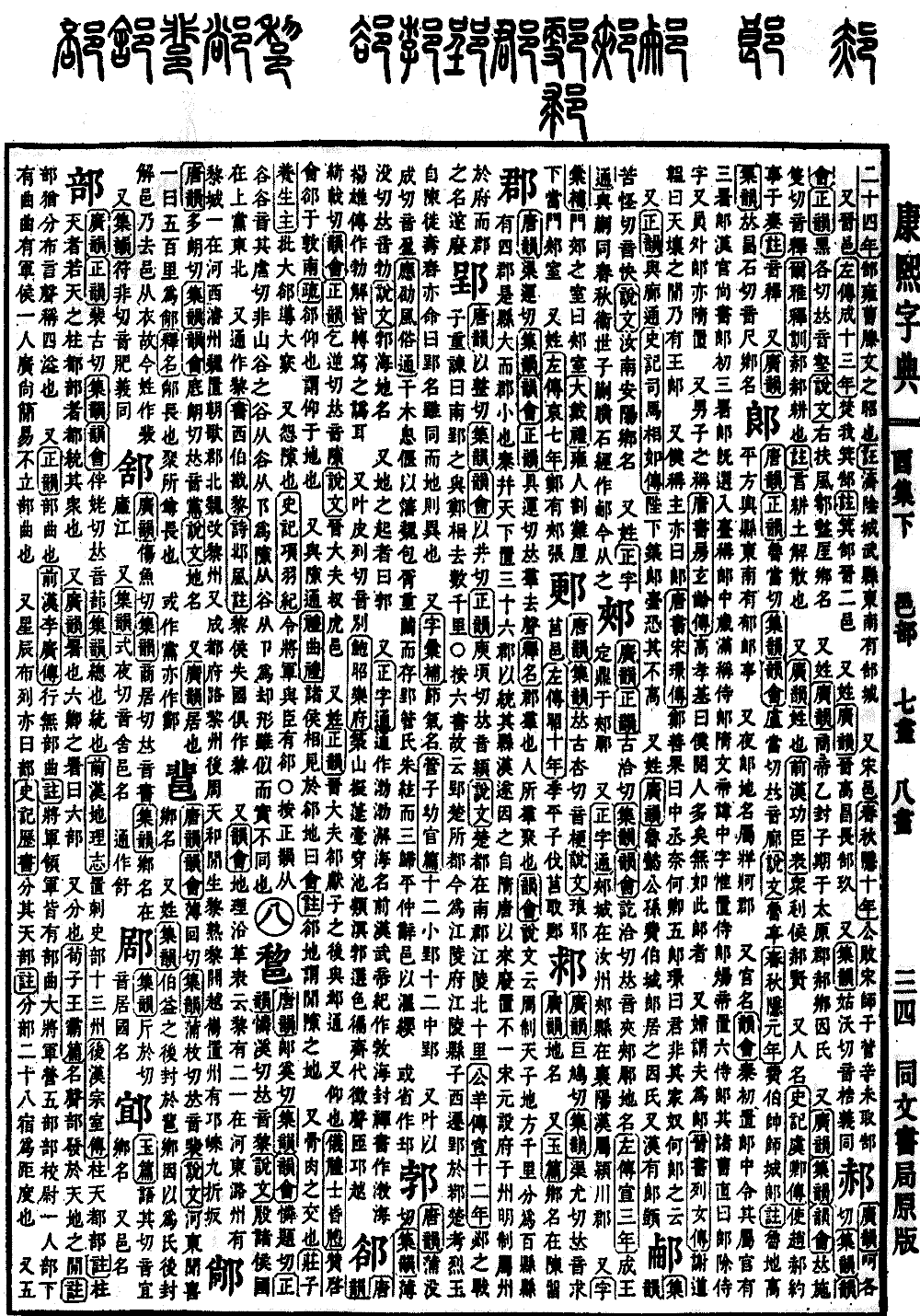
You Collection, Lower Volume
Radical: City (yì)
Kangxi Stroke Count: 15
Page: Page 1272, Entry 17
Pronounced pei (third tone) in "Guangyun" and "Zhengyun," and ban lao (entering tone) in "Jiyun" and "Yunhui."
"Jiyun": Means to gather and to unify.
"Former Han Dynasty - Treatise on Geography": Established thirteen provinces, each with an inspector.
"Later Han Dynasty - Biography of Imperial Relatives": Zhu Tian Du Bu.
Note: Zhu Tian means like pillars of heaven. Du Bu means to command and unify the multitude.
Also in "Guangyun": Refers to an office; the offices of the six ministers are called the Six Ministries.
Also means to divide.
"Xunzi - The Hegemon": Reputation and influence are distributed between heaven and earth.
Note: Bu means to distribute. It means that reputations and influences spread far and wide.
Also in "Zhengyun": Refers to a subdivision of troops.
"Former Han Dynasty - Biography of Li Guang": He marched without subdivisions of troops.
Note: Generals commanding armies all had subdivisions of troops. The Grand General's camp had five subdivisions, each headed by a subdivision commander. Below each subdivision were smaller units, each with a company commander. Guang preferred simplicity and did not establish subdivisions of troops.
Also, the arrangement of stars is called Bu.
"Records of the Grand Historian - Calendar": Divided its celestial regions.
Note: Divided the twenty-eight constellations into segments and degrees.
Also, the Five Elements are called the Five Ministries.
"Former Han Dynasty - Treatise on Laws and Calendars": Started with the Five Ministries.
Note: The Five Ministries refer to metal, wood, water, fire, and earth.
Also, books are divided into four parts.
"Zhengzitong": Li Chong, an official in the Jin Dynasty, was appointed as a compiler. He reviewed and classified classical texts. He divided the Five Classics into the A section, the Records of the Grand Historian into the B section, the philosophical texts into the C section, and poetry and prose into the D section. This was very systematic and was adopted as a permanent system by the Imperial Library. "History of the Tang Dynasty - Treatises on Literature" collected books in four parts, arranged in order of A, B, C, and D, following Chong's system.
Also, a star name.
"Book of Jin - Treatise on Astronomy": The seven stars of the Big Dipper, the seventh is called Bu Xing, also called Ying Xing, which presides over military affairs.
Also in "Zihui Bu": The cover of a carriage.
"Rites of Zhou - Kao Gong Ji": The wheelwright makes the cover, its length is two chi.
Also, it is the same as "Rang." A large staff.
"Huainanzi - Talking Mountain": Yi died by peach wood staff.
Also, Bai Bu, a medicinal name. It grows like a vine, with roots that connect in tens. Also known as wild Asparagus.
Also pronounced pu kou (third tone) in "Tang Yun," and bo kou (entering tone) in "Jiyun" and "Yunhui," pronounced similarly to "pou." Bu Lou, a small mound.
"Zuo Zhuan - 24th Year of Duke Xiang": Small mounds without pine or cypress trees.
Also in "Zihui Bu": Fu jiu (entering tone), pronounced pi.
"Kan Yin - Thirteen Provinces Record": A proverb says: When an official's career is not successful, he encounters the Ji Bu region.
Verification: "Former Han Dynasty - Treatise on Geography" mentions the establishment of thirteen provinces with inspectors. The original text has been corrected to "Established thirteen provinces, each with an inspector." "Book of Jin - Treatise on Astronomy" mentions the seven stars of the Big Dipper, the seventh is called Bu Xing, also called Ying Xing, which presides over military affairs. The word "Xing" has been added after "Ying" in the original text. "Rites of Zhou - Kao Gong Ji" states that the wheelwright makes the cover, its length is two cun. The original text has been corrected from "two cun" to "two chi."