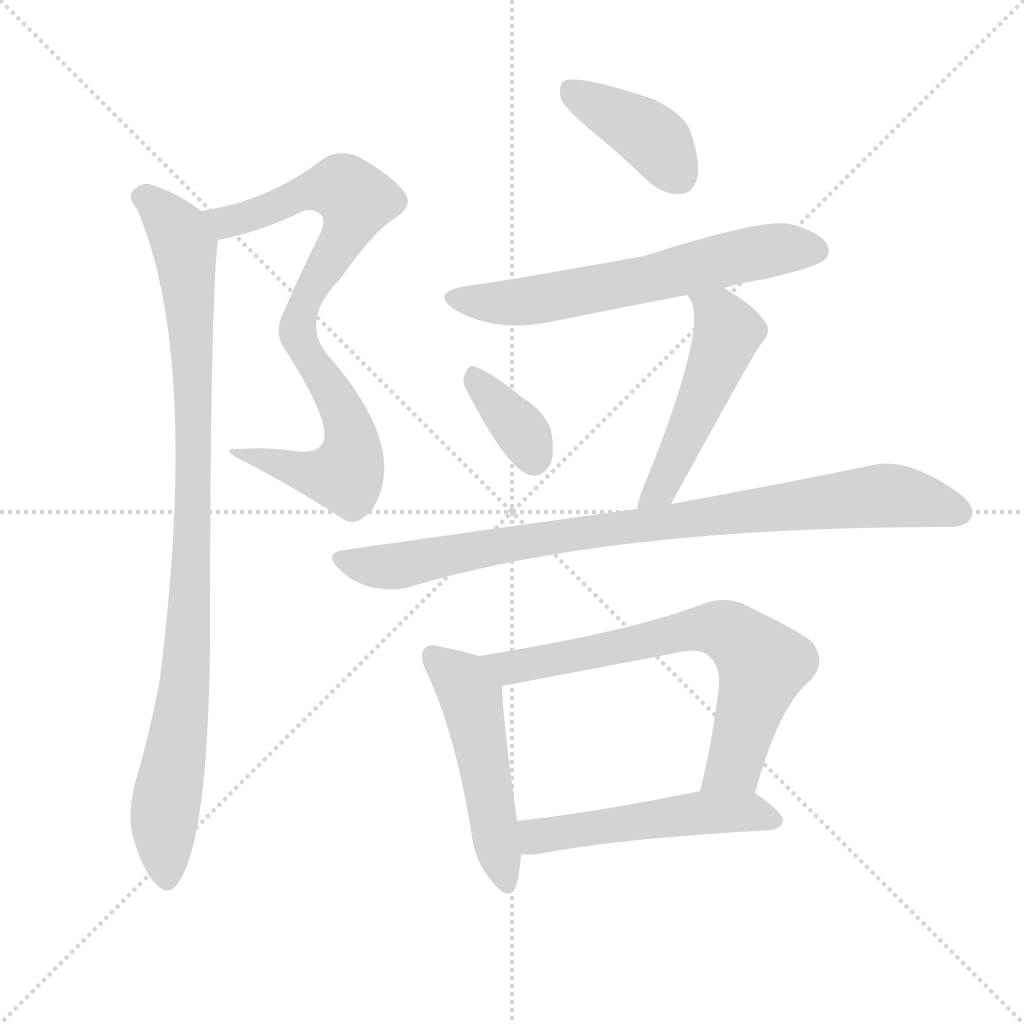
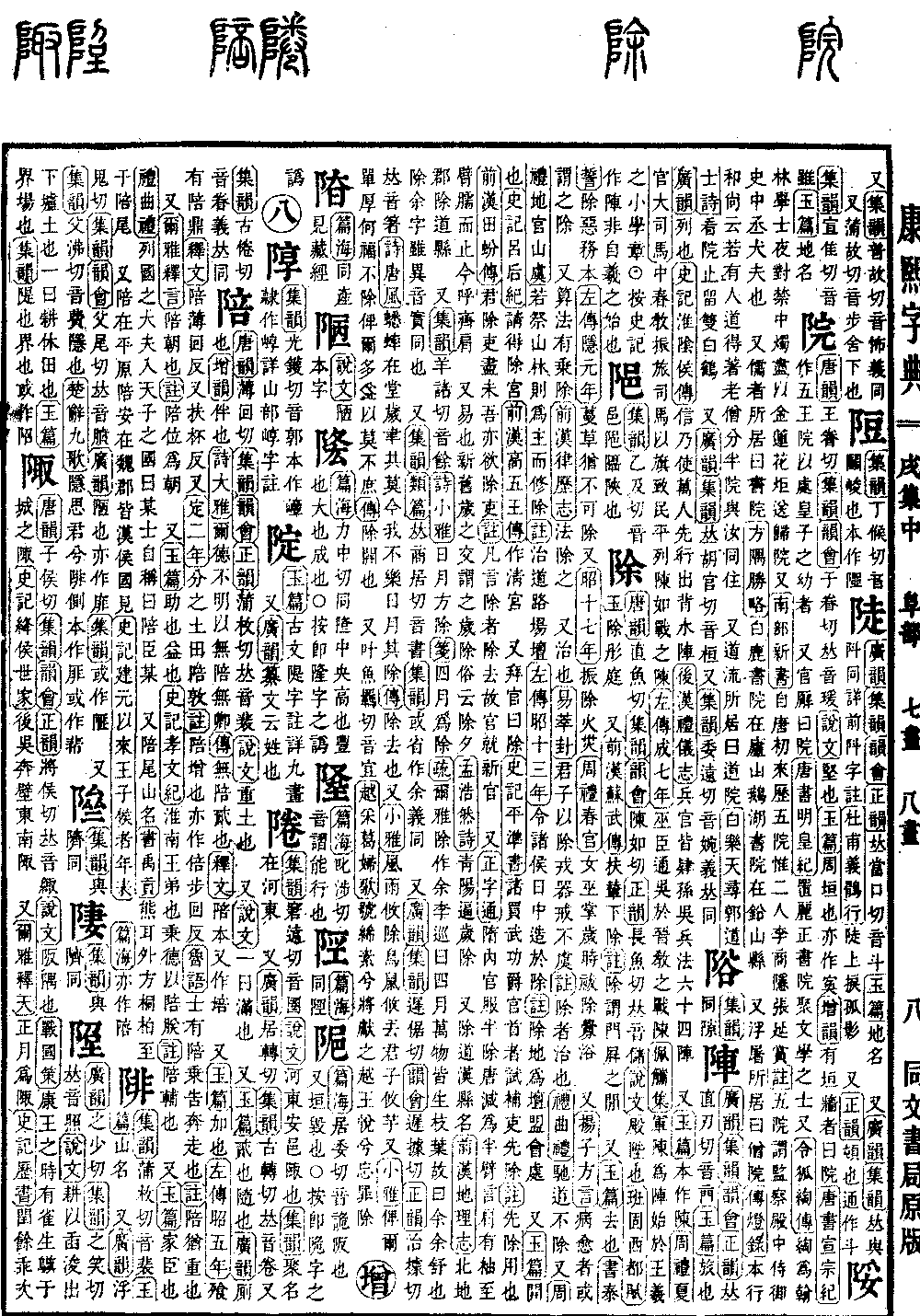
Xu Collection, Middle Volume
Radical: Mound (fù)
Kangxi Strokes: 16
Page Number: 1352, Entry 18
According to Tangyun (Tang rhyme dictionary), the sound is pronounced as bo hui qie. According to Jiyun, Yunhui, and Zhengyun, the sound is pronounced as pu mei qie, similar to "péi".
Shuowen Jiezi explains it as "overlapping earth." It also states: "Another interpretation is 'full'."
Yupian explains it as "deputy," "attendant."
Guangyun explains it as "side," "subordinate."
Zengyun explains it as "to accompany."
The Book of Odes (Shijing), Greater Odes, has the line: "Your virtue is not bright, therefore without attendant or minister." The commentary explains: "without an assisting deputy." Shishen mentions: "pei" is sometimes written as "péi" (a variant of pei).
Yupian also explains it as "to increase."
Zuo Commentary (Zuozhuan), Duke Zhao, Fifth Year, records: "The supper had accompanying tripods." Shishen annotates the pronunciation: "pei" is read as bo hui fan, and also as fu bei fan.
Zuo Commentary (Zuozhuan), Duke Ding, Second Year, records: "Dividing the land and fields increased and thickened." The note explains: "pei" means "to increase." It is also written as "bèi" (a variant of pei). The pronunciation is bu hui fan.
Discourses of Lu (Luyu) says: "A scholar had an accompanying carriage to announce his departure." The note explains: "pei" is like "repetition," "deputy."
Erya (Erya), Shiyan, explains "pei" as meaning "to pay court." The note clarifies: "pei" position means to pay court.
Yupian also explains it as "to assist," "to benefit."
Records of the Grand Historian (Shiji), Annals of Emperor Wen, records: "He was the brother of the King of Huainan, possessing virtue to assist me." The note explains: "pei" means "to assist."
Yupian also explains it as "vassal."
Book of Rites (Liji), Quli, records: "A grand master from a vassal state, upon entering the Son of Heaven's capital, refers to himself as 'a certain scholar,' and refers to himself as 'a certain accompanying minister'."
There is also Peiwěi, which is a mountain name. The Book of Documents (Shangshu), Yu Gong, records: "From Xiong'er to Waifang and Tongbai, extending to Peiwěi."
Additionally, Pei in Pingyuan, and Peian in Weijun, were both Han dynasty marquisates. See Records of the Grand Historian (Shiji), Chronological Table of Princes and Marquises Since the Jianyuan Era.
Pianhai also writes it as "cuò" (a variant of pei).