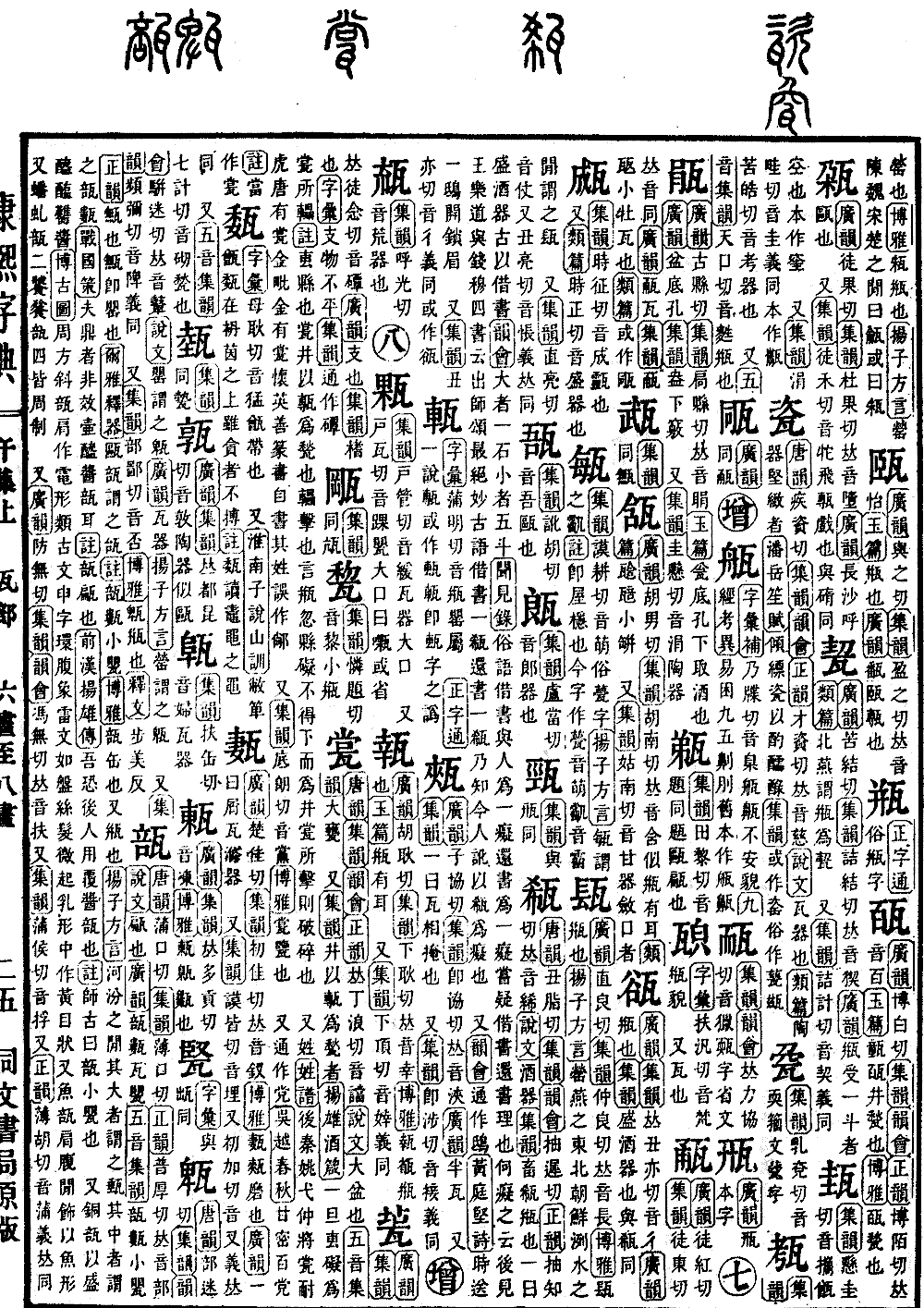
Wu Collection, Upper Volume
Radical: Tile (wǎ)
Kangxi stroke count: 13
Page 749, Entry 45
Pronounced bu (falling tone)
In the Tang Dynasty Rhymes (Tangyun), the sound of buoy and mouth. In the Collected Rhymes (Jiyun), the sound of thin and mouth. In the Correct Rhymes (Zhengyun), the sound of general and thick. The pronunciation is bu (falling tone).
According to the Explaining Graphs and Analyzing Characters (Shuowen), it is a small earthen pot. According to the Broad Rhymes (Guangyun), it is a bu-lei, a jar made of tile. According to the Five Sounds Collected Rhymes (Wuyin Jiyun), it is a small jar. According to the Correct Rhymes (Zhengyun), it is a wu, which is a type of jar.
According to the Literary Expositor (Erya), in the section on vessels, a small earthen bowl is called a yi. The commentary states that it is a small jar. According to the Extensive Refinement (Boya), it is a type of earthen jar, also a bottle. According to Yang Xiong’s Dialects (Fangyan), in the regions along the Yellow and Fen rivers, a large vessel is called a zhui, and a medium-sized one is called a bu-lei.
According to the Strategies of the Warring States (Zhanguoce), a tripod is not like a pot, a vinegar jar, a sauce jar, or a bu-lei. The commentary states that a bu-lei is a small earthen bowl. According to the Biography of Yang Xiong in the History of the Former Han Dynasty (Qianhan), I fear that later generations will use this to cover a sauce jar. The commentary by Yan Shigu states that it is a small jar. There are also bronze vessels used for storing vinegar, meat paste, and sauce.
According to the Illustrated Antiquities (Bogutu), the square-shouldered bu-lei of the Zhou dynasty features shoulders decorated with lightning patterns similar to ancient script, with belly patterns resembling coiled hair and slightly protruding nipple-like forms. The center is decorated in the style of yellow eyes. There are also fish-decorated bu-lei with fish motifs between the shoulder and belly, as well as two coiled dragon bu-lei and four gluttonous-ogre bu-lei, all following the formal designs of the Zhou dynasty.
Pronounced fu.
Pronounced fu.
Pronounced pu. The meaning is the same.