Si Collection, Upper Volume
Radical: Water (shuǐ)
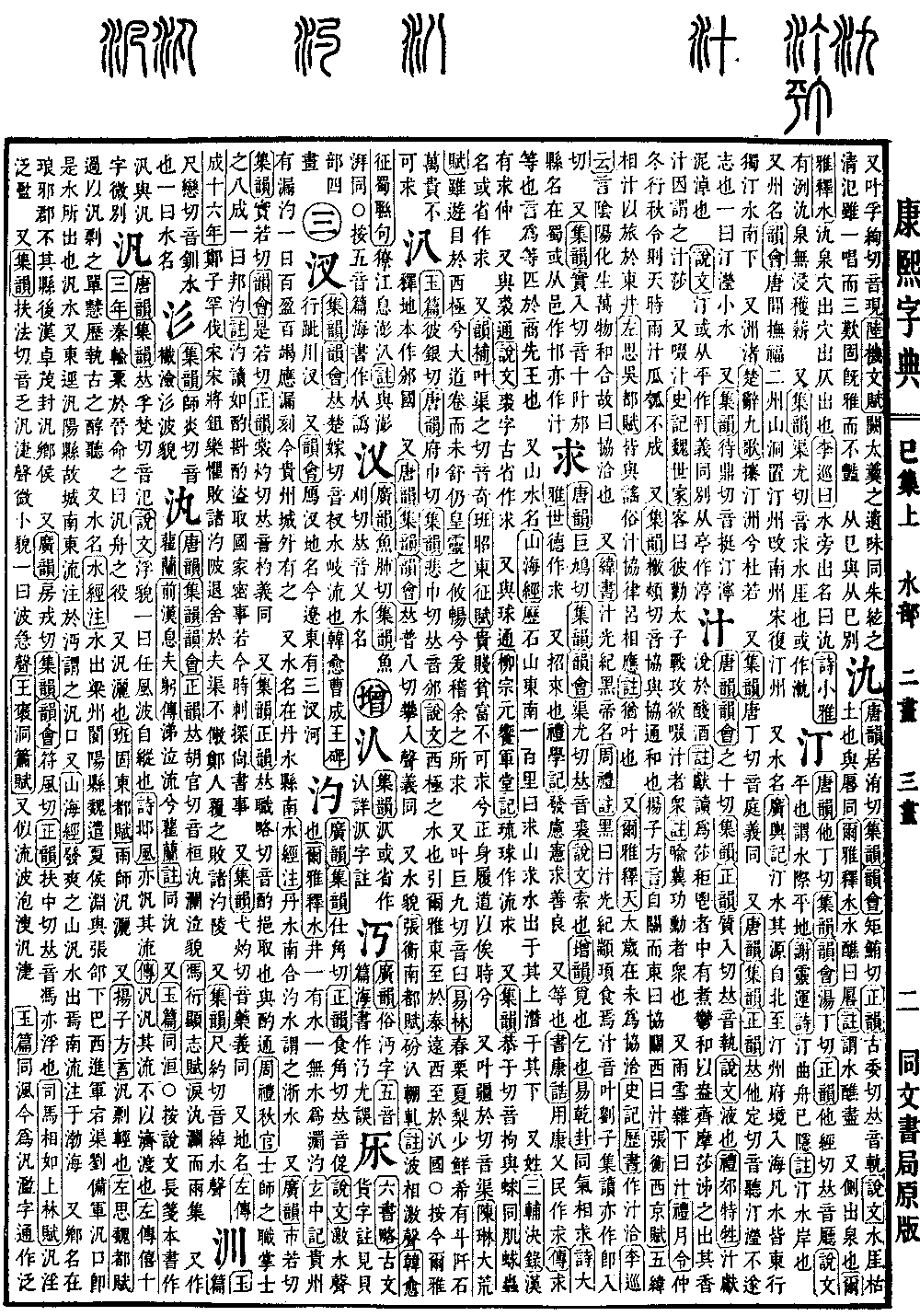
汁
Kangxi stroke count: 6
Page 604, Entry 03
Tangyun (Tangyun) and Yunhui (Yunhui) pronounce it zhi. Jiyun (Jiyun) and Zhengyun (Zhengyun) pronounce it zhi. The pronunciation is the same as zhi. Shuo Wen Jie Zi (Shuo Wen Jie Zi) defines it as liquid.
Book of Rites (Liji), section Jiao Te Sheng, records: Offering the scented liquid in a shallow cup. The commentary notes: xian is pronounced suo. In the black millet wine (juchang), aromatic turmeric is boiled and mixed with angqi wine, then hand-strained to extract the fragrant liquid; hence it is called zhishuo. There is also the term chuozhi (sipping liquid).
Records of the Grand Historian (Shiji), Biography of the House of Wei, records a guest saying: Many people incite the Crown Prince to go to war, hoping to receive a share of the soup. The commentary notes: This is a metaphor for the many who hope to obtain merits.
Also, when rain and snow fall together, it is called zhi. Book of Rites (Liji), section Yueling, records: If the administrative orders of autumn are implemented in the middle of winter, then it will rain and snow, and melons and fruits will not ripen.
Also, Jiyun (Jiyun) pronounces it xie. It is interchangeable with xie, meaning harmony. Yangzi (Yangzi) Fangyan (Fangyan) records: East of Hangu Pass it is called xie, and west of Hangu Pass it is called zhi. Zhang Heng's Western Capital Rhapsody (Xijing Fu) writes: The five planets are in harmony (zhi), traveling toward the Eastern Well. Zuo Si's Rhapsody on the Capital of Wu (Wudu Fu) writes: Everything is in accord (zhixie) with the customs and songs, and the musical pitches respond. The commentary notes: zhixie means coordination or harmony.
Also, Erya (Erya), section Shitian, records: When the Tai Sui star reaches the position of Wei, it is called xieqia. Records of the Grand Historian (Shiji), section Lishu, writes it as zhiqia. Li Xun explains: It means the yin and yang are transformed, and all things are harmoniously blended, hence it is called xieqia.
Also, the Weishu (Weishu) records Zhiguangji as the name of the Black Emperor. The Zhou Rituals (Zhouli) commentary says black corresponds to Zhiguangji, and the Emperor Zhuanxu consumed this. Zhi is pronounced ye; Liu Changzong reads it this way. It is also pronounced ziji.
Also, Jiyun (Jiyun) pronounces it shi. Fang is the name of a county in the Shu region. Some editions write it under the City radical. It is also written as zhi.
Textual research: The Zhou Rituals (Zhouli) commentary says black corresponds to Zhiguangji, and the Emperor Zhuanxu consumed this. Zhi is pronounced ye; Liu Changzong reads it as ziji. It is also pronounced jiru. I have noted that in the explanation of the Zhou Rituals (Zhouli), zhi is pronounced ye, and Liu Changzong provides the pronunciation as ziji; it is not the case that Liu Ziji is a person's name. I have amended Liu Ziji to read Liu Changzong, and jiru to read ziji.